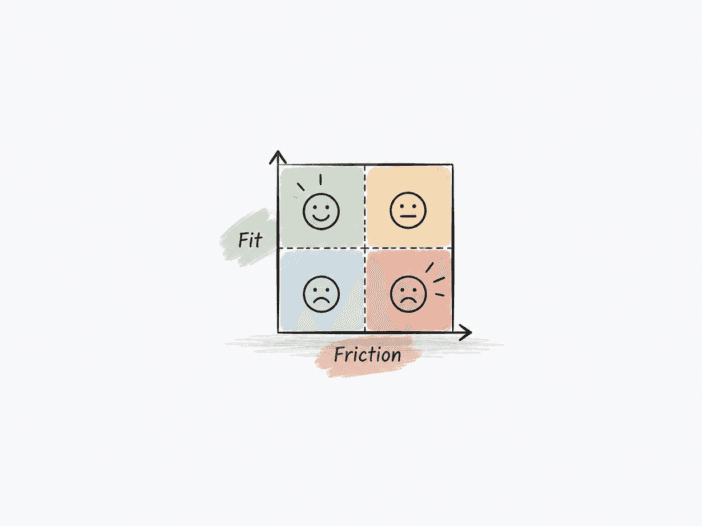
If you are considering a product, the question you usually care about is not:
“Is this product good?”
It is closer to:
“Does this product make sense for the way I plan to use it?”
The Fit–Friction Matrix lets you check if a product fits your real-world use, not just tally up points or chase a high score.
The matrix puts three details side by side for each row:
- your setup or context;
- how the available evidence lines up with that setup;
- the main friction that could affect fit.
Read the Row That Looks Most Like Your Setup
A typical matrix looks like this:
| Buyer Setup / Context | Fit Signal | Main Friction |
| A defined buyer setup | A qualitative fit signal | The main condition that may reduce suitability |
Do not start by chasing the row with the strongest Fit Signal.
Start by finding the row that matches how you actually plan to use the product.
If your daily carry includes a laptop, charger, documents, and a water bottle on public transit, a row about light office carry will tell you more than a row focused on air travel, even if that one looks stronger.
Context comes first. The right match depends on your setup, not just the row with the boldest signal.
Buyer Setup / Context: What Situation Is Being Evaluated?
The first column spells out what the evidence actually covers.
A setup may be defined by:
- what is carried;
- device size;
- product variant;
- daily vs travel use;
- packing load;
- body fit;
- airline context;
- another decision-relevant condition.
A row that matches your situation closely gives you a Fit Signal you can actually act on.
Do not treat a positive row as a verdict for every setup. The fit can change with different gear or use cases.
Fit Signal: How Does the Evidence Align With That Setup?
WellsifyU uses a controlled set of Fit Signals.
Recurring Strong Fit
Use this when the available evidence repeatedly supports the setup with relatively little decision-relevant friction.
Read it as:
This setup repeatedly works well in the available evidence.
That pattern does not guarantee a good fit for every buyer or every setup.
Generally Works
Use this when the setup is broadly supported, but some recurring limitations remain worth checking.
Read it as:
This setup usually works, but the main friction still matters.
Conditional Fit
Use this when the product can work, but success depends on a specific condition.
That condition could be packing load, laptop thickness, body size, product variant, or another clear boundary.
Read it as:
This can work if the condition beside it matches your setup.
Mixed / Variant-Dependent
Use this when the evidence changes by variant, generation, or setup, or when buyer reports stay mixed.
Read it as:
Do not generalize across the whole product family. Check the exact version and condition that matches your setup.
Limited Fit
Use this when recurring evidence points to meaningful friction for the defined setup.
Read it as:
This setup keeps running into a limitation that could affect your buying decision.
Specific Example Only
Use this when a setup appears in one or a very small number of specific examples but does not yet form a recurring pattern.
Read it as:
This setup has worked or failed in a specific case, but the evidence is too limited to draw a broad conclusion.
Insufficient Evidence
Use this when the available material does not support a responsible conclusion for the setup.
Read it as exactly that:
We do not have enough eligible evidence to tell you.
Do not treat ‘Insufficient Evidence’ as a hidden positive or negative. It means there is not enough to go on yet.
Main Friction: What Could Change the Decision?
The third column usually gives you the most practical detail in the matrix.
A product can fit your setup overall but still have one recurring condition that changes whether it actually works for you.
Examples might include:
- tight device clearance;
- loaded bulk;
- limited quick access;
- shared compartment space;
- body-fit sensitivity;
- attachment complexity;
- airline-fit uncertainty.
When you read the row, ask yourself this question:
Would this friction actually bother me?
A limitation can be a dealbreaker for one buyer and not matter at all to another.
For example, limited quick access can be a real problem on public transit but barely register if your bag moves between a car and an office.
An Illustrative Example
Imagine a travel backpack with the following matrix:
| Buyer Setup / Context | Fit Signal | Main Friction |
| 3–4 day laptop travel | Recurring Strong Fit | Structured layout reduces open packing flexibility |
| Daily office carry | Conditional Fit | Bulk becomes more noticeable when lightly loaded |
| Under-seat use | Mixed / Variant-Dependent | Fit changes with packing load and airline context |
How do you actually use it?
If you mostly travel for 3 to 4 days at a time, the first row is your best reference point. The structured layout could still be a trade-off, but the fit pattern keeps coming up positive.
If you want a single bag for daily office use, the second row shows the product can still work, but you need to factor in the extra bulk.
If you need the bag to work as a personal item, the third row tells you not to trust a general carry-on claim. You have to check the exact variant, packed size, and airline rules.
The matrix works because it lets the same product be a strong fit in one context and only a conditional fit in another. You do not have to force a single verdict.
Fit Signal Is Not the Same as Evidence Depth
A Fit Signal tells you how the evidence aligns with the setup.
Evidence depth tells you how much eligible evidence supports that relationship.
Those are two different things.
A row can show a good fit pattern with limited evidence. Another row can show limited fit with strong evidence.
If you see evidence depth somewhere else in the article, read it alongside the matrix.
For the evidence-depth framework, see What Stronger and Weaker Review Evidence Looks Like.
Fit Signals Are Not Calculated From UBC, TCR, or CFL
The Fit–Friction Matrix is a qualitative tool.
It does not just convert Buyer-Evidence Metrics into labels behind the scenes.
UBC, TCR, and CFL each describe a specific relationship. The Fit Signal summarizes the broader buyer-fit picture for the setup.
That means you should not try to reverse-engineer a rule such as:
“UBC above X always means Recurring Strong Fit.”
There is no universal conversion intended.
How to Use the Matrix Before Buying
Try this sequence:
- Find the row that matches your setup best.
- Read the Fit Signal for that context only.
- Check the Main Friction before you decide.
- Decide if that friction actually matters for your use.
- If the row is conditional or mixed, check the exact boundary for your setup.
- If your setup is absent, do not assume the nearest row applies automatically.
The matrix helps you narrow your decision. It does not replace your own judgment.
What If Your Setup Is Not in the Matrix?
If you do not see a row that matches your use case, the available evidence may not support a clear answer yet.
Do not try to force another row to fit your setup.
Look through the rest of the Product Insight for buyer examples, variant notes, or clear evidence gaps.
If your setup matters enough, treat it as something you still need to check before you buy. Do not assume the matrix covers every edge case.
Why the Matrix Uses “Friction” Instead of “Cons”
A standard pros and cons list treats every negative point as if it matters the same to every buyer.
Friction is more specific. It points to the real-world condition that could actually change your decision.
A large travel backpack can feel bulky for daily commuting but work just right for a multi-day trip. A tight accessory pocket can frustrate someone with a big charger but not matter at all to a buyer using a compact GaN charger.
Calling these issues ‘friction’ keeps the focus on fit:
Does this limitation appear in the context I care about?
That is the question the matrix helps you answer.
