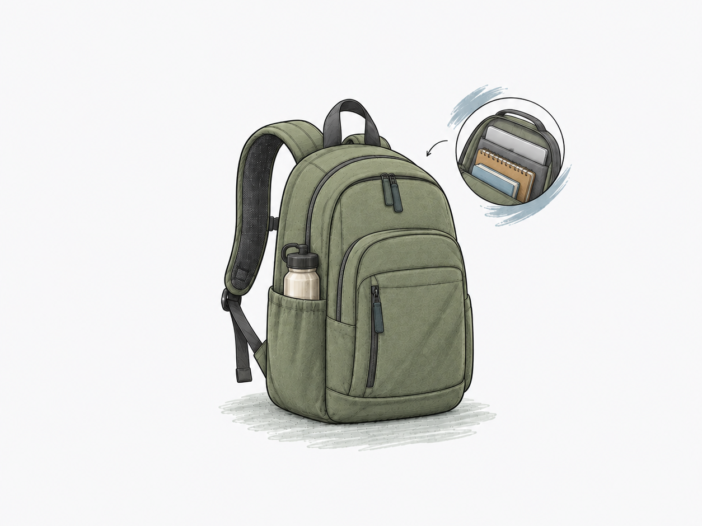
The JanSport Main Campus fits buyers who haul a real school-day load: laptop or Chromebook, books or binders, lunch, water bottle, and all the smaller class extras. Buyers who fill the bag report that the shoulder straps stay comfortable, even with everything loaded.
You get high volume and a flexible build, but you give up a reinforced base, smooth zipper access every time, reliable fit for wide bottles, and strong protection in heavy rain. Based on buyer evidence, the Main Campus doesn’t behave like a tank in rough conditions.
If space sits at the top of your list, this trade-off makes sense. But if you need rigid laptop protection or snag-free access, factor those limits into your decision.

Product Snapshot
- Core role: The product description presents the Main Campus as a large-capacity backpack with two main compartments, a padded laptop compartment, exterior zippered storage, and additional organization.
- Strongest observed use case: School. This is where the evidence is deepest, including repeated middle-school, high-school, and college loads and several reports covering a full school year or multiple years.
- Secondary use cases: Work, commuting, and short travel are also represented, but with fewer repeated long-duration examples than school use.
- Laptop fit evidence: Buyer reports include a regular Chromebook, a Chromebook inside its carry case, and one 15.6-inch laptop. These are observed buyer examples, not verified universal fit limits.
- Protection boundary: Two buyer Q&A responses state that the bottom is not padded. The evidence therefore does not support treating the Main Campus as a suspended-bottom or impact-protective laptop bag.
- Variant scope: The evidence does not establish a decision-relevant size or model variant. Color references appear cosmetic.
Buyer Evidence Metrics
| Buyer Question | Metric | Evidence |
| Is zipper snagging or stiffness more concentrated in school/college use than in other observed zipper-use contexts? | CFL 0.93× | Limited · n=6 |
| When buyers praise the bag’s roominess, how often does small-item organization or access friction appear with it? | TCR 0.21 | Moderate · n=14 |
| Does the evidence consistently separate moderate/brief rain from heavier or prolonged wet exposure? | UBC 1.00 | Limited · n=4 |
How these metrics work: Context Friction Lift (CFL) measures whether a known friction is more concentrated in a defined eligible context than in the eligible comparison context; for CFL, public n reflects the smaller eligible comparison group. Trade-Off Coupling Rate (TCR) measures how often an observed product strength appears together with a specific friction among eligible buyer evidence.
Use Boundary Consistency (UBC) measures how consistently eligible buyer evidence separates a supported use case from the condition where that use becomes more limited or conditional. n is the number of relevant, eligible, deduplicated buyer observations used for that metric—not the product’s total review count. These are buyer-evidence signals, not product-performance scores. See how these buyer-evidence metrics work.
What those signals mean in practice
- CFL 0.93× does not identify school use as a special zipper-risk context. A value close to 1 means the eligible evidence shows similar zipper friction concentration inside and outside school/college use. This is not a failure rate or severity score.
- TCR 0.21 means roominess usually appears without a paired organization complaint in the eligible evidence. Small-item access friction does occur, but it is a minority pattern rather than an automatic consequence of the bag’s larger capacity. The metric does not imply causation.
- UBC 1.00 reflects a clean rain-use boundary in a small evidence set. The four eligible observations consistently separate more workable moderate/brief rain from the need for greater caution in heavy or prolonged wet exposure. It is not a waterproof rating or a probability that contents will stay dry.
Fit–Friction Matrix
| Buyer Setup / Context | Fit Signal | Main Friction |
| Daily middle- or high-school load with Chromebook/laptop, books or binders, lunch, water bottle, and class extras | Recurring Strong Fit | Zipper access can be stiff or snag-prone, even though several school users report normal zipper performance. |
| College or work load with laptop, cords/chargers, lunch, headphones, documents, or other daily tech | Generally Works | Flexible construction can feel thin or sag under denser loads; strong bottom reinforcement is not established. |
| Chromebook or laptop carried with routine school/work items | Conditional Fit | Buyer-reported fit is positive, but two Q&A responses state that the bottom is not padded. |
| Wide 32–40 oz bottle carried in the side pocket | Conditional Fit | Fit varies by bottle geometry, and buyer evidence conflicts on both bottle compatibility and whether the bag has one or two usable side pockets. |
| Campus or commute use in moderate rain | Conditional Fit | Heavy or prolonged wet exposure is the clearer boundary; the evidence does not support calling the bag waterproof. |
| Short travel or carry-on use with clothing plus electronics or day-use essentials | Generally Works | Travel evidence is less deep than school evidence, and the side straps are not established as a rolling-luggage-handle attachment. |
The Strongest Fit: Students Carrying More Than the Basics
The Main Campus has its clearest evidence advantage when the buyer needs one bag to absorb a multi-part school load.
Repeated examples include combinations such as:
- Chromebook or laptop;
- books, notebooks, binders, or file folders;
- lunch or lunch box;
- water bottle;
- pencil case;
- sweatshirt or PE clothing.
Several buyers describe the shoulder straps as comfortable with these fuller loads, and multiple buyers report the bag remaining useful through a full school year or longer.
Durability is not a sure thing. Some buyers report tearing within months, bottle-pocket failure, or zipper problems. Plenty of students get a full year or more, but results are mixed.
When the size can become too much
Most school-size comments are positive, but the evidence is not unanimous. One buyer explicitly found the Main Campus too large for school and reassigned it to travel use.
The Main Campus works for students who fill the extra space. If your daily carry is just a light laptop and a notebook, this bag is probably more than you need.
Work and Commute Use: Useful Space, Softer Structure
Work-oriented evidence shows that the Main Campus can move beyond school carry.
Observed setups include:
- smartphone, tablet, chargers, earbuds, flashlight, and papers;
- computer, cords, lunch, and headphones;
- two laptops for a work trip;
- approximately 20–30 lb of tech gear carried five days per week in one specific report.
That last setup highlights the structural trade-off. One buyer carried 20–30 pounds of tech gear and said the bag held up, but the material felt thin and sagged under the weight. This is a single report, not a hard load limit for everyone.
The Main Campus can handle heavy loads, but it doesn’t have a rigid frame or structure. Expect a softer build, not a structured tech hauler.
Laptop Carry: Fit Evidence Is Better Than Bottom-Protection Evidence
Laptop compatibility and laptop protection are not the same question.
The buyer evidence supports several fit examples:
- one Q&A says a 15.6-inch laptop fits;
- another says a regular Chromebook fits;
- one school buyer carried a Chromebook inside its own case with additional books.
But the protection evidence is more limited:
- two separate Q&A responses state that the bag bottom is not padded;
- one two-laptop work-trip buyer wanted additional bottom support;
- The evidence does not establish a suspended laptop compartment or controlled impact protection.
The Main Campus fits buyers who need room and device separation. If you want bottom-impact protection, add a sleeve or choose a different bag.
Bottle-Pocket Fit: Ounces Alone Do Not Predict Compatibility
Bottle fit is one of the clearest places where simple size labels become misleading.
The evidence includes successful reports for:
- some 32 oz bottles;
- one 35 oz Stanley;
- one 40 oz Owala.
But it also includes unsuccessful reports for:
- one 32 oz Nalgene;
- one 40 oz flask measuring about 3.5 inches in diameter.
Bottle shape, not ounce rating, determines fit. If you use a wide bottle, check its actual shape against the pocket instead of trusting the ounce label.
The listing says two bottle pockets, but several buyers received a bag with just one. The evidence does not settle whether all Main Campus bags have one or two pockets.
Zipper Friction: Recurring, but Not Confined to One Use Case
Zipper behavior is the most repeated access friction in the evidence.
Reported problems include:
- protective flap material getting caught in the zipper path;
- stiff operation;
- zipper teeth moving off track;
- operation that is easier with two hands.
At the same time, other buyers report normal zipper operation, strong zipper quality, or no zipper failure over extended school use.
The CFL 0.93× metric shows zipper friction is not just a school problem. Zipper issues show up about as often in other uses. Test zipper access with your own setup, not just if you are a student.
Rain: A Boundary, Not a Waterproof Claim
The available evidence supports a cautious separation between lighter exposure and more demanding wet conditions.
- One Q&A describes moderate rain as workable.
- One school-use report says the exterior became wet in pouring rain and the interior fabric could become damp, although the buyer had not experienced wet contents.
- Another Q&A says prolonged rain or submersion would likely let water reach the contents.
- A heavy-rain Q&A advises extra safeguarding in very wet conditions.
The UBC 1.00 metric shows a clear pattern across the four reports: moderate rain is usually fine, but heavy or prolonged rain means you need extra protection. This is not a waterproof rating. Plan for extra coverage if you expect real wet weather.
How Buyers Use the Extra Capacity
The evidence shows the same high-volume layout serving three different roles:
- School: the deepest pattern, with laptops/Chromebooks, books, binders, lunch, water, and class extras carried together.
- Work and commute: mixed personal tech, office items, cords, lunch, headphones, and in one case a dense tech load.
- Short travel: examples include four days of clothing plus electronics and games, overseas replacement travel, airline carry-on use, and day-use essentials during a two-week Scotland trip.
Travel setups show the Main Campus can flex for short trips, but the evidence is thinner than for school use. Treat travel as a bonus, not the main reason to pick this bag.
What Buyers Compare It With
The comparison evidence is limited and should be read as individual buyer context rather than formal head-to-head testing.
- JanSport SuperBreak: one buyer moved to Main Campus because the SuperBreak was struggling with a larger school load. That buyer reported more capacity, better straps, and more padding after the switch.
- JanSport Cross Town: one reviewer suggested Cross Town when the buyer does not need Main Campus-level volume but still wants a lightweight pack.
- JanSport It’s Possible: the same reviewer preferred Main Campus for larger work/school loads and described its bottom material as thicker.
- JanSport Cool: that reviewer suggested it when expanded volume was still wanted, but the buyer prioritized what the reviewer considered better quality.
These comparisons help explain why buyers switch, but there are not enough to rank the whole JanSport lineup.
What Buyers Should Check Before Buying
- Check how much bottom protection your laptop needs. Two buyer Q&A responses say the bottom isn’t padded, and the evidence doesn’t show suspended or impact-rated laptop protection.
- Decide how sensitive you are to zipper friction. Flap snagging, stiff operation, off-track zipper teeth, and two-handed use recur, but other buyers report normal zipper performance. The evidence supports variability, not a universal defect.
- Test bottle geometry, not just bottle capacity. Reported fit differs even among bottles in the 32–40 oz range, so ounce rating alone is not a dependable compatibility rule.
- Verify whether one or two bottle pockets matter to you. The listing wording and several buyer reports conflict on pocket count.
- Plan secondary protection for sustained heavy rain. Limited buyer evidence separates more workable moderate exposure from heavier or prolonged wet conditions; it does not establish waterproofing.
- Durability is mixed, not guaranteed. Some buyers get years of use, others see early tearing, zipper problems, or bottle-pocket failure. The evidence supports both stories, so don’t count on a guaranteed lifespan.
