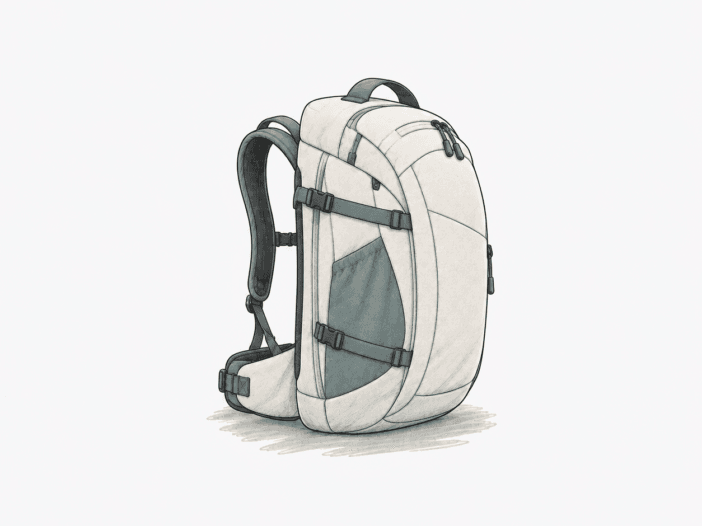
The Osprey Fairview 40L tries to cover two travel roles that seem similar at first: a main carry-on and an under-seat personal item. In practice, those roles pull the bag in different directions.
Buyer feedback supports the 40L as a main travel backpack and overhead carry-on. Travelers use it for multi-city trips, rail and bus transfers, and walking between hotels, with one-bag setups lasting anywhere from 10 days to several weeks.
Under-seat use with the 40L is less predictable. Some buyers fit it under the seat, but others run into problems when the bag is packed full or when the airline, aircraft, or seat position changes.
This trade-off sits at the center: you get real packing space and a harness that shifts weight to your hips, but you lose some certainty about under-seat fit and quick-access pockets you would find in more compartment-heavy bags.
Most labeled buyer feedback covers the 40L. Only one direct 55L example shows up, so the 55L has less support.

Product Snapshot
| Product detail | Decision relevance |
| Fairview 40L | The best-supported configuration in the available buyer feedback. |
| Travel-oriented carry system | Buyers repeatedly report adjustable torso positioning, hip-belt load transfer, and stowable straps as useful during travel. |
| Large main packing area | Supports substantial one-bag loads, but buyers who want many dedicated pockets may need extra organizers. |
| Laptop storage | Useful for tech travel, although some 40L buyers say its padding or placement reduces usable packing space. |
| Exact empty weight | Not established here because the available unspecific Q&A gives conflicting figures. |
Buyer Evidence Metrics
| Buyer Question | Metric | Evidence |
| How clearly does 40L overhead carry-on use separate from under-seat/personal-item use? | UBC 0.88 | Moderate · n=8 |
| How often does supportive 40L carry appear together with body-fit friction? | TCR 0.22 | Moderate · n=9 |
| How often does 40L laptop storage appear together with packing-space or pressure friction? | TCR 0.33 | Limited · n=6 |
How these metrics work: Use Boundary Consistency (UBC) measures how consistently eligible buyer evidence separates a supported use case from the condition where that use becomes more limited or conditional.
Trade-Off Coupling Rate (TCR) measures how often an observed product strength co-occurs with a specific friction within eligible buyer evidence.
n is the number of relevant, eligible, deduplicated buyer observations used for that metric—not the product’s total review count. These are buyer-evidence signals, not product-performance scores. See how these buyer-evidence metrics work.
Three points matter more than the numbers themselves:
- UBC 0.88 does not mean you have an 88% chance of fitting in an overhead bin or failing under a seat. It means the eligible 40L feedback separates those two roles pretty consistently: overhead carry-on use is better supported, while under-seat use becomes conditional.
- TCR 0.22 does not mean the harness fails 22% of the time. Out of nine eligible 40L observations where the supportive carry system mattered, two also reported body-fit friction. Most did not, but torso, shoulder, and collarbone fit still matter for each buyer.
- TCR 0.33 comes from just six eligible laptop-related 40L observations. Two paired useful laptop storage solutions for space or pressure concerns. That is enough to flag a packing trade-off, but not enough to say the laptop compartment will create a problem for every buyer.
Fit–Friction Matrix
| Buyer Setup / Context | Fit Signal | Main Friction |
| 40L with selectively packed or compressed clothing, shoes, and travel essentials for roughly one to two weeks | Recurring Strong Fit | Extra shoes, nonessential items, or a heavily expanded load reduce packing flexibility. |
| 40L used as the main backpack for air, rail, bus, and city-to-city travel | Generally Works | The bag remains substantial travel luggage, so smaller-item access may require extra organization. |
| 40L used as an overhead carry-on | Generally Works | Airline rules still vary; this does not establish universal cabin compliance. |
| 40L expected to work as an under-seat personal item | Conditional Fit | Packing level, airline, aircraft, and seat position can change the outcome. |
| 40L carrying a laptop alongside a dense travel load | Conditional Fit | Some buyers report that laptop padding or placement takes usable space or requires more careful packing around the device. |
| 40L adjusted for longer walking with the hip belt carrying part of the load | Generally Works | Some buyers still report neck, shoulder, collarbone, or upper-frame mismatch after adjustment. |
The 40L Fits Best When You Treat It as Main Travel Luggage.
The main 40L pattern is about more than just capacity. Buyers use the space for real multi-day trips and carry the bag between trains, buses, and hotels.
Examples from explicit 40L feedback include:
- One buyer used the 40L for a 10-day trip with a 26 lb allowance and described the packing as workable, although selective and tight.
- One buyer used a Fairview 40L with an Osprey DayLite Plus on a 12-day, four-country Europe trip.
- One long-duration traveler reported using the 40L for a one-year round-the-world trip, with packed loads ranging from about 7 kg to 12.5 kg.
- Another 40L setup included three seasons of clothing in four packing cubes, personal-care items, a laptop, an extra screen, an iPad, two rain jackets, and sandals.
These examples do not set a universal packing limit. They show the 40L works best for travelers who pack selectively, compress clothing, and use the bag as their main travel setup.
Overhead Carry-On and Personal Item Are Different Jobs
Start with this decision boundary: do you need the Fairview 40L to fit under a seat, or just in the overhead bin?
Buyer feedback supports overhead-bin use. Under-seat fit is mixed, so the 40L does not work as a universal personal item.
The contrast is specific:
- One buyer reported a stuffed 40L fitting under the seat on an Allegiant Air trip to Mexico. That is one successful example, not a general airline rule.
- One buyer reported that the 40L fit under Southwest middle and window seats but not the aisle seat in two attempts. The evidence therefore shows that seat position can matter.
- Another buyer said a fully packed 40L would not fit under the seat, while a more lightly packed, compressible load could be tightened down.
- Another 40L buyer framed the bag as carry-on size rather than an under-seat personal item.
If you need to avoid the overhead bin, treat the 40L with caution. If you plan to use it as your main overhead carry-on, buyer evidence lines up much more consistently.
Load Support Is a Strength, but Body Fit Is Still Personal
The 40L’s adjustable harness stands out because buyers use it with real travel loads, not just for short airport walks.
Shorter users say adjustment helps balance weight between hips and shoulders. Other travelers describe comfortable walking during multi-stop trips.
One 5’5″, 120 lb buyer stood with a loaded 40L for two hours at Milan train station without strain after adjusting the shoulder clips and hip belt. That is one person’s experience, not a guarantee of comfort for everyone.
Other 40L feedback shows the opposite edge of the fit range:
- One petite, small-framed buyer liked the adjustable torso system but found the upper frame sitting awkwardly behind and above the shoulders after adjustment.
- Another buyer reported some collarbone discomfort even though the pack adjusted across a wide height range.
- Comparison feedback between the Fairview 40L and Farpoint 40L notes differences in belt width and shoulder-strap geometry, with neither model offering a clear comfort advantage for that buyer.
The useful buying question is not “Does the adjustable harness fit petite travelers?”
Instead, ask: Can you position the hip belt, shoulder straps, and upper frame so the pack transfers weight without pushing into your neck, shoulders, or collarbones?
Buyer feedback shows adjustability helps, but it does not guarantee a good fit.
The Main Compartment Prioritizes Packing Flexibility Over Pocket Density
The Fairview 40L’s big main compartment makes one-bag setups possible, but buyers separate packing space from organization.
In practical terms:
- A large central space can make it easier to arrange clothing, shoes, packing cubes, or other bulky travel items.
- Some buyers add packing cubes or mesh bags because the bag itself does not separate every small item.
- Quick access matters when buyers want chargers, batteries, or documents without opening the main compartment.
- Bottle access depends on how full the bag is. Some buyers use the front pocket, but others find storage too tight or awkward when the bag is packed full.
Layout changes across Fairview 40L generations show up in buyer feedback. Laptop placement, front pockets, and bottle storage can differ, so do not assume every version matches a single review.
Laptop Carry Solves One Problem and Can Create Another
The available 40L evidence supports laptop storage as a real travel use case. Buyers report carrying laptops alongside clothing and other travel gear.
But that same structure can eat into your packing space.
Among the limited laptop-related 40L evidence:
- some buyers value having a dedicated laptop area;
- some say the padding occupies space they would rather use in the main compartment;
- one buyer specifically worried about how densely packed contents might press against the laptop area.
The evidence does not show laptop damage or poor protection. It does show that if you pack the 40L tightly, the laptop area takes up space you cannot ignore.
This trade-off matters most if you do not travel with a laptop. For those buyers, the fixed laptop area can feel like lost capacity.
Variant Fit Patterns
- 40L — Generally Works for one-bag travel. Direct 40L feedback repeatedly supports multi-day and multi-week travel with selective packing, compression, and an overhead-carry-on role.
- 40L — Conditional as a personal item. Specific under-seat successes exist, but conflicting examples show that fill level and aircraft seating can change the result.
- 40L — Mixed on body fit. The adjustable harness often helps with load distribution, including for several shorter buyers, but direct 40L feedback also includes frame, collarbone, and shoulder-fit friction.
- 55L — Specific Example Only. Only one cleanly scoped 55L contribution is available. In that example, the smaller secondary daypack reportedly fit under the seat, while the main 55L pack did not. That single observation is not enough to generalize about 55L comfort, organization, capacity, or broader airline compatibility.
- Unknown-size Fairview feedback — useful only as family context. It reinforces recurring themes such as travel capacity, stowable straps, quick-access limitations, bottle-access friction, and mixed body fit. Still, those observations don’t apply to the 40L or 55L when the size isn’t stated.
What Buyers Carry With It
The most informative 40L loadouts show what “one-bag travel” actually means in practice.
Buyer-reported examples include:
- clothing and travel essentials for about one to two weeks;
- two pairs of shoes plus roughly a week or two of warm-weather clothing in one setup;
- packing cubes or compression methods to keep the load controlled;
- laptops, tablets, and chargers mixed with clothing in tech-heavy travel setups;
- a smaller daypack for daily use after the Fairview is left at the hotel or hostel.
One buyer used mesh laundry bags as makeshift organizers when packing densely. That points to a pattern: if you want more small-item structure, you will probably need to add it yourself.
What Buyers Compare It With
Buyer comparisons don’t establish an overall winner, but they clarify the problem Fairview is being asked to solve.
- Osprey Farpoint 40L: one buyer compared both under roughly 15 lb loads and found different harness geometry but no dramatic comfort difference.
- Osprey Kyte 42L: one long-time Kyte user saw the Fairview 40L as a more travel-focused replacement with laptop storage, but kept the Kyte because the Fairview’s compromises didn’t suit her needs.
- Osprey Sojourn Porter 45L: one buyer preferred the Porter’s perceived quality and use of interior space, while still describing the Fairview 40L as a viable smaller carry-on.
- Peak Design 30–45L: one shorter-user comparison favored the Fairview’s load-transfer setup, but that is a single buyer context rather than a cross-product ranking.
What Buyers Should Check Before Buying
- Decide if you need an overhead carry-on or a true personal item. The 40L works much more reliably as a carry-on. Under-seat use depends on your setup.
- Test the harness with real weight, not just an empty bag. Buyer feedback indicates that the hip belt and torso adjustment help with load transfer, but some buyers still report discomfort after adjustment.
- List what you actually reach for during transit. If you often grab a bottle, charger, or documents, limited quick-access pockets may matter more than main compartment size.
- Decide if the laptop area is worth the space. If you travel with a computer, you may value it. If not, the padded structure can feel like lost packing volume.
- Check which Fairview generation or layout you are buying. Buyer feedback indicates that laptop placement, front pockets, and bottle storage can vary between versions.
- Do not assume the Fairview is waterproof. Buyer reports conflict: some say gear stayed dry, others needed a separate rain cover.
Bottom Line
Buyer feedback points to a specific role for the Osprey Fairview 40L.
The Fairview 40L fits best if you want one main backpack for overhead carry-on, open packing space, and a harness that shifts weight to your hips.
Fit gets more conditional if you need the bag to act like a smaller personal item, a pocket-heavy tech organizer, or a pack that fits every body type without adjustment.
This is the decision boundary: pick the Fairview 40L for its travel-carry strengths first. Then check if your airline, body fit, quick-access habits, and laptop setup fit inside that role.

