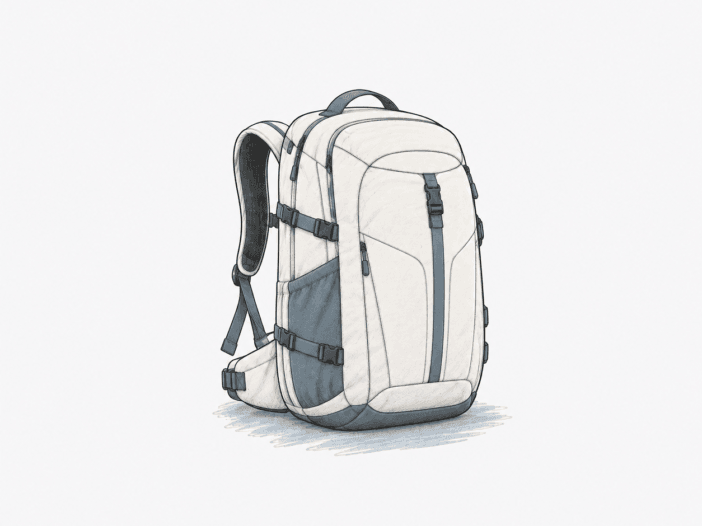
Farpoint sizing is not just a numbers game. Each configuration changes how the bag carries, packs, and fits real travel setups, based on what buyers actually report.
The 40L gets the strongest buyer support for overhead-bin one-bag travel, especially with clothing, toiletries, a laptop or tablet, and packing cubes. The 55L makes sense if you actually plan to use the detachable daypack for tech on the plane or as a day bag after arrival. The 70L handles extended travel, but carry-on status depends on how you split the bags and what your airline allows. For the 80L, buyer evidence is too thin to call a clear fit.
One trade-off shows up in every size. Buyers like the supportive carry, but the frame, laptop sleeve, limited organization, or daypack attachment can create problems depending on your gear and how you pack.

Product Snapshot
- 40L: Buyer evidence backs it as an overhead-bin one-bag setup, not as a dependable underseat personal item. Most buyers use packing cubes or pouches with the open main compartment.
- 55L: Most buyers use it as a main travel pack plus detachable daypack. The two-bag setup works for some travel patterns, but daypack access, sagging attachments, and laptop placement become real issues once you load the smaller bag with tech or dense gear.
- 70L: Buyer evidence supports it for extended travel and hotel-based daypack use. Some buyers have carried it in the cabin, but that depends on how you configure the bags and what the airline allows. There’s no universal carry-on fit here.
- 80L: Only five high-value buyer reports met the evidence bar. Those examples show the 80L handling larger loads or checked-bag travel, but the sample is too thin to support any broad fit or durability call for the whole line.
Buyer Evidence Metrics
| Buyer Question | Metric | Evidence |
| How consistently does 40L evidence separate overhead-bin use from underseat personal-item use? | UBC 0.89 | Moderate · n=9 |
| How often does supportive 40L carry appear together with frame or laptop-structure packing intrusion? | TCR 0.56 | Moderate · n=9 |
| How often does 55L split-pack versatility appear together with daypack, access, or organization friction? | TCR 0.40 | Moderate · n=10 |
| How consistently does 70L evidence keep cabin use conditional on configuration or airline? | UBC 1.00 | Limited · n=5 |
How these metrics work: Use Boundary Consistency (UBC) shows how often eligible buyer evidence draws a clear line between a supported use case and where that use gets more limited or conditional.
Trade-Off Coupling Rate (TCR) tracks how often a product strength co-occurs with a specific friction in eligible evidence. n is the count of relevant, eligible, deduplicated buyer observations for that metric, not the total review count. These are buyer-evidence signals, not product-performance scores. See how these buyer-evidence metrics work.
A 40L UBC of 0.89 does not mean you have an 89% chance of passing airline checks. It means buyer evidence consistently backs overhead-bin use, not underseat personal-item use. One carry-on example worked only because the airline was lenient, even though the bag exceeded their technical limits. Always check your airline’s rules before flying.
The 70L UBC of 1.00 is based on just five buyer reports. In that small sample, cabin use always depended on how the bags were configured or what the airline allowed. Treat this as a pattern in the evidence, not a guarantee for your trip.
Fit–Friction Matrix
| Buyer Setup / Context | Fit Signal | Main Friction |
| 40L + clothing/toiletries + laptop or tablet + packing cubes, used as an overhead-bin bag with meaningful airport, rail, or city walking | Recurring Strong Fit | Underseat personal-item use is poorly supported, and the frame/laptop structure can consume packing flexibility. |
| 40L + larger 15–16-inch laptop + many small work or tech items, with an expectation of built-in admin organization | Mixed / Variant-Dependent | Laptop fit conflicts across devices and generations; sparse pockets can push the buyer toward separate pouches or organizers. |
| 55L main pack for clothing + detachable daypack for laptop, in-flight items, or destination use | Generally Works | The daypack can feel small or top-access-heavy, and dense laptop/water loads can increase sag or attachment friction. |
| 70L for extended travel + detachable daypack, with the system separated for cabin or destination use | Conditional Fit | The complete configuration is not established as a universal standard carry-on; airline and configuration checks remain necessary. |
| 80L for a larger checked-travel load, with backpack carry mainly between transport and accommodation | Specific Example Only | Evidence is sparse; retained examples include overstuffed-shape handling friction and an individual broad-shoulder fit problem. |
Variant Fit Patterns
40L: strongest evidence for one-bag overhead travel
Most 40L buyers pack clothing, toiletries, and a laptop or tablet, usually with packing cubes. Several buyers report comfortable airport, city, or longer walks with the adjustable harness and hip belt under real load, not just empty.
The 40L aligns best when:
- you plan to use it as an overhead-bin carry-on, not as a guaranteed personal item;
- you prefer a large, relatively open packing area and are comfortable adding your own cubes or pouches;
- you value load transfer enough to accept some internal space being occupied by the frame and laptop structure.
The 40L becomes more conditional when:
- you need dependable underseat fit;
- you want many built-in pockets for chargers, passport, wallet, medication, or small work gear;
- you carry a larger laptop and need a sure fit. One European traveler fit an iPad Air plus a 14-inch PC, but other buyers report tight or failed fits with 15–16-inch devices. The evidence does not support a universal laptop-size claim for the 40L. Always check your device’s actual dimensions (laptop plus case) against the sleeve’s interior measurement.
Body fit is not universal. Several buyers adjusted the harness for comfort, but one buyer, 5 ft 10 in and 310 lb, found that the 40L hip belt did not work for their build. That is one person’s experience, not a rule for all larger bodies. Always test the harness and hip belt under your actual load before deciding.
55L: useful when the detachable daypack is part of the plan
Most 55L buyers use it as a two-bag travel system: clothing goes in the main pack, while the detachable bag handles your laptop, in-flight essentials, work gear, or day-use items.
The 55L aligns best when:
- you genuinely want to detach a smaller bag after arrival;
- you like splitting an airline load into overhead main pack + underseat personal item when the airline permits it;
- you are comfortable using packing cubes or pouches instead of relying on extensive built-in organization.
Problems show up when you load the daypack heavily. One airport example: a passenger packed a laptop and about 2 liters of water in a daypack and reported sagging and slower separation at the checkpoint. Another buyer carried about 13 kg in the main pack with the daypack on the front and got neck pain and bounce. These are specific, load-sensitive cases. Always test the daypack with your actual tech and water load, not just by listed capacity.
Buyer opinions on the daypack split. Some see the detachable bag as the main reason to buy the system. Others call it too small, too top-access-focused, or the reason they switched to a different setup.
70L: extended-travel evidence, but cabin use stays conditional
70L buyers report five-week trips, mixed clothing and tech loads, and a 17-day Japan trip with trains, subways, stairs, cold-weather gear, and laundry stops. These examples support the 70L as an extended-travel system, not just a bigger 40L.
Airline fit is a real boundary here. Some buyers split the system, putting the big pack overhead and the daypack with a laptop under the seat. Others found the 70L too big for standard carry-on rules.
These reports are not contradictions. How you configure the bags and what your airline allows will change the answer. The evidence does not support calling the full 70L system carry-on compliant for everyone. Always check your airline’s rules and test your setup before flying.
80L: useful examples, but not enough evidence for a broad pattern
Only five high-value 80L buyer reports met the evidence bar. Treat this variant with caution, and don’t assume it will fit your travel pattern or airline rules.
The best-documented case was a two-week trip to Greece and Italy with six flights, carrying about 16 kg of clothing, a light wool jacket, shoes, and a second small backpack. The buyer found the pack comfortable once on, but also reported loose strap ends, an off-balance side handle, and trouble with baggage conveyors when the bag was fully packed and awkwardly shaped.
At Rome Fiumicino Airport, the same buyer encountered an oversized baggage objection with ITA Airways due to conveyor handling, but had no issue with Turkish Airlines. That is one traveler’s experience, not a general rule for either airline.
How Buyers Use It
The Farpoint works best as travel luggage you carry like a backpack, not as an everyday bag. Treat it as a travel system, not a daily commuter.
- Transport-heavy international travel: 40L and 55L buyers talk about airports, rail transfers, city walks, and stairs where hands-free carry makes a difference.
- Hotel-based day use: 55L and 70L buyers leave the main pack at the hotel and use the detachable bag for day trips.
- Business travel: one retained the 55L; for example, used the system for three- to four-day domestic business trips and occasional eight- to nine-day overseas trips, with a 26 oz Brita bottle and a separate electronics pouch.
- Long walking: one 40L buyer used the bag on the Camino de Santiago, and one 55L buyer took an 11-day Europe trip with long walks and the steep stairs in Amsterdam. These are individual cases, not proof that the bag is always comfortable for long distances. Always test comfort under your real load and walking pattern.
What Buyers Carry With It
A few buyer loadouts show why packing matters more than the capacity number. Your setup and packing style will change what actually fits and how the bag carries.
- 40L: One European traveler packed an iPad Air and a 14-inch PC in the sleeve and used compression cubes for the rest. That setup worked for them, but it doesn’t mean every laptop will fit.
- 55L: One buyer on a four-week Southeast Asia trip loaded the daypack with a 16-inch gaming laptop, DJI Mini 2 Pro Fly More combo, GoPro, cables, a 750 mL bottle, and an umbrella. They still wanted better access to laptops, hydration options, and a rain cover.
- 70L: Buyers packed clothing, books, gadgets, and a laptop, sometimes using the smaller pack for a laptop or day-use gear in two-bag setups.
- 80L: One detailed example carried about 16 kg for two weeks, including clothing, a light wool jacket, shoes, and a second small backpack.
What Buyers Compare It With
Buyer comparisons clarify the Farpoint’s trade-offs, but no universal winner emerges.
- tomtoc Navigator 40L: one Farpoint 40L buyer suggested the comparison after finding the Farpoint rigid and function-light for the price. The evidence does not document that buyer’s final experience with the tomtoc.
- North Face Overhaul 40L: one comparison favored the Farpoint’s carry comfort and airflow but criticized its organization and laptop fit.
- Patagonia Black Hole 45: one buyer preferred the Farpoint suspension for longer carry but viewed the Patagonia pocket layout more favorably.
- Osprey Sojourn Porter 46L / Porter 46: 55L buyers liked the Farpoint’s ventilation, straps, and detachable daypack capacity, while some preferred the Porter-style packing shape and built-in organization.
The pattern is clear. Farpoint stands out for supportive carry and travel mobility. Buyers who want more built-in organization or a simpler packing shape usually choose something else.
What Buyers Should Check Before Buying
- Check the exact Farpoint generation and configuration before you buy. Buyer evidence spans several listings and generations, and laptop placement, organization, and daypack bundling can vary across them.
- Decide if you want overhead-bin carry or underseat personal-item use. The 40L evidence draws a clear line between those roles. For the 70L, cabin use depends even more on how you configure the bags and what your airline allows.
- Test your real laptop size and how you’ll access it. A 14-inch PC plus iPad fit in one 40L setup, but other buyers had trouble with 15–16-inch devices. Device labels alone won’t guarantee a fit.
- Be honest about how you organize. If you already use packing cubes and tech pouches, you’ll probably be fine with the open layout. If you expect lots of built-in admin pockets, you’ll likely find organization lacking.
- For the 55L, try the daypack with your actual load. Laptops, water, camera gear, or other dense items can affect how the attachment feels and how quickly you can separate the bags at checkpoints.
- Check body fit for yourself instead of assuming the harness will work for everyone. The evidence has plenty of comfort wins, but also some hip-belt and shoulder-fit failures.
Treat the Farpoint family as several different travel systems that share a name. The 40L is best backed for overhead-bin one-bag travel. The 55L makes sense when the detachable daypack actually solves a real in-flight or destination problem. The 70L works for extended travel, but airline fit is still a big caveat. The 80L does not have sufficient evidence to support a broad call.

