A laptop sleeve seems straightforward until you use it daily. Extra padding can crowd a backpack compartment, while a thinner sleeve often gives up accessory space or secure retention. The screen-size label alone doesn’t guarantee your laptop’s width, depth, thickness, or corner shape will fit.
No single laptop sleeve works best for everyone. Each option here fits a different carry setup, depending on whether you want more padding, less bulk, better host-bag integration, separate accessory storage, or a structured sleeve for just the laptop.
Best Laptop Sleeves by Carry Setup
Each of these four sleeves solves a different carry problem. Focus on how you actually carry your laptop, not on this list as a quality ranking.
| Product | Setup it matches | Main trade-off |
| tomtoc 360 Protective Laptop Sleeve | Laptop carried inside another bag, with chargers and other hard accessories kept separate | Reinforced padding and the separate accessory pouch increase thickness and create a two-piece carry setup |
| Bellroy Laptop Sleeve — 14-inch variant | Bare, relatively thin laptop; low-bulk office or travel carry; quick device access | Minimal accessory capacity, tighter fit boundaries, and less retention confidence than a fully zippered closure |
| Osprey Daylite Laptop Sleeve | Moving a laptop between backpacks, duffels, or suitcases; compact accessory load | Pack-friendly access comes with geometry-sensitive fit and mixed impact-protection expectations |
| Thule Gauntlet Sleeve — 16-inch variant | Structured, laptop-only carry with occasional in-case clamshell use | Minimal storage and limited internal restraint when the sleeve is partly open |
Start With the Carry Problem, Not the Brand
The sleeve needs to fit both your laptop and the rest of your carry setup.
- Measure your laptop’s actual chassis instead of trusting the screen size. Buyer reports show that width, depth, thickness, and corner shape all affect whether a sleeve fits.
- Check where the sleeve will spend most of its time. Extra padding or structure can make a difference if the sleeve rides inside a tight backpack compartment.
- Decide if you want to carry accessories with the laptop or store them separately. Chargers, mice, hubs, and SSDs can quickly change how much space you need.
- Pick a closure style that matches your routine. Magnetic access, full zippers, and clamshell openings each solve different problems and change how securely the laptop stays inside.
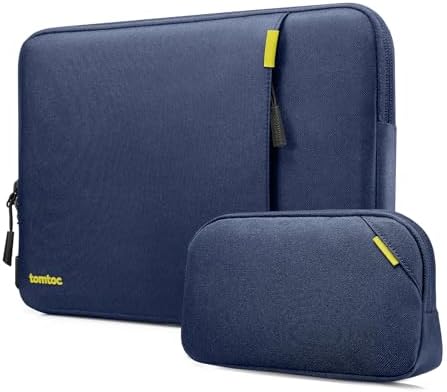
tomtoc 360 Protective Laptop Sleeve: More Padding, Plus Separate Accessory Carry
The tomtoc 360 fits best when you care more about laptop protection and keeping hard accessories separate than about having the thinnest sleeve possible.
Recurring buyer feedback supports a soft interior, substantial padding, and reinforced corner or edge protection. Family-level evidence also supports a separate accessory pouch, which helps keep chargers, cables, a mouse, an SSD, or a hub from pressing directly against the laptop.
If you usually carry the sleeve inside a backpack or travel bag, this setup can be especially useful. The trade-off shows up when space gets tight: extra padding takes up more room, and the accessory pouch means you’re carrying two pieces instead of one.
Fit needs close attention. Size-specific buyer evidence shows that a snug fit can become too tight as your laptop’s dimensions approach the sleeve’s limits. Sizing up can fix tightness but may let the laptop move around more inside.
The seller claims water-resistant construction without chemical coatings. Buyer evidence does not confirm lab-tested weather protection for this sleeve.
Best fit for: buyers prioritizing padding and accessory separation inside a larger carry system.
Look elsewhere if: you prioritize an ultra-thin profile, integrated shoulder carry, or a single compartment for both a laptop and bulky accessories.
Want to examine its fit boundaries and protection setup more closely? Read the tomtoc 360 Protective Laptop Sleeve Product Insight →
Bellroy Laptop Sleeve — 14-Inch Variant: Slim Carry With Faster Access
The Bellroy 14-inch sleeve works best for carrying a single, thin, bare laptop with minimal added bulk.
Buyer feedback highlights the slim profile, soft interior, and easy magnetic access. This simple design makes it easy to move your laptop between a desk, meeting room, or another bag without adding much structure.
This sleeve leaves little room for chargers, mice, or other accessories. The magnetic closure also does not hold the laptop as securely as a full zipper.
Bellroy lists a maximum laptop size of 312 × 221 × 15 mm for this sleeve and says even a thin hard-shell case will not fit. Buyer evidence for 14-inch MacBook Pro models is mixed, so you should check your laptop’s actual chassis dimensions instead of relying on the screen-size label.
Reports on magnetic security are mixed, and some buyers mention concerns about the bottom cutouts or slits. These issues aren’t universal, but they matter if you want a fully enclosed laptop.
A strong match when: low bulk and quick access matter more than accessory storage.
Think twice when: the laptop is thick, wears a shell, or you want fully enclosed zippered retention.
Need the fit details before deciding? Explore the Bellroy Laptop Sleeve Product Insight →

Osprey Daylite Laptop Sleeve: Built Around Moving Between Larger Bags
The Osprey Daylite works better as a protective layer for moving your laptop between backpacks, duffels, or suitcases than as a standalone organizer.
Buyer evidence highlights the soft lining or padding, carry handle, external accessory pocket, and short-side (vertical) access. This setup works well if you move your laptop in and out of a larger bag often.
Fit sensitivity is the main limitation. Two laptops with the same screen size can fit very differently because their chassis dimensions and shapes differ.
Direct 16-inch reports, for example, include successful fits for a 16-inch MacBook Pro and Lenovo P1 Gen 5, while a Lenovo P15 Gen 2 did not fit. That does not create a universal compatibility chart; it reinforces why physical dimensions matter.
The accessory pocket fits compact items better than bulky chargers. If you care most about rugged impact or edge protection, you may want a sleeve with more protective structure.
Where it makes sense: frequent transfer between host bags, vertical or short-side access, and a modest accessory load.
Potential mismatch: bulky accessories, strong impact-protection needs, or buying purely by printed screen size.
If host-bag integration is your deciding factor, see the full Osprey Daylite Laptop Sleeve Product Insight →

Thule Gauntlet Sleeve — 16-Inch Variant: Structured Protection Without Much Extra Storage
The 16-inch Thule Gauntlet fits buyers who want a structured sleeve for the laptop only, not one that also stores accessories.
Buyer evidence for the 16-inch Gauntlet points to a structured feel and mostly positive feedback on fit and protection. Some buyers use the laptop while it stays inside the sleeve in a clamshell setup.
This use case gives the Gauntlet a different role than sleeves built for quick bag transfers. Its structure adds protection but does not make it a full carry case.
Storage is minimal, and buyer reports mention limited restraint when the sleeve is partly open. There is not enough evidence to support claims about protection from direct punctures or sharp-corner impacts.
Only six buyer reports specifically mention the 16-inch Gauntlet, so the evidence base is narrower than for other sleeves here. Treat any reported limitations as points to check, not as guaranteed problems.
Makes sense for: structured, laptop-focused carry and buyers interested in occasional in-case use.
Less suitable for: substantial accessory storage or anyone expecting the laptop to remain restrained while the sleeve is partly unzipped.
For the evidence specific to this 16-inch variant, visit the Thule Gauntlet Sleeve Product Insight →

Narrow the Choice With Four Questions
The simplest way to narrow down these sleeves is to decide what job you need the sleeve to do.
- Need to keep hard accessories away from the laptop? The tomtoc 360’s separate pouch most clearly changes the carry setup.
- Want one bare laptop with as little added bulk as possible? The Bellroy 14-inch variant is built around that simpler use case.
- Move the laptop between backpacks or other larger bags frequently? The Osprey Daylite’s access and host-bag pattern matter more.
- Prefer a structured 16-inch laptop-only sleeve with possible in-case use? The Thule Gauntlet fills that distinct role.
If none of these descriptions match your setup, the problem may not be the brand. Device shape, accessory load, host-bag space, or closure style may decide the fit.
What to Check Before Buying a Laptop Sleeve
A good sleeve needs to fit your whole carry setup, not just the laptop name on the packaging.
- Measure your laptop’s width, depth, and thickness, especially if it has unusually square or rounded corners.
- Recheck the dimensions if your laptop has a hard shell or protective cover. Extra thickness can change whether the sleeve fits.
- Test how much space you have inside your host bag. Reinforced padding can make a sleeve too bulky for a laptop compartment that would otherwise fit.
- Decide ahead of time where you’ll keep the charger, mouse, hub, SSD, and cables.
- Think about what happens if you carry the sleeve upside down, partly open, or outside another bag. Closure style and internal restraint matter more in those situations.
The best laptop sleeve is the one that makes your daily carry easier. Protection matters, but so do fit, bulk, accessory placement, and how well the sleeve works with your bag.
