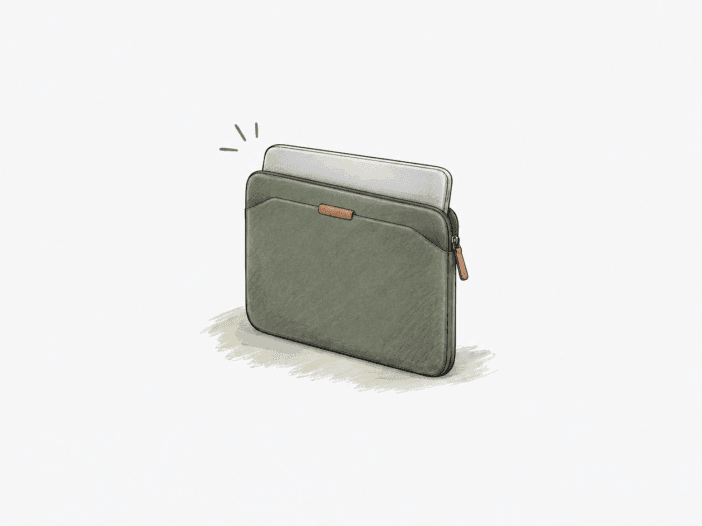
The Bellroy Laptop Sleeve works best for buyers who carry a single thin, bare laptop and want a low-bulk layer inside a backpack or messenger bag. The main trade-off is straightforward: you get a compact, snug fit, but there’s almost no room for extra device thickness, hard-shell cases, or accessories. Buyer reports suggest the MacBook Pro 14 fit is especially hit-or-miss.

Product Snapshot
This sleeve is built for slim, device-first carry, not for hauling a laptop plus accessories.
| Product detail | Decision relevance |
| 14-inch focal sleeve | Most buyer evidence applies to this size; separate 13-inch and 16-inch sleeves should not automatically inherit the same conclusions. |
| Bellroy-stated maximum: 312 × 221 × 15 mm | Device dimensions and thickness are more useful than the nominal screen-size label when checking fit. |
| One compartment | The format favors laptop-only carry; Bellroy says there is no additional notepad sleeve. |
| Magnetic closure | Buyers often like the quick access, but excessive device tightness can stop the closure from seating correctly. |
| Commonly nested inside another bag | Buyer reports repeatedly support low-bulk secondary protection more than heavy-duty standalone protection. |
Buyer Evidence Metrics
Device thickness sets the clearest fit boundary in buyer evidence. Limited accessory space comes up less often but still matters. Clasp-down retention shows up as an occasional caution, but there isn’t enough data to give it a numeric rate.
| Buyer Question | Metric | Evidence |
| Do thin, bare devices separate clearly from thicker, oversized, or hard-shell-cased setups? | UBC 1.00 | Moderate · n=15 |
| Does the minimalist single-device role commonly come with accessory-space friction? | TCR 0.67 | Limited · n=6 |
| Does retention become more concerning when the opening faces downward? | CFL — | Very Limited · n=3 |
How these metrics work:
- Use Boundary Consistency (UBC) measures how consistently eligible buyer evidence separates a supported use case from the condition where that use becomes more limited or conditional. UBC 1.00 does not mean a 100% chance of fitting; MacBook Pro 14 reports remain mixed, and one Bellroy Surface Pro 9 answer conflicts with Bellroy’s stated maximum dimensions.
- Trade-Off Coupling Rate (TCR) measures how often an observed product strength appears together with a specific friction among eligible buyer evidence. It does not establish causality. Here, the compact single-device role often appears alongside limited room for extras.
- Context Friction Lift (CFL) measures whether a known friction is more concentrated in a defined context than in the eligible baseline. For CFL, public n reflects the smaller eligible comparison group. Because only three eligible clasp-down or inversion observations support this signal, the numeric value is intentionally suppressed.
- n is the number of relevant, eligible, deduplicated buyer observations used for that metric—not the product’s total review count. These are buyer-evidence signals, not product-performance scores.
- See how these buyer-evidence metrics work.
Fit–Friction Matrix
This sleeve fits best when your setup sticks to a single, bare device. Fit becomes conditional if you add thickness, extra gear, expect full enclosure, or carry it in a different orientation.
| Buyer Setup / Context | Fit Signal | Main Friction |
| Bare, relatively thin laptop used as a low-bulk layer inside another bag | Recurring Strong Fit | Added thickness, an oversized chassis, or a hard-shell case can push the device beyond the practical fit boundary. |
| Bare 14-inch MacBook Pro | Mixed / Variant-Dependent | Reports range from glove-like fit to excessive tightness, incomplete insertion, or magnets that cannot close. |
| Laptop-only office, meeting, home, or short mobile carry | Generally Works | Charger, mouse, tablet, or notepad storage is limited by the device-first, single-compartment format. |
| Magnetic access in normal upright or nested carry | Generally Works | A tight device can prevent the closure from seating; a few clasp-down or inverted-use reports describe retention failure. |
| Buyer expecting fully enclosed dust/liquid protection | Limited Fit | Bottom corner openings or slits are a recurring concern, and the evidence does not establish verified water protection. |
Screen Size Is Not the Real Fit Test
Check your laptop’s actual thickness before trusting the ’14-inch’ label.
Bellroy repeatedly states a maximum device size of 312 × 221 × 15 mm for the focal sleeve and says even a thin hard-shell case pushes the device outside that fit. Buyer reports follow the same broad boundary: thinner MacBook Air, XPS, and similar devices are repeatedly described as fitting cleanly or snugly, while thicker Windows laptops and cased devices generate more fit friction.
MacBook Pro 14 breaks the simple fit rule. Some buyers get a glove-like fit, while others find the sleeve too tight to close or seat fully. UBC 1.00 suggests the evidence separates thin, bare setups from thicker or cased ones, but it doesn’t guarantee every laptop within the size limit will fit. One buyer said a sleeve bought in December 2025 ran slightly larger than an older Bellroy sleeve, but a single report does not confirm a redesign.
There is also one Bellroy Q&A claiming that a much larger stated Surface Pro 9 footprint fits comfortably, which conflicts with Bellroy’s own 312 × 221 × 15 mm maximum elsewhere. That contradiction is a reason to treat the stated envelope as the clearest available boundary—not as a universal guarantee for every device inside a nominal screen-size class.
Minimal Carry Is the Advantage—and the Accessory Limit
If you want to protect one device and keep the rest of your gear elsewhere, this low-bulk sleeve makes sense.
Buyers often use the sleeve inside padded backpack or messenger bag compartments. Several mention carrying the laptop between rooms or on short trips without a bigger bag. Still, this host-bag fit is not universal. One buyer said the sleeve would not fit the laptop compartment in a Bellroy Transit bag.
Minimalism cuts down what you can carry with your laptop. Bellroy lists one compartment and no extra notepad sleeve. Buyers report little or no room for chargers, mice, tablets, or other extras. TCR 0.67, from six eligible observations, shows how often compact device-only carry pairs with accessory-space friction.
One isolated review describes a front accessory pocket, but that conflicts with Bellroy’s one-compartment statement and the broader buyer pattern. It is not strong enough evidence to treat accessory storage as a standard feature.
Magnetic Access Is Convenient, but Orientation Matters
The magnetic closure gives you quick access, but it does not guarantee retention in every carry position.
In normal use, many buyers describe the magnet as useful, strong enough, or easy to open. Fit and closure are connected, however: when a laptop is too thick or too snug, several buyers report that the magnetic seal cannot fully engage.
A few buyers report a different issue when carrying the sleeve upside down or with the opening facing down: the laptop can slip past the magnetic closure. Only three eligible observations support this, so no published CFL rate exists. If you plan to carry the sleeve clasp-side down without another bag, check retention for yourself instead of assuming it will hold.
Protection Expectations Should Stay Modest
Buyer evidence shows the sleeve protects against scratches and light bumps, but not heavy impacts, full sealing, or weatherproofing.
Several buyers use the Bellroy sleeve inside another bag, and some explicitly describe it as a secondary layer rather than the only protection they would trust while traveling. The available evidence does not include lab testing for drops, impact, abrasion, or water resistance.
Two recurring details matter if protection is your main reason for buying:
- Buyers repeatedly mention bottom corner openings or slits as a concern for dust, liquid, and incomplete enclosure. The evidence does not show waterproof or fully sealed performance.
- Buyers give mixed feedback on exterior maintenance. Some like the look and feel, while others report dust, pet hair, stains, creasing, or dents. A few long-term users say their sleeve held up well, but those cases do not prove typical durability.
What Buyers Should Check Before Buying
The real decision isn’t just owning a ’14-inch laptop,’ but whether your carry setup fits the sleeve’s narrow role.
- Measure the device first. Compare the bare laptop with Bellroy’s stated 312 × 221 × 15 mm maximum rather than relying on screen size alone.
- Skip the case. Even a thin hard-shell case keeps the laptop from fitting inside Bellroy’s stated size limit.
- Expect mixed results with MacBook Pro 14. Some buyers get a clean fit, others find it too tight. The model name alone does not guarantee a match.
- Plan to store accessories elsewhere. Most buyers end up carrying only the device, not a sleeve that holds a charger or extras.
- Think about how you’ll carry the sleeve. Upright or nested magnetic use works better than carrying it clasp-side down on its own.
- Set your protection expectations to match the evidence. Bottom openings and no lab-tested water or drop protection mean this sleeve is better for light, low-bulk use than for sealed or heavy-impact needs.

If low bulk is your priority, see where the Bellroy fits among the other carry styles in our Best Laptop Sleeves guide →
