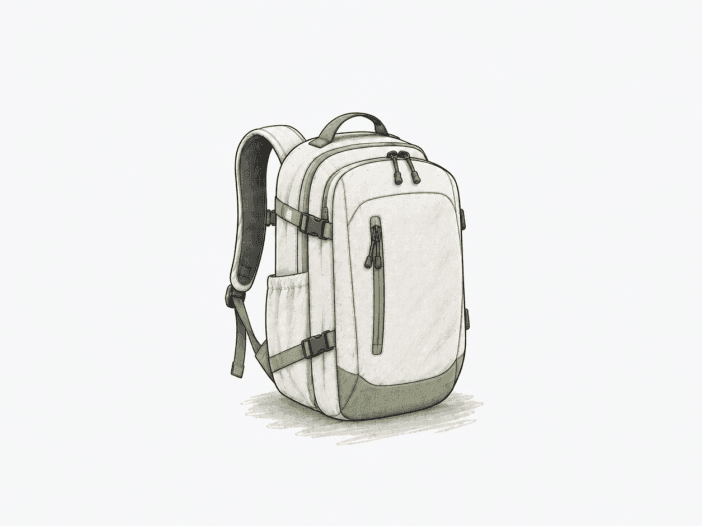
The Osprey Daylite Expandable Travel Pack functions as a lightweight personal-item and short-trip backpack built for open clamshell packing, not heavy structure. The 26 L base expands to 32 L, but this design sets firm limits on laptop protection, built-in organization, and the bag’s ability to compress for tight under-seat spaces.
This combination gives you a compact travel shape that can absorb overflow before you need a larger pack. The trade-off is managing the physical limits at the edges, rather than expecting one bag to cover every carry scenario.
The pack works best when your trip fits within 26–32 L, and you can manage the protection trade-offs.
Best for: personal-item and short-trip travel where light weight, suitcase-style access, and occasional expansion matter more than dense organization.
| Decision check | What matters |
|---|---|
| Under-seat fit | The firm back resists compression, so tighter seat geometry can eliminate spare foot room even when the bag fits. |
| Laptop protection | A 16-inch laptop can fit, but bottom cushioning and sleeve padding are not dependable enough to assume impact protection. |
| Organization | Clamshell access works well for clothing and grouped gear; small-item organization becomes constrained as the main compartment fills. |
| 26 L vs 32 L | Expansion adds 6 L and about 2 inches of depth, trading useful overflow capacity for noticeably more bulk. |
Main deal-breaker: the pack allows easier laptop fit than dependable laptop protection, and the firm back limits your ability to compress the bag when under-seat clearance is tight.
If your priority is outside this range, move to a more specialized work, long-trip, or active-daypack design instead of pushing the Daylite beyond its structural limits.

The firm back makes tight under-seat spaces the real limit.
The declared base dimensions are 17 x 13 x 6 inches, and the bag can work under an airline seat. On American Airlines, the pack fit with room for a foot beside it. On Frontier Airlines, it also fit under the seat as a personal item.
The structural limit shows up when clearance gets tighter. The firm back panel resists compression, so the bag cannot shrink to recover a missing inch of space. In a tighter seat, you can lose all spare foot room; even unexpanded, the pack has failed to fit fully under the seat on two flights.
Treat under-seat use as a condition to verify against your carrier’s rules and packed dimensions, not as a universal property. Tight aircraft geometry and a full load can move the Daylite outside the usable range quickly.
Laptop fit is easier than laptop protection.
A laptop can fit in the Daylite, but two separate limits apply: whether the device physically fits and whether the bag provides the required cushioning. If built-in protection is a requirement, both benchmarks must be met.
The bottom does not provide dependable impact cushioning.
A 16-inch laptop fits through the dedicated top access, but the bottom does not provide dependable cushioning under the device area.
Without that material beneath the laptop, setting a loaded bag on a hard surface leaves less padding to absorb contact. Careful placement or a separate protective sleeve becomes necessary to prevent impact.
Sleeve padding is not consistent enough to assume
Device-area padding varies by unit: some configurations provide substantial padding, while others are minimal enough that a MacBook requires an outer case for reliable protection. This variation means you need to inspect the exact unit rather than assume the sleeve provides the required protection.
The clamshell is excellent for large items; the organizer isn’t built for accessory-heavy loads.
The full-zip opening exposes the interior, and top access lets you reach inside without opening the bag flat. The smaller organizer and front pockets have limited independent space. As the main compartment fills, its load presses into these shallower pockets and reduces their usable capacity.
- Clothing and grouped gear: the open interior is easy to see and pack.
- Small accessories: narrow pen slots and the half-opening admin area provide limited flexible separation.
- Fully packed loads: shallow front and internal pockets lose usable space as the main compartment presses into them.
If you already use separate pouches for cables and small items, the trade-off remains manageable. If you rely on the bag for dense tech organization, the layout becomes the limiting factor before total volume is reached.
The 6 L expansion works best as overflow, not permanent extra capacity.
The 26 L base can take a surprisingly dense mixed load. A 16-inch laptop, full-size keyboard, Nintendo Switch, clothing, bottle, pouches, snacks, and other electronics fit together in the base configuration, showing how much mixed travel gear the compact body can absorb.
Opening the expansion adds about 2 inches of depth and 6 L of volume, taking the pack from 26 L to 32 L. That extra depth increases the bag’s bulk in crowded transit and makes it more noticeable on your body. The volume gain is real, but so is the extra space it takes up.
Use the expansion after compressing soft cargo. A compression clothing bag can tighten clothing and preserve more base volume, but it doesn’t create new capacity or solve rigid-item conflicts. If your normal load fits in 26 L, treat the 32 L state as overflow, not the default.
Bottle fit depends on diameter and how hard the main compartment is pushing outward.
The side pockets stretch, but they don’t behave like unlimited-volume sleeves. A 1 liter Nalgene was too wide for the pocket, while a 700 ml titanium bottle fit. That makes bottle diameter—not just stated volume—the practical fit variable.
The second constraint is internal. When the main compartment is overstuffed, its load presses into the side pocket and reduces the clearance for a bottle. A slimmer bottle has more margin, while a wide bottle can shift from snug to impractical as the bag fills. If you carry a wide bottle, your fit margin decreases as the main compartment fills.
The low empty weight helps, but full-load comfort still depends on strap fit.
At 1.85 lb empty, the Daylite starts light, and a dense mixed load can remain comfortable on the harness. This does not guarantee comfort with every heavy carry.
For Ryanair personal-item travel, the roomy capacity fits the airline, but the pack became heavy and uncomfortable during city walking between hotels when the shoulder straps sat awkwardly and felt under-padded. Load shape, carry duration, and body fit set the comfort limit more than empty weight alone.
Four to five months defines the known durability horizon.
At 4–5 months of repeated stuffing, overpacking, work carry, and weekend travel, the seams and zippers remained intact, and the pack still looked nearly new. After about four months of travel use, the fabric showed little visible wear, though the hand feel remained inexpensive. These are short-horizon benchmarks; durability beyond this period is not established.
Zipper behavior is unit-sensitive rather than uniformly good or bad.
Zipper performance varies enough that the exact unit matters more than any blanket durability claim.
- Clean state: after 4–5 months of repeated overpacking and travel use, the zipper remained trouble-free.
- Problem state: a binding zipper can repeatedly catch and become difficult to open or close smoothly.
If the zipper binds around the corners when new, treat that as something to resolve inside the return window rather than assuming it will become normal with use.
Light rain resistance does not make the pack waterproof.
The outer fabric resists light rain, but the zipper-heavy construction is not waterproof. For sustained rain, you need a rain cover, which adds the requirement to carry and manage a separate accessory.
The main compartment is easier to secure than the front pockets.
The main zipper accepts a small lock, and the computer-pocket zipper can secure to a loop. The front pockets are weaker security locations because their shallow single-zip openings offer less control over opening size and don’t provide the two-pull lock point of the main compartment.
- Computer access: the zipper can secure to a loop.
- Front-pocket valuables: shallow single-zip openings are the weaker security location.
What to check before buying
- Verify airline fit: compare your exact carrier and fare limits with the bag’s base packed dimensions.
- Inspect laptop protection: check bottom cushioning and sleeve padding on the exact unit before carrying a laptop without a sleeve.
- Verify bottle clearance: insert your intended bottle after packing the bag.
Buy it for light, flexible short-trip travel—not for maximum structure
Choose it if:
- A 26 L base with 6 L of occasional overflow covers your usual travel load.
- You prefer broad clamshell access and are comfortable organizing small items in pouches.
- You can verify airline fit and provide separate device protection when needed.
Skip it if:
- You need dependable padded-base laptop protection from the backpack itself.
- You want dense built-in organization for a tech-heavy load.
- You need a soft bag that can compress significantly when under-seat clearance gets tight.
See the Osprey Daylite Expandable Travel Pack on Amazon
Move to a more specialized bag when the Daylite’s middle ground is the wrong priority.
| If you need… | Look at… |
|---|---|
| More dedicated capacity for long trips | Aer Travel Pack 3 — shifts toward long-trip carry, with more weight and a more premium price position |
| A smaller bag mainly for work carry | Aer City Pack 2 — shifts toward compact work carry, while the Daylite keeps the stronger luggage-style clamshell role |
| A dedicated active-lifestyle daypack | Osprey Hikelite 18 — active-day use, but too long for the cited strict 40 x 30 x 20 cm under-seat limit |
