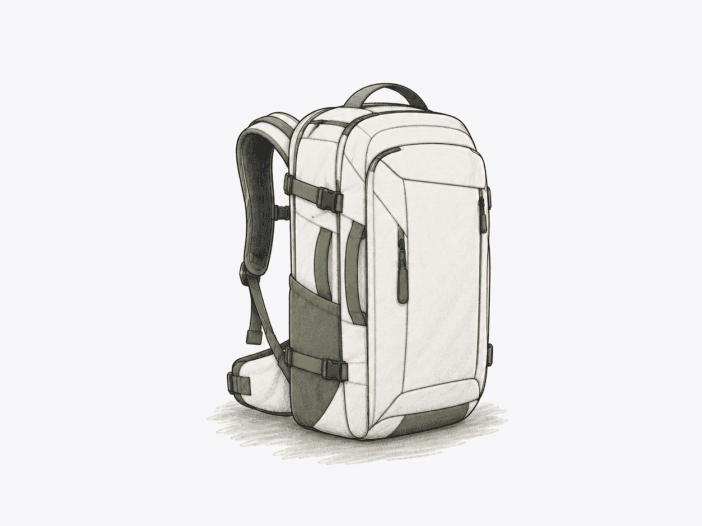
The Pacsafe EXP45 is a 45 L carry-on built for theft deterrence and open packing volume. The security hardware increases both access steps and starting weight. Your decision comes down to four physical boundaries: your laptop size, your willingness to use a multi-step lock sequence, how long you expect to carry a loaded pack, and whether your trip requires strict cabin-bag dimensions.
Security matters more here than instant access.
Best for: security-first air or international travel where you want 45 L of open packing space and are comfortable trading some access speed for theft deterrence.
| Decision check | What matters |
| Laptop fit | The outside pocket has limited expansion; exact chassis bulk matters more than a 16-inch label, and larger laptops can become a tight fit. |
| Security vs access | The multi-step locking system adds theft-deterrence friction but also slows routine compartment access; skip it if near-instant access is essential. |
| Loaded carry | The harness can remain comfortable under substantial travel loads, but shoulder pinch can emerge during long loaded walks. |
| Cabin fit | The 45 L pack is better treated as overhead-oriented; under-seat placement can leave it protruding, so exact airline and fare limits matter. |
Main deal-breaker: the outside laptop pocket can become tight with larger chassis, while the anti-theft controls can feel slow when you need fast compartment access.
If your priority differs: if your laptop needs more clearance or you want near-instant access throughout the day, start with a lower-friction bag design instead.

A 16-inch label does not guarantee laptop fit.
The outside laptop pocket does not expand. As your laptop chassis gets bulkier, clearance drops, so a device that matches the nominal screen size can still fit tightly. The real limit isn’t the 16-inch label, but the physical space your laptop takes up in a pocket with minimal stretch.
A 16-inch MacBook Pro fits within the declared range, and a larger 16-inch gaming laptop also fits. However, thicker or heavily built laptops can push the pocket to its limit. If your device is near the upper edge of the pocket, check the fit directly: you want closure without force, visible tension, or awkward removal.
The anti-theft system works by deliberately slowing access.
Secured access requires more than a single zipper pull. The lock sequence can include releasing the top buckle, operating the lock, freeing linked zipper hardware, separating the sliders, and unzipping.
Each added step increases the time it takes for someone to get inside, which is the core deterrence. These steps also become your routine every time you open the compartment; a tight latch or unfamiliar sequence adds friction for you, too.
- For quick grab-and-run protection: secure the compartments and strap so taking or rummaging through the bag takes more time and exposure.
- For a fully locked setup: add small combination locks for both compartments and the strap; they do not protect against prolonged unattended attack.
- For routine access: the system can remain workable once familiar, but if one-motion access is a priority, the EXP45 starts on the wrong side of the trade-off.
The harness handles travel weight, but long walks are the real stress test.
The harness supports airport transit, multi-destination travel, a 10-day load, and up to 25 lb carried over two weeks of train travel and touring. The real limit is not just weight, but how the shoulder strap feels during long walks. Walking duration and your shoulder contact point set the comfort boundary, not just the pack’s capacity.
- Good sign: your loaded pack stays comfortable for the amount of walking your trip actually requires.
- Warning sign: shoulder pinch appears during an extended loaded walk, even if the pack initially feels fine.
- Decision rule: if a realistic loaded walk reproduces that pressure, prioritize a carry system that fits your body better rather than assuming adjustment will solve it.
Overhead carry is the safer assumption than under-seat fit.
The EXP45 fits overhead compartments as a 45 L carry-on. Under a seat, the bag will fit but still protrude by a couple of inches. Physical insertion doesn’t mean full containment; the seat footprint is a hard limit, no matter how much the bag compresses.
Use the EXP45 as an overhead-oriented carry-on unless your exact trip says otherwise. Carrier and fare rules can change, so the final decision belongs to the current rule for your flight—not to a past successful trip or a generic carry-on claim.
Open packing space beats built-in subdivision.
The suitcase-style compartment prioritizes flexible volume instead of dense internal segmentation. It holds a week of tightly rolled clothing or a full 10-day travel load, and the internal layout keeps smaller gear visible. The trade-off is in the front pocket, where built-in subdivision is limited.
- If clothing is the main load: packing cubes can divide the open compartment into smaller zones without giving up the main volume.
- If front-pocket organization is the problem: packing cubes do not fix it; they add structure inside the main compartment, not more built-in front-pocket sections.
Camera compatibility and durability need narrower reading.
Three specific boundaries remain after you check core fit: whether your camera module matches a known-compatible size, whether the zipper hardware matches your EXP45 generation, and whether durability concerns the whole bag or a single component. Each sets a different purchase risk and should be considered separately, not as a single quality judgment.
Camera modules are only proven at known dimensions.
Peak Design Camera Cubes V1 fit the EXP45 in small, medium, and large sizes. A travel camera gear box also fits while leaving room for other carry-on items. If you need modular camera organization, these named cubes are the confirmed fit; other rigid inserts with different dimensions require a direct fit check.
Zipper hardware is sturdy, but the interface has a learning curve.
The zipper hardware is metal, sturdy, and interlocking. The interlocking tabs require a learning curve. Fabric and holder details change by EXP45 generation, so only compare zipper features within the same version.
- Version-specific limit: EXP45L Version 1 accepted stronger or thicker external locks; that does not transfer unrelated fabric or holder details across generations.
Long-term use does not eliminate the risk of component-level failure.
The locking zipper tabs and strap anchoring remained functional after more than 6 months of international travel and convention use, including anchoring the strap to a chair while dining.
A closely similar Pacsafe 45 L also remained durable through about 4 years of frequent air travel. Still, minor aesthetic differences keep that four-year lifespan from applying to the current EXP45 version. Neither duration predicts a universal lifespan.
A strap-lock mechanism broke after one trip and stayed locked, requiring pliers for release. The top seam near the handle tore during use, and crooked or asymmetrical seam construction required a return. These are component-level failures, not evidence of a common failure. The strap-lock failure occurred on a bag from an unauthorized seller, and warranty service was denied. Seller authorization is required before purchase.
What to check before buying
- Cabin rule: compare the declared 21.7 x 13 x 7.5 in dimensions with the current carry-on and under-seat rule for your exact airline and fare.
- Warranty eligibility: verify the seller and purchase channel against Pacsafe’s current warranty terms before buying.
- Laptop clearance: load your exact laptop into the outside pocket and confirm it closes without force, excess compression, or obvious tension.
- Seam construction: inspect seam alignment, stitching continuity, and the top seam around the carry handle on the physical unit.
- Version identity: confirm the exact EXP45 version before transferring version-specific fabric, holder, zipper, or long-use observations.
Choose the EXP45 when theft deterrence is worth the extra friction.
Choose it if:
- You want a security-first carry-on and accept a deliberate multi-step opening sequence.
- Your laptop setup clears the fit check above.
- A realistic loaded walk stays comfortable for the duration of your trips.
- Your trip clears the cabin-rule check above for the position you plan to use.
Skip it if:
- Your laptop pushes the outside pocket into a tight fit.
- You need near-instant access to the main compartments throughout the day.
- Long loaded walks produce shoulder pinch in your setup.
- Full under-seat containment is essential, and the packed bag does not meet that requirement.
See the Pacsafe EXP45 on Amazon
If you’re drawn to the EXP45 for its security-focused access, consider what you give up and what other large packs prioritize instead. Our Best Large Laptop Backpacks roundup puts those differences side by side.
