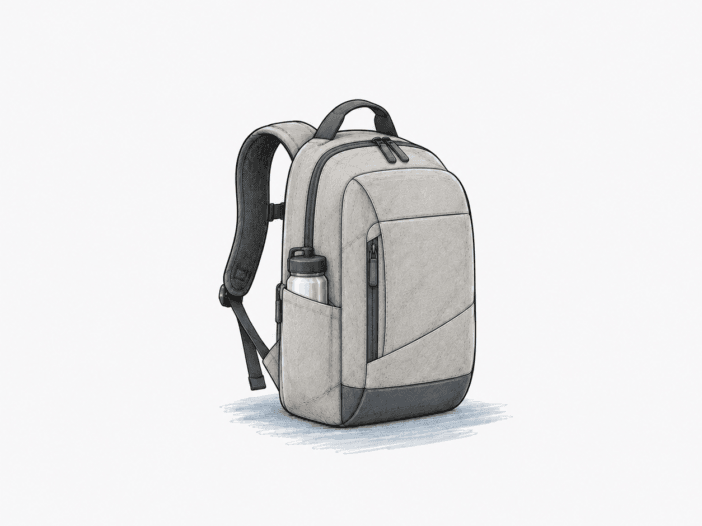
The Incase City Compact is built for days when your laptop is the main payload and everything else takes a secondary role. Its slim profile holds a full tech and document load without expanding into a deep commuter pack.
Still, that same geometry creates a narrow margin: bulky laptops, three-dimensional cargo, or shoulder straps that don’t match your frame can push the bag past its physical limits.
The narrow operating range is intentional. When you confirm your laptop fits, keep bulky items to a minimum, and the harness sits securely on your shoulders, the City Compact delivers a streamlined daily carry. If any of these physical conditions break, the trade-offs show up immediately.
The City Compact is strongest when your laptop and daily load stay predictable.
Best for: Laptop-first commuting with documents, chargers, smaller tech, and light layers rather than a mixed high-volume load.
| Decision check | What matters |
|---|---|
| Device fit | Chassis geometry matters more than screen diagonal; a laptop can fit the bag yet miss the dedicated padded compartment. |
| Packing range | Tech, documents and light layers suit the shallow format; bulky clothing, shoes, lunch or thick books can consume usable space quickly. |
| Carry fit | Wide, outward-angled straps can migrate on some shoulders, so loaded strap stability matters more than padding alone. |
| Component durability | Long service is possible, but zipper, strap, and mesh failures can also occur much earlier; durability is not predictable from age alone. |
Main deal-breaker: Laptop screen size alone doesn’t guarantee a dedicated-compartment fit, and near-limit chassis need an exact fit check before you rely on the bag’s padded laptop interface.
If you routinely combine a laptop with gym gear, lunch, bulky books, or other thick items, this compact format is the wrong starting point.

Laptop fit depends on chassis geometry, not the screen size.
Laptop fit is a two-stage decision. The chassis must enter the bag, then it must still use the dedicated padded interface without forcing.
Clean fit preserves usable clearance.
A Dell XPS 13 sits cleanly in the padded compartment, so insertion, closure, and removal don’t become a pressure problem. That clean seat shows the boundary in action: once clearance is tight enough to require force, whole-bag capacity no longer matches usable laptop-compartment fit.
Near-limit chassis can fit the bag but miss the sleeve boundary.
A 17-inch Lenovo with an extended battery can be forced into the backpack only with a very tight fit. Whole-bag entry therefore does not prove dedicated-sleeve fit, because the outer cavity can accept a chassis after the padded interface has already used up its usable clearance.
A Toshiba Satellite 5.6-inch fits in the backpack but not in the dedicated laptop pocket. That split is the clearest boundary: when the chassis moves into general storage, the bag still carries the computer but no longer provides its intended padded laptop interface.
Extra surface friction can consume already-small clearance near the sleeve limit. If your laptop must ride in the main compartment, a water-resistant laptop sleeve can restore some independent protection, but it also takes up interior space and adds no clearance. A bulky 15.6-inch-class chassis that will not seat cleanly belongs in a laptop backpack for bulky 15.6-inch laptops instead.
- 15-inch HP Envy x360: fits cleanly in the dedicated laptop compartment, preserving the intended padded interface.
The slim profile carries more than it looks like—until bulky categories collide.
The City Compact uses its shallow volume efficiently when your load stays flat or compressible. A Dell XPS 13, 20k power bank, wireless mouse, chargers, windbreaker, and over-ear headphones all fit with room to spare because these items stack without competing for depth. The geometry works when your gear shares compatible shapes.
The physical limit shows up when you add shoes, lunch, thick books, or clothing to the same compartment. A laptop plus gym shoes and clothing can fill the bag, and combining school and gym loads can exceed the compact format.
If bulky items are part of your daily carry, a larger laptop backpack gives each category its own volume instead of forcing everything to share the City Compact’s shallow space.
The shoulder straps can be comfortable or become the reason to return it.
Padding is not the main variable; strap geometry sets the limit. Wide straps that angle outward can shift laterally if they don’t match your shoulder shape, so even a well-padded harness may require constant adjustment as you walk.
At the same carried weight, the City Compact’s shoulder and back interface is less stable than a 2011 Incase Icon backpack if your shoulder geometry causes outward strap migration.
Other body types stay stable, so this isn’t a universal comfort issue. You need to check the fit with your actual load, not just by body height or padding thickness.
Durability can run for years, but the weak point is often a component.
Both long service and early failure are possible, so averaging them into a single expected lifespan does not reflect the real limits. The key benchmark is what the bag endured, which parts stayed intact, and which component failed first.
Heavy use can leave the main structure surprisingly intact.
A 13-inch Chromebook shared the bag for about 2 years with tools, food, picnic items, and repeated loads around 40 lb; the bag stayed functional until near the end of that period. A roughly 3-year bus, train, and walking commute also left almost no general wear, with only slight wear concentrated near the nylon strap adjuster under heavy loads.
Other long-duration states reached 6 years of daily use while still working and about 5 years in near-mint condition until abusive zipper handling prompted replacement. These endpoints show that long service is possible under different stress levels without turning any one duration into a forecast.
Zippers and strap attachments are the risk you cannot average away.
The shortest service intervals are clear: a front-pocket zipper can stop closing at 2 months, a shoulder-strap seam can fail at 3 months, a laptop-compartment zipper can come off track at 8 months, and a zipper failure can make the bag unusable at 18 months.
Zipper separation turns off a pouch even if the body fabric is intact, and strap or mesh attachment failures remove structural function at the connection point. If you rely on one bag daily and cannot afford zipper or strap downtime, this variability is a structural risk.
Bottle carry, rain, access, and cable storage add four smaller constraints.
These do not redefine the bag’s laptop-first purpose, but each can change the daily experience enough to matter. Missing exterior storage consumes interior volume, while limited zipper travel narrows access; rain resistance and small-item organization add separate limits.
- Bottle carry: larger bottles still borrow main-compartment space. If exterior separation is essential, choose a laptop backpack with an exterior bottle pocket.
- Heavy rain: sustained downpours can dampen the interior while the body-side laptop pocket stays dry; water resistance is not waterproofing.
- Deep-pocket access: narrow openings reduce sightlines and hand clearance, so loose items at the bottom are slower to retrieve.
- Cable-heavy organization: With cables, drives, small headphones, and a battery, Cocoon Slim holds small accessories in a built-in elastic grid while the City Compact’s organizer slots can run short. A Cocoon Grid-it adds independent retention without replacing the backpack.
Tablet carry works, but the internal layout isn’t consistent.
The buying decision separates physical tablet fit from a dedicated padded tablet interface.
Large tablets can fit alongside another device.
A 12.9-inch iPad Pro can fit the outer compartment while a notebook rides inside. The bag therefore has enough physical geometry for a large tablet-and-device combination in that arrangement.
Dedicated tablet padding depends on the configuration.
Dedicated iPad storage varies: some layouts include a padded tablet compartment, while others place the tablet in general storage. A tablet may still fit physically, but if padded separation matters, verify the pocket layout on the unit you are buying.
A DSLR pushes the bag beyond the job its padding and depth are built for
A Nikon D7000 paired with a 13-inch MacBook Pro is not a practical fit because the camera body adds depth to a bag optimized for flatter electronics. Once that bulky camera shape competes with the laptop, the slim profile stops behaving like efficient tech storage and starts becoming a clearance problem.
Protection creates a second boundary. Even if a DSLR fits physically, laptop-oriented padding isn’t shaped around a camera body and lens. If your camera is a primary payload rather than an occasional item, the right move is to change carry type rather than treat unused laptop-bag space as camera protection.
What to check before buying
- Confirm the tablet layout if dedicated separation matters. Make sure the current unit has the padded tablet interface you intend to use.
- Seat your exact laptop with its normal case. It should close and come out without excessive pressure in the dedicated compartment, especially near the sleeve’s clearance limit.
- Walk with your real load. Both shoulder straps should remain centered without repeated correction or hand support.
- Inspect the high-stress hardware early. Run each zipper and check pull/track alignment, strap seams, and mesh attachments for binding, separation, or damage.
- Check the current rain-resistance claim if heavy rain is routine. Add separate waterproof protection when your exposure requirement goes beyond ordinary water resistance.
Buy it for disciplined laptop carry, not for packing flexibility.
Choose it if:
- Your exact laptop fits the dedicated compartment cleanly, and your daily load is mostly tech, documents, and light layers.
- The loaded shoulder straps stay centered on your body rather than migrating outward.
- You value a compact silhouette enough to accept internal bottle carry, narrower access, and variable component durability.
Skip it if:
- A bulky laptop cannot use the dedicated sleeve without forcing it or has to ride in general storage.
- Gym gear, lunch, fuller books, and other thick cargo are normal, not occasional; a larger laptop backpack is the better format.
- A dedicated exterior bottle pocket is essential to your daily packing system.
- Early zipper, strap, or mesh failure would be unacceptable for a bag you depend on every day.
See the Incase City Compact on Amazon
When the core fit breaks, change the carry geometry
| If you need… | Look at… |
| A different carry fit because the City Compact’s straps sit wide or slip outward | Incase Icon Slim — the replacement choice when carry comfort becomes the deal-breaker |
If the City Compact feels right but you want to compare different ways to use the under-20L space, see our Best Small Laptop Backpacks roundup for other compact carry routes worth considering.
