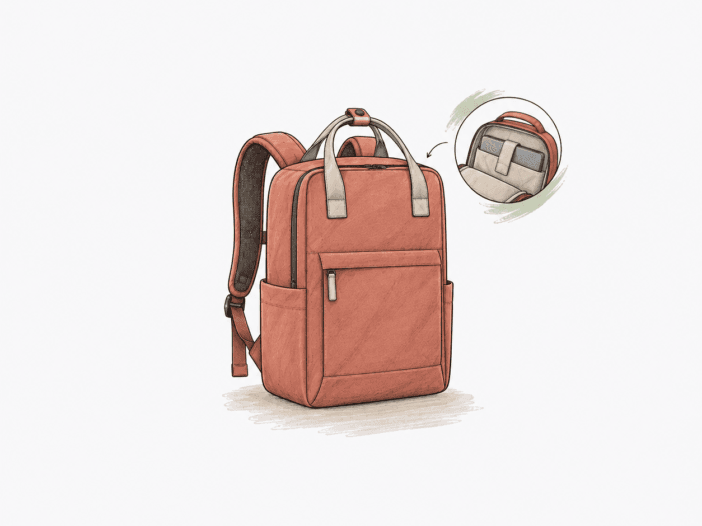
The Fjällräven Kånken Laptop 15″ is a compact 18 L backpack with a separate padded rear laptop compartment. The simple layout keeps the main cavity flexible, but your decision comes down to physical fit. Device size, bottle width, shoulder breadth, and load shape set the real limits, not just the product name.
This bag works when those physical limits already match your routine. If you need more laptop clearance, wide-bottle carry, deeper organization, or a harness that adapts to a broader frame, the structure will not provide it.
Best when your laptop fits the envelope—not just the screen label
Best for: compact campus or work carry when your exact laptop and any sleeve fit the rear compartment with comfortable zipper clearance.
| Decision check | What matters |
| Device fit | Rear compartment is 36 × 26 × 3 cm; a 15-inch or 15.6-inch label does not guarantee enough chassis, sleeve, and zipper clearance. |
| Usable capacity | The 18 L cavity suits compact school/work loads; bulky binders, lunch, or a laptop moved into the main compartment can exhaust usable space quickly. |
| Body fit | The compact harness favors narrower shoulders; broader frames can use most of the available strap adjustment and feel restrictive. |
| Bottle carry | A 16 oz Contigo and 24 oz Owala can fit with effort, while a wider 32 oz bottle can fall outside the practical side-pocket range. |
| Weather exposure | The shell is water resistant, not waterproof; sustained or heavy rain can reach contents, so routine wet-weather laptop carry needs separate protection. |
Main deal-breaker: a nominal 15-inch or 15.6-inch laptop can still become a tight or failed fit because the compartment is physically limited to 36 × 26 × 3 cm.
If your laptop or sleeve already pushes close to the 15-inch compartment limit, choose a larger configuration to avoid a forced fit.

The 15-inch badge hides a three-dimensional fit problem.
The laptop decision is really about clearance, not diagonal screen size. Two devices can share a 15-inch label and still occupy very different amounts of the fixed rear compartment.
The 36 × 26 × 3 cm envelope sets the hard boundary.
The rear compartment has a fixed 36 × 26 × 3 cm envelope. Height, width, and thickness must work together, so a device that fits one dimension comfortably can still fall short in another. A MacBook Pro Retina fits within that range, with room for a magazine, showing how a slimmer chassis can leave useful clearance around the device.
That same geometry explains why nominal size is a poor shortcut. A longer or thicker chassis consumes the free space needed to seat the laptop fully against the compartment and still zip it around without force. Once that margin disappears, the 15-inch label stops being a useful compatibility guarantee.
A sleeve can turn marginal clearance into a tight zipper.
A thicker laptop chassis can make the compartment a tight fit, requiring extra force to close the zipper. Adding a sleeve to a device already near the compartment’s physical limit further reduces clearance, since the sleeve increases the overall dimensions the compartment must accommodate.
Some 15- and 15.6-inch laptops exceed the compartment’s physical limits and do not fit the dedicated space. Moving the device into the main cavity keeps it in the bag, but uses up cargo space instead of solving the rear-compartment fit constraint.
| Device state | What the compartment does |
| MacBook Pro Retina | Fits with room for a magazine. |
| 15-inch MacBook | Fits cleanly in the dedicated compartment. |
| 15-inch MacBook Pro | Can become a tight fit with little zipper margin. |
The 18 L cavity rewards dense loads, not bulky ones
The boxy 18 L main cavity holds compact books, notebooks, folders, and other dense items efficiently. Rigid pieces like lunch containers or binders fill the fixed volume quickly, so the liter figure doesn’t guarantee space for bulkier items. A compact workload fits, but a planner-and-accessories load can leave no room for lunch, and binder-heavy packing can exceed the cavity’s limit.
Wide bottles push the side pockets out of their comfort zone.
The side pockets are sized for narrow bottles, with limited lateral stretch at the opening. A 16 oz Contigo and a 24 oz Owala fit, but both require effort to insert. As bottle width increases, the pocket’s stretch runs out. If you depend on carrying a wide reusable bottle outside, the pocket may not accommodate it, and you may need to move the bottle inside.
If a reusable bottle doesn’t fit the side pocket, your only option is to use the main compartment. This keeps the bottle with the bag, but uses up interior volume that the 18 L pack cannot recover. Outside hydration fit directly reduces available cargo space.
The compact harness favors narrower shoulders.
The compact shoulder-strap stance fits smaller frames, but shoulder breadth uses up lateral room and strap adjustment. As you pull the harness wider, less strap length remains for adjustment. On broad shoulders, the bag can become physically restrictive even if the load fits. If you already use compact-pack straps near their maximum extension, treat body fit as a separate check from capacity.
Padding helps, but contact pressure still decides comfort.
Foam-padded straps distribute shoulder pressure and can stay comfortable for daily work, school, and long travel loads. Padding does not eliminate every pressure point. Under heavier loads, the upper handle attachment can press into the shoulder area, and a poor match between body and load can shift the bag from comfortable two-strap carry to a setup that only works by loosening or adjusting how it sits. Comfort depends on load, body geometry, and contact points together, not just padding.
The rear zipper can become the functional failure point.
The laptop compartment only works as long as its zipper opens and closes reliably. Some zippers are stiff or catch, but one early-failure case involved the rear zipper breaking within three months after only a few uses, leaving the compartment unusable. This failure mode is not a frequency estimate, but any binding or early zipper trouble is a defect worth returning, not a minor nuisance.
Multi-year use is possible, but that doesn’t create a lifespan promise.
The bag can remain structurally functional across different use periods. At 6 months, no tears or zipper malfunctions appeared. At 1 year, continued use was possible. Separate 3-year use points remained intact, and a couple of years of everyday carry ended with the bag still usable.
These checkpoints show durability potential, but do not guarantee a continuous lifecycle or predict how long another unit will last. Surface dirt or color fade can appear while function remains intact, and isolated hardware failures can still occur much earlier.
Water resistance helps with moisture, not sustained rain.
Vinylon F is water resistant, not a sealed waterproof barrier. Incidental moisture stays out, but longer or heavier exposure can let water in through fabric interfaces and openings. In heavy rain, contents at the top and bottom can become wet even with an umbrella. A laptop carried through routine downpours needs separate rain protection, not just the shell.
Open packing comes at the cost of shallow built-in organization.
The simple layout with a main compartment, internal zip pocket, front zip pocket, and two side pockets preserves a large open cavity instead of dividing the 18 L volume into small zones. This works for minimalist packing, but a full main compartment can round the front panel outward and reduce front-pocket clearance. With many small accessories, the bag favors pouches over built-in admin storage.
- Main cavity: prioritizes open packing space over fixed dividers.
- Front pocket: loses practical clearance as the packed main body rounds outward.
What to check before buying
- Measure the laptop with its sleeve installed. Compare height, width, and thickness with the 36 × 26 × 3 cm rear-compartment envelope.
- Test your reusable bottle. Use a normally loaded side pocket if you need to carry water outside the bag.
Choose it only when compactness matters more than spare clearance.
Choose it if:
- your exact laptop and sleeve leave comfortable rear-compartment zipper clearance;
- an 18 L open cavity matches your normal school or work load;
- the compact harness suits your shoulder width;
- narrow-bottle carry and water resistance are enough for your routine.
Skip it if:
- your laptop is thick, sleeved, or already close to the compartment limit;
- broad shoulders make compact harnesses restrictive;
- you depend on a wide reusable bottle staying outside the main cavity;
- sustained heavy-rain protection is a requirement.
See the Fjällräven Kånken Laptop 15“ on Amazon
If it’s not the right fit
| If you need… | Look at… |
| More clearance for a 15- or 15.6-inch laptop, especially with a sleeve or thicker chassis | 17-inch Kånken — adds laptop-compartment clearance; the exact laptop and sleeve dimensions still need to fit the larger compartment. |
If you like a small backpack but are not sure open packing fits your daily load, compare the Kånken with other small laptop backpacks that offer more structured tech storage, lighter carry, travel features, or added security.
