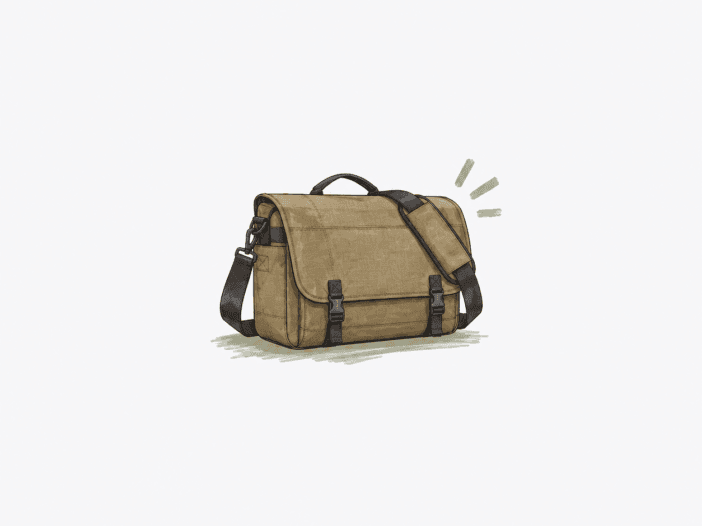
The Carhartt Ripstop Messenger works as a flexible work bag for paperwork, notebooks, a laptop that physically fits, and other flat gear. The 600-denier polyester and Rain Defender treatment provide everyday utility. Still, the soft structure, open-flap design, and configuration-dependent laptop area set a clear boundary: this bag does not function as a protective computer case.
Best when your workload stays flat, and your laptop fits cleanly
Best for: mobile work carry when your load remains flat enough for both buckles to close, the strap hardware stays stable, and your specific laptop enters and exits the sleeve without force.
| Decision check | |
| Loadout closure | Flat work loads suit the bag best; bulky cargo can consume enough depth that both flap buckles no longer close securely. |
| Device fit | The 17-inch sleeve claim is not a fit guarantee; 15.6-inch fit can range from clean to forced, while a 17-inch laptop can sit at the clearance limit. |
| Protection boundary | Laptop fit does not guarantee protection; some configurations have little padding, bottom support, or structural rigidity. |
| Shoulder carry | Under load, the strap hardware can rotate or bunch, while the sewn-in strap removes the simple replacement path if it becomes the weak point. |
| Containment | The buckle flap leaves side openings, so loose accessories can escape when the bag is tipped or laid sideways during travel. |
Main deal-breaker: the stated 17-inch sleeve does not guarantee your laptop will clear the opening or fit without force, and the laptop area may be too soft or lightly padded to protect your device during transport.
If you need a fully sealed main compartment for loose electronics or a more protective laptop carry system, this bag won’t meet that requirement.

Flat workloads fit until bulky cargo steals buckle reach
The bag holds flat, layered work gear most efficiently. As bulky cargo stacks outward, it uses up the available depth under the flap, reducing the flap’s reach to the two buckle anchors. Secure closure becomes the practical capacity limit before the main compartment reaches its full volume.
- Inside the working range: a laptop, charger, leather portfolio, and 3 RS Means books fit together; a laptop with 2 five-subject notebooks and a portfolio also fit.
- At the strain point: a computer plus a lunch bag left enough flap reach for only 1 side buckle to close.
- Past the limit: 4 textbooks, a spiral binder, dance shoes, a water bottle, and a pen-and-pencil bag did not fit.
A laptop can fit and still be poorly protected.
Laptop suitability depends on three separate physical limits: sleeve clearance, protective structure, and the available space for a second device such as a tablet. Each of these can reach its limit independently, so passing one does not guarantee the others.
Screen size is a weak proxy for sleeve clearance.
The limiting factor is the physical size of the laptop chassis, not the screen-size label. As width and thickness use up the sleeve opening and internal space, insertion becomes tighter even if the nominal size matches the declared 17-inch sleeve.
- 15-inch: a laptop fit with spare room for a few small items, and another 15-inch load left room for lunch.
- 15.6-inch: outcomes split between a clean fit and a slim laptop that required force to enter.
- 17-inch: a laptop barely fit, putting this size at the edge of usable clearance.
- Gaming laptop: the device did not fit the interior laptop pocket.
Padding and structure are separate from fit.
A device that fits into the sleeve can still lack protection. Some configurations provide enough laptop-area padding, while others have minimal cushioning, little bottom support, and a flexible shell. With less material and structure isolating the device, movement or contact around the bag reaches the laptop with less buffering, especially during field or vehicle transport.
The soft body depends on its contents for shape. A laptop or notebook can brace the sidewalls, but with little rigid material inside, the bag can fold flat or collapse, making loading and positioning more difficult.
Tablet clearance can disappear before laptop space does
A protective case uses up tablet-pocket clearance just as a thick laptop chassis uses up sleeve clearance. When the combined device and case thickness reaches the slot limit, the pocket is no longer a practical dedicated space, even if the rest of the bag still has capacity.
A Samsung S9 did not fit the intended tablet space. That puts large tablets and rugged cases outside the safe assumption range: the tablet pocket can still be too small for your device.
The flap is convenient, but it is not a sealed barrier.
The open construction sets three boundaries: whether loose items stay inside when the bag changes orientation, how rain reaches the load, and what happens if liquid leaks inside the main compartment. All three depend on where the bag provides a physical barrier for contents and water, and where it does not.
Side gaps let loose items migrate when the bag tips.
The flap closes over the top with two side-release buckles, not a full perimeter zipper. Side gaps let gravity move loose contents toward the opening when you tip the bag. Hard drives and other accessories can fall out if you lay the bag on its side for airplane under-seat stowage. Loose-item travel works better when those items are already inside closed pouches.
Rain Defender protects the fabric, not the opening.
Rain Defender makes water bead and roll off the 600-denier polyester so the bag stays dry in ordinary rain. However, the surface treatment does not close the physical gaps around the flap. Fabric-level repellency does not equal sealed weather protection for electronics.
Damp-cloth cleaning avoids the machine-wash condition that can compromise Rain Defender. A gentle machine wash can leave the exterior cosmetically usable after air drying, but the water-repellent treatment’s condition remains uncertain.
An internal bottle leak has nowhere to drain.
A leaking bottle creates the opposite water path: liquid starts inside the bag. With no bottom drainage hole, liquid has no direct escape and can pool around electronics. If a water bottle leaks beside a laptop, trapped liquid can flood the bag and damage the laptop inside.
Shoulder carry works only while the hardware stays controlled.
Shoulder carry depends on three separate constraints: whether the strap hardware stays stable under load, whether the received strap is comfortable for your carry duration, and whether you can replace it easily if the strap becomes the weak point. Stability, comfort, and repairability are separate physical limits, even though they all converge at the same shoulder strap.
Load can rotate the clip and bunch the webbing.
With both clasps fastened, the bag stays balanced on the shoulder. Under load, the clip can rotate upright, and the webbing can bunch at the plastic attachment loop. If you leave the bag unfastened, the soft body can open and shift. The practical limit is a loaded carry state where the hardware stays flat, and the strap angle remains stable as you move.
- Works: both clasps are fastened, and the loaded hardware stays flat and balanced.
- Strains: the clip rotates upright or the webbing bunches at the attachment loop.
- Stops: the strap tangles against the plastic hardware or the bag shifts enough to make normal shoulder carry unstable.
Comfort depends on the strap padding you actually receive
Loaded shoulder carry can be comfortable, but unpadded configurations can become uncomfortable enough to require extra padding. Because shoulder-pad presence is not consistent across all units, comfort depends on the physical strap you receive, not just the product name.
The sewn-in strap removes the easy replacement path.
The shoulder strap is sewn into the bag and isn’t designed for a standard clip-off exchange. If the strap no longer meets your comfort or durability needs, replacing it requires modifying the attachment rather than swapping in another detachable strap.
Organization can change from useful separation to loose-item clutter.
Organization works when dividers and pockets match your load, but sparse layouts leave more of the main compartment as shared volume. When small items lose dedicated separation, they move around inside the bag and become harder to retrieve. Pocket layout matters as much as raw capacity for cables, tools, pens, and other work accessories.
- More organized states: dividers, Velcro retention, and useful pocket sizes can separate papers, books, computer gear, or contractor items.
- Sparse states: fewer internal pockets let small items flop around, making retrieval less predictable.
- Missing states: expected storage pockets may be absent, so don’t assume compartmentalization from the product name alone.
The quick-access pocket has a real size ceiling.
A front pocket is convenient only as long as your item clears both the opening and the usable internal volume. As a phone gets wider or thicker, that margin disappears. The pocket remains, but the object no longer fits the access geometry it was designed for.
One small under-flap pocket fit an iPhone 5, but newer, larger phones did not. That exact fit sets a practical boundary: phone-pocket compatibility depends on device dimensions, not just the presence of a front pocket.
The bag body has intact checkpoints, but the strap attachment can fail early.
The bag body has several intact use checkpoints under specific conditions. After 6 months of mill-shift carry with small hand tools and daily essentials, the bag had no tears or damage; school-bag use reached almost 1 year with the bag still functional; and the plastic buckles remained functional after nearly 2 years. Those durations apply only to those loads and environments; they should not be read as a general service-duration forecast.
The strap attachment is the more critical wear point. After 1 month, webbing can bunch at the attachment loop and create uneven stress. Under 4 days of school use, the carry strap can begin to rip out. For demanding daily carry, the sewn attachment requires more scrutiny than the fabric body, since a failure there compromises the primary carry mode.
What to check before buying
- Trial-fit your exact laptop. It should enter and leave the sleeve without force, with enough clearance for normal loading and removal.
- Inspect the padding and bottom support in the laptop area. Make sure the unit you receive has enough cushioning and structure for your transport environment.
- Confirm the exact organizer and shoulder-pad layout. Check the under-flap pockets, pen storage, front-pocket count, and strap padding you actually receive.
- Use current Carhartt care guidance before machine washing. If preserving Rain Defender matters, follow Carhartt’s current care method rather than assuming cosmetic recovery means the treatment survived.
Choose it for flexible work carry, not sealed or protective transport.
Choose it if:
- Your normal load stays flat enough for both flap buckles to close securely.
- Your laptop slides into the sleeve without force, and the included padding suits your transport environment.
- The loaded shoulder hardware stays flat and stable with both clasps fastened.
- Loose items are already contained, so you don’t need the main compartment to seal fully.
Skip it if:
- Bulky cargo routinely prevents secure two-buckle closure or exceeds the practical depth limit.
- Your laptop is tight, forced, or outside the sleeve, or you need more protective structure than the unit you received provides.
- The strap hardware rotates, bunches, or tangles, or you need a shoulder strap you can replace without modifying the bag.
- Loose accessories must stay enclosed when the bag is tipped, laid sideways, or stowed during travel.
Check the Carhartt Ripstop Messenger on Amazon
For a broader look at rugged, professional, compact, and commute-focused alternatives, visit our Laptop Messenger Bags comparison.
