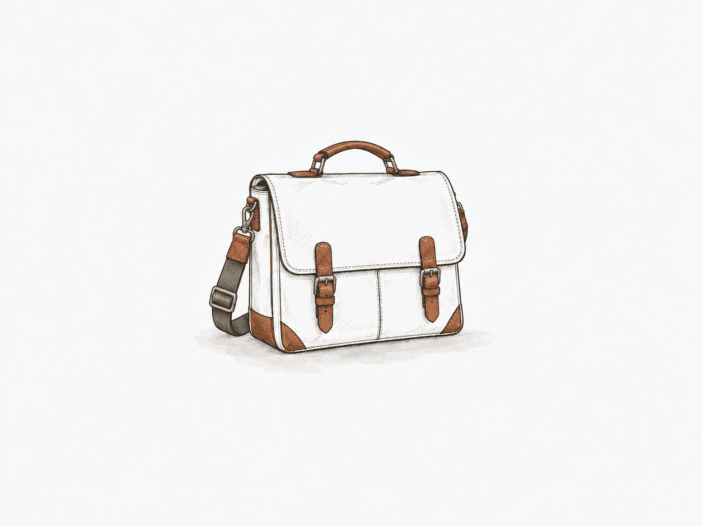
The Samsonite Colombian Leather Flap-Over is a structured leather office satchel defined by four physical interfaces: total packed thickness, full zipper clearance around your specific laptop, the flap-and-clasp access sequence, and the exact back-panel trolley interface.
The bag performs best when your daily carry matches these boundaries—a conventional laptop-and-document load, not a bulky or frequently accessed setup.
A strong office fit when the load stays flat, and access stays deliberate.
Best for: A relatively flat office kit built around a laptop, documents, charger, and small accessories, with most main-compartment access happening while stationary.
| Decision check | What matters |
| Packing depth | The fixed 4.3-inch depth suits relatively flat office loads; bulky additions can cause bulging or force routine items out. |
| Laptop fit | Near the declared 15.6-inch range, insertion alone is not enough—verify that the zipper closes fully around the exact chassis. |
| On-the-go access | The flap-and-clasp sequence works best for occasional or stationary access; frequent retrieval while moving adds friction. |
| Trolley compatibility | SmartSleeve behavior varies by back-panel configuration; verify that the exact bag has a usable pass-through if roller attachment is essential. |
Main deal-breaker: A laptop or packed load can physically enter the bag yet still cross the point where the case no longer closes cleanly.
If your priority differs: Start from usable depth or a more direct opening path if bulky carry or rapid repeated access is routine.

Fixed depth rewards flat office gear and punishes bulky additions.
The case provides a fixed 4.3-inch depth. Every thick item you add reduces space for the rest of your load and limits how well the case closes and holds its shape.
A 15.6-inch laptop with an extended battery, charger, a 3/4-inch portfolio, mouse, pens, and small accessories will fit within this boundary. Adding a couple of paperback books pushes the total thickness past the structural limit, causing visible bulging and loss of normal closure.
Total packed thickness is the real constraint, not the number of items. If your regular work kit closes without bulging, you are within the bag’s practical range. If you need to remove routine items to restore closure, the fixed-depth structure has already reached its limit.
- Relatively flat office kit: stays within the case’s intended working pattern when it closes normally.
- Thicker books or bulky additions: consume the same fixed depth and can push the shell outward.
- Routine items must be removed: treat that as a capacity mismatch rather than spare room waiting to be found.
Laptop fit ends where zipper clearance disappears.
At the upper size limit, screen size is only a rough guide. A larger laptop chassis can use up the clearance needed for the zipper to close. The soft-sided compartment may let you insert a laptop, but without enough perimeter clearance, you will not achieve a secure closure.
A Sony VAIO Fit 15 with a 15.5-inch chassis fits, showing that a chassis near the declared 15.6-inch range can remain inside the working boundary. Fit still depends on the chassis, not the screen label alone.
A 17-inch MacBook exceeds the structural boundary. You can insert it into the padded laptop area, but the fit is too tight for the zipper to close fully. For laptops near the size limit, the real compatibility test is whether the zipper closes securely, not just whether the device fits inside.
| Exact laptop setup | Physical outcome |
| 13-inch MacBook Pro | Fits in the main pocket. |
| Lenovo T530, 15.6-inch with extended battery | Fits the case. |
| 17-inch MacBook | Enters tightly, but the zipper will not fully close. |
The flap is easy at a desk but slower to access repeatedly on the move.
The flap and clasp sit in front of the main zippered storage, so you need to open them before you can reach the main compartment. If you access the bag mostly while stationary, this extra step stays manageable. If you need to retrieve items repeatedly while standing or moving, the same sequence becomes a recurring friction point. The clasp can be tricky, and the front pocket only opens partway, so quick access is limited.
- Mostly stationary access: the flap-and-clasp sequence is a reasonable trade-off for the format.
- Fast repeated access while moving: the same sequence becomes a persistent friction point.
- Front-pocket shortcuts: may help with small items, but the pocket opening itself can be constrained.
Long service is possible, but hardware can become the weak link.
Durability depends on two physical limits: how long the main structure remains usable under a given workload, and whether smaller load-bearing or closure hardware can fail sooner. Good leather condition does not guarantee the same lifespan for clips, rings, or clasps.
Long-term condition depends on the workload.
The flap leather can remain intact after 1 year, developing an aged appearance. The leather, strap, handle, buckles, and clips can remain structurally sound after 4 months of constant use.
The bag can withstand packed public-transit commuting five days a week for 9 years without structural failure. These durations are benchmarks under different workloads and do not combine into a single guaranteed service life.
Clips and clasp parts can fail much earlier.
Small hardware can fail much sooner than the leather body. A small ring attached to a clip can fail after 5 months, and a metallic clip can fail after 2 months.
In another case, a clasp pivot pin can break out of one end, letting the spring shift and block normal release. These points make the hardware itself a structural checkpoint, even if the leather remains serviceable.
Verify SmartSleeve on the exact back panel.
SmartSleeve is listed for this product, but the back-panel interface depends on the exact configuration. Some versions lack a slider sleeve, and others have a rear pocket that does not open far enough to accept a luggage handle.
The reason for this back-panel difference is not specified. If you require secure trolley attachment, use the exact back-panel geometry as your deciding factor instead of relying on the product name.
What to check before buying
- Pack your normal combined workload: confirm the case closes normally without pronounced bulging or removing routine items.
- Load your exact laptop and normal accessories: confirm the intended compartment zipper closes fully without forced tension.
- Inspect the exact back panel: confirm an open-through sleeve is present and actually accepts your roller handle.
Choose it for structured office carry, not maximum flexibility
Choose it if:
- Your normal workload stays relatively flat, and the case closes cleanly.
- Your exact laptop closes fully inside the intended compartment.
- You access the main compartment only occasionally or when stationary.
Skip it if:
- Your laptop can enter but prevents the zipper from closing fully.
- Bulky additions routinely make the case bulge or force normal items out.
- You need fast, repeated access while standing or moving.
- A secure trolley attachment is mandatory, and the back panel lacks a usable pass-through.
See the Samsonite Colombian Leather Flap-Over on Amazon
Want to see how this structured leather option compares with lighter, more flexible alternatives? Explore our Best Laptop Messenger Bags.
