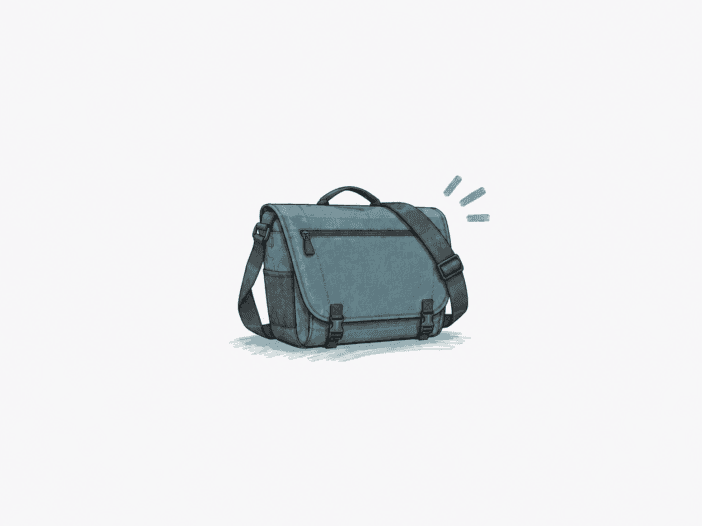
The Osprey Daylite Messenger is a 12 L messenger built for compact, everyday carry of a laptop, tablet, and essentials. Your buying decision hinges on three factors more than the headline volume: how the tapered body handles bulk, whether the exact laptop fits correctly, and whether the single-strap carry stays stable under a real load.
Choose the Daylite when compactness matters more than forgiving capacity.
Best for: Carrying a laptop or tablet, papers, lunch, a light layer, and small tech in a compact messenger format for commuting, study, or mobile work.
| Decision check | What matters |
| Usable 12 L capacity | The tapered body suits a disciplined laptop/tablet-and-essentials load; bulky items consume usable space faster than the 12 L figure suggests. |
| Laptop fit | Screen size alone does not predict compatibility; the exact chassis must seat fully in the sleeve without force, protrusion, or closure interference. |
| Carry stability | Balanced crossbody loads are the safer match; shoulder-only or asymmetric loads can cause strap slip, twisting, forward pull, or pressure. |
| Bottle compatibility | A 20 oz bottle can fit securely, a 32 oz bottle may feel insecure, and the tested 40 oz Nalgene does not fit the exterior holder. |
Main deal-breaker: Bulky loads, laptops near the fit boundary, or an unstable shoulder-only carry can turn the slim shape from a benefit into a structural limit.
If your priority differs: Choose a more forgiving carry format when you need routine carry-all volume, a confirmed fit for a borderline laptop, or a more stable shoulder system.

The tapered 12 L body rewards an essentials-first load.
The 12 L body works best when the load is compact and shape-efficient. The lower body narrows, so bulky objects occupy usable space faster than the nominal volume suggests; soft exterior pockets can also push into the interior, and a bulky front-pocket item can interfere with full flap closure.
The result is a bag that can carry a useful daily kit without inviting the overpacking of a larger messenger. If your daily kit depends on bulky clothing or carry-all space, this geometry makes the Daylite the wrong capacity class.
- A laptop or tablet, papers, lunch, a light layer, and small tech remain within the practical working range of the 12 L structure.
- A Switch 2 fits alongside additional items, keeping that handheld setup within the compact-load boundary.
- Clothing-heavy or carry-all loads can exceed the practical interior before you reach the full nominal volume.
Strap comfort depends on balance, not padding alone.
The padded strap can remain comfortable with a balanced moderate load, but the geometry is less forgiving when the bag is worn shoulder-only or loaded asymmetrically. The pad is fixed rather than independently movable; the strap is sewn to the bag and can transmit twist into the webbing, and bottle mass on one side can pull the messenger forward while walking.
- Balanced carry maintains comfort, including with some fully loaded configurations.
- Shoulder-only carry can slip if the pad lacks sufficient grip or does not align with the shoulder.
- An off-center bottle increases forward pull and can require repeated repositioning.
- Persistent neck pressure, strap twist, or instability with the normal load signals a structural stop condition, not an adjustment issue.
Laptop fit is controlled by chassis geometry, not the screen-size label
Nominal screen size does not determine fit; the sleeve and tapered lower body set the boundary based on the laptop’s actual chassis dimensions. A 15-inch MacBook Pro reaches the physical insertion limit and requires force to enter the pouch, while a 13-inch MacBook Air moves in and out with full clearance. Two devices with different chassis sizes can both enter the bag, but only one meets the intended seating margin.
A clean fit also leaves meaningful room for the rest of the load. With a 14-inch Dell work tablet, 13-inch iPad Pro, work folders, and Apple chargers loaded together, the tablet, iPad Pro, and folders fit in the laptop sleeve while the Apple chargers remain in the main compartment. The useful boundary is therefore full seating with usable clearance, not whether a device can merely be pushed through the opening.
Near the fit boundary, this distinction is decisive: if a laptop requires force, protrudes, or cannot reach the bottom of the sleeve, it fails the intended fit. Physical insertion alone doesn’t confirm compatibility; reject a marginal fit unless it seats exactly.
| Exact device | Physical outcome |
| 16-inch M1 MacBook | Fits with room for a notepad and charging cable. |
| 14-inch MacBook Pro | Fits with a cased Steam Deck, headphones and accessories. |
| 15-inch MacBook Air | Fits inside the bag. |
| 16-inch MacBook Pro | Can fit with no room to spare in a tighter setup. |
Larger bottles expose the limits of the stretch pocket.
The bottle pocket stretches enough that insertion alone can give a false sense of compatibility. As bottle diameter or height increases, the pocket can accept the container while leaving too little depth or lateral retention; the extra mass above the pocket edge then has more leverage as the bag moves.
A 32 oz Iron Flask fits in the stretch pocket but lacks secure retention due to its size. A 40 oz Nalgene exceeds the pocket boundary and doesn’t fit the exterior holder, so you must store it in the main compartment. For bottles in the 32–40 oz range or taller, walking retention matters more than stationary insertion.
| Bottle | Pocket outcome |
| 20 oz Stanley thermos | Fits without falling out. |
| 32 oz Iron Flask | Fits, but retention feels insecure. |
| 750 ml SuperSparrow bottle | Fits shallow enough to strike door frames. |
| 40 oz Nalgene bottle | Does not fit the exterior holder. |
The flap trades fastest access for a simpler main opening.
The flap is the primary retention layer over the main compartment, and it also overlaps the front pocket. That architecture keeps the layout simple, but it adds a step before front-pocket access, while the semi-recessed buckles reduce finger clearance for one-handed opening. Because there is no second full-width zipper beneath the flap, a heavily filled main compartment also has less containment if the bag is inverted.
- Zippered front and side pockets secure smaller items separately.
- Front-pocket access requires opening the flap first.
- Semi-recessed buckles can be awkward to operate one-handed.
- If the main compartment is fully packed, inverting the bag can allow contents to escape because there is no secondary closure beneath the flap.
Laptop protection is adequate for commuting, not hard-impact duty.
The laptop area uses a padded sleeve and a firmer back panel, with the sleeve suspended above the bag floor. This spacing reduces direct bottom contact, and the firmer back supports the device, but the surrounding body is flexible and lightly padded. A cleanly seated laptop receives standard commuting protection, not a rigid, drop-focused enclosure.
- Fully seated devices benefit most from the suspended sleeve position.
- Padding outside the laptop area remains comparatively light.
- Buyers prioritizing high-impact protection need more than the bag alone provides.
Durability checkpoints are encouraging but don’t define a lifespan.
The bag maintains structural integrity after several years of daily use, 1 year of consistent outings, 35 days of continuous European rail travel, and 2 months of daily hiking with frequent overloading. These durability checkpoints cover varied loads and exposures, but they don’t define a specific service life.
Flight use works when physical clearance and packing needs align.
The compact exterior allows the packed Daylite Messenger to fit under a seat or in overhead storage, and one packed configuration meets the personal-item sizer dimensions for Porter, Flair, and WestJet. These are physical-clearance benchmarks for those setups, not a guarantee for all airlines or fares. For flight use, treat these sizer results as clearance examples, not as a rule for your itinerary.
Internal capacity is a separate constraint. The tapered 12 L body can clear a sizer but still be too small for a clothing-heavy personal-item load, and carrier rules can change independently of the bag. Flight suitability requires both sufficient interior room for the trip and a current rule check for the exact itinerary.
What to check before buying
- Pack the complete daily load. Confirm the flap closes normally and the required exterior pockets remain usable.
- Seat the exact laptop. Confirm it reaches the intended sleeve position without force, protrusion, or interference with closure.
- Walk with the normal load. Try shoulder-only and crossbody carry and check slip, twist, pad position, neck pressure, and forward pull.
- Walk with the exact bottle. Check pocket depth, lateral retention, and bag balance, not just insertion.
- Check the current airline rule. Compare the fully packed bag with the allowance for the exact carrier and fare.
Buy it for disciplined compact carry; skip it when any core fit is marginal.
Choose it if:
- Your normal load is a compact laptop or tablet setup with limited bulky items.
- Your exact laptop seats fully in the sleeve with usable clearance.
- The normal load remains stable and comfortable in your preferred carry mode.
Skip it if:
- Bulky carry-all volume is a routine requirement, not an occasional exception.
- Your laptop protrudes, needs force, or cannot reach the intended sleeve position.
- The strap slips, twists, or creates persistent neck pressure with your normal load.
- The Daylite Messenger’s overall design is the mismatch; Chrome is a category-level alternative, not a specific model recommendation.
Check the Osprey Daylite Messenger on Amazon
Before settling on a compact messenger, compare it with larger and more structured options in our Best Laptop Messenger Bags for Work and Daily Carry guide.
