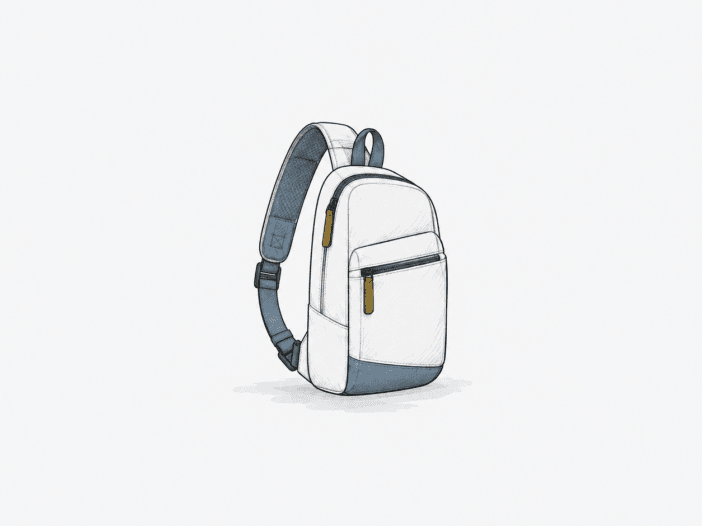
The Navigator-T24 fits best when you want to carry a laptop or tablet and skip the bulk of a full backpack. Buyer evidence backs up this device-led setup: laptop or tablet, charger, power bank, cables, notebook or travel documents, and a handful of small essentials. The bag’s advantage shrinks once you add bulky items, extra clothes, large headphones, or try to pack several heavy devices at once.
Size naming creates the main complication. Buyer evidence uses 5L, 7L, and 9L labels at different times, but these labels do not form a reliable size ladder. Always check the current listing and measure the actual compartment before trusting an older review for fit.

Product Snapshot
The real decision is whether your daily tech load fits inside the sling’s compact-carry limits, not how much you could cram in at maximum.
| Product detail | Decision relevance |
| Crossbody sling with switchable left/right lower attachment | Supports shoulder switching and swing-forward access without removing the bag. |
| Device-led internal layout | Best-supported loads center on a laptop or tablet plus compact accessories rather than clothing volume. |
| 5L, 7L, and 9L labels appear in the evidence | Historical naming is inconsistent; compare current dimensions rather than relying on liters alone. |
| One-shoulder carry | Works for many daily and travel setups, but weight and duration materially change comfort. |
| Soft-sided structure | The bag does not stand upright independently, and some buyers wanted a wider-opening or clamshell-style access path. |
Buyer Evidence Metrics
Buyer evidence points to the same pattern: compactness works when you keep the load in check. Device fit and strap behavior start to matter more as you add size, weight, or carry the bag for longer stretches.
| Buyer Question | Metric | Evidence |
| Does the compact footprint often come with a tighter load-flexibility boundary? | TCR 0.55 | Moderate · n=11 |
| Does switching shoulders also bring front-pocket access friction? | TCR 0.57 | Limited · n=7 |
| Is strap slippage more concentrated during extended or repeated use? | CFL 2.92× | Limited · n=5 |
| Does the 5L evidence separate tablet-centered use from more conditional 13-inch MacBook Air fit? | UBC 0.80 | Limited · n=5 |
| Is the 9L laptop-length boundary consistent in the dimensioned seller evidence? | UBC 1.00 | Limited · n=4 |
How these metrics work:
- Trade-Off Coupling Rate (TCR) measures how often an observed product strength appears together with a specific friction among eligible buyer evidence. It does not establish causality.
- Context Friction Lift (CFL) measures whether a known friction is more concentrated in a defined eligible context than in the eligible baseline. It is not a severity or probability measure. For CFL, public n reflects the smaller eligible comparison group.
- Use Boundary Consistency (UBC) measures how consistently eligible buyer evidence separates a supported use case from the condition where that use becomes more limited or conditional. It is not a product-quality score or fit probability.
- n is the number of relevant, eligible, deduplicated buyer observations used for that metric—not the product’s total review count.
- These are buyer-evidence signals, not product-performance scores.
See how these buyer-evidence metrics work.
UBC 1.00 for the 9L does not mean a 100% chance that a laptop will fit. It means the four eligible dimensioned observations were internally consistent around that particular length boundary. Likewise, CFL 2.92× does not mean strap slippage will occur; it shows that the friction was more concentrated in the eligible extended/repeated-use evidence than in the comparison group.
Fit–Friction Matrix
Match your real load to these setups before choosing by capacity label alone.
| Buyer Setup / Context | Fit Signal | Main Friction |
| Compact laptop or tablet + charger, cables, power, notebook/travel documents, and a few small essentials | Recurring Strong Fit | Bulky headphones, large bottles, books/lunch, seasonal layers, or extra clothing reduce the compact-carry advantage. |
| 5L tablet-centered load with small accessories | Generally Works | Capacity margin is narrow; folders, thicker accessories, and 13-inch MacBook Air fit become conditional. |
| 7L 14-inch-class laptop or multi-device tech load with compact accessories | Generally Works | Laptop + tablet combinations can become heavy on one shoulder, and case-on 12.9-inch tablet fit is mixed. |
| 9L dense gaming-tech or laptop + bottle + large power setup | Specific Example Only | Observed setups can approach the practical volume limit quickly, and exact laptop chassis length remains critical. |
| Extended walking or repeated carry with shoulder switching | Mixed / Variant-Dependent | Strap adjustment can loosen, shoulder/neck fatigue rises with heavier loads, and the front vertical pocket can become awkward from one shoulder orientation. |

Variant Fit Patterns
Pick the role you need first, then check the current dimensions. Buyer evidence shows the naming has changed, so a past ‘9L’ may not match a current ‘7L’ listing.
| Variant label in evidence | Best-supported role | Main boundary to verify |
| 5L / Navigator XS | Minimal tablet-led EDC or personal-item carry where the smallest footprint matters most | 13-inch MacBook Air fit is mixed, and document/bulk capacity tightens quickly. |
| 7L / Navigator S | More laptop, tablet, gaming-handheld, bottle, and power capacity without moving to a conventional backpack | Larger footprint and heavier one-strap loads; case-on 12.9-inch tablet fit is not consistent. |
| 9L label in older/explicit evidence | Dense tech loads, including protected gaming hardware or laptop + bottle + large power gear | Seller dimensioned examples accept roughly 12.7–12.75-inch laptop lengths as fit/tight, while 13.0–13.4-inch examples are rejected. |
Screen diagonal is a weak shortcut for fit. What matters more: the actual chassis size, case thickness, compartment you use, and the label on the current listing. ’13-inch,’ ’14-inch,’ or ’15-inch’ alone won’t guarantee a match.
What Buyers Carry With It
Real-world loadouts show where the sling works well and where a supposed fit still feels cramped.
| Variant / scope | Observed loadout | What it tells a buyer |
| 5L | M2 MacBook Air + 11-inch iPad with Magic Keyboard | A 13-inch-class laptop can fit in at least one 5L setup, but the fit was snug and conflicts with a seller recommendation to move up for a 13-inch M1 MacBook Air. |
| 7L | Samsung Galaxy Tab A9+ + ROG Ally X in JSAUX Mod Case + 26,000mAh power bank + 100W charger/cables + two earbuds | The 7L can support a dense electronics load when the items are compact and deliberately organized. |
| 9L | Steam Deck in JSAUX BG0102 hard case + xReal glasses + controller + 26Ah battery | The larger labeled configuration can work for protected gaming gear, but this remains a specific loadout rather than proof that all similarly described devices will fit. |
The Compact Footprint Is the Strength—Until You Start Packing for “Just in Case”
Buyers keep coming back to the Navigator-T24 because it cuts out backpack bulk and temptation. They use it for laptops, tablets, chargers, cables, travel documents, handheld gaming gear, and small daily items. The bag stays easy to wear in cafés, airports, public spaces, and on city walks.
Compactness cuts both ways. In eligible compact-use evidence, TCR 0.55 shows the compact-carry benefit often comes with a real load boundary. Buyers feel the squeeze when they add full-size headphones, big bottles, books, lunch, winter gear, or clothing. The bag works best when you already know exactly what belongs inside.
Shoulder Switching Helps Mobility, but Access Is Not Fully Symmetrical
Switching the lower strap attachment helps if you swap shoulders or swing the bag forward to grab gear. This movement gives the sling a real edge over a backpack.
The front vertical pocket creates a snag. After switching shoulders, several buyers say the pocket sometimes faces down or gets awkward to open safely. TCR 0.57 shows this friction came up in some, but not all, eligible shoulder-switching reports.
If you plan to switch shoulders often on long walks, test pocket orientation with your own dominant carry side. Do not assume access will feel the same both ways.
Long Wear Depends More on Load Discipline Than on the Sling Format Alone
Buyer evidence does not back up a universal comfort claim. Some buyers report comfortable all-day wear, long travel, and even heavy loads. Others feel shoulder or neck fatigue once the bag is packed tight.
Strap adjustment comes up more often. CFL 2.92× shows strap-slippage reports cluster in the extended or repeated-use group, not as much in the smaller comparison set. Some buyers need to retighten the strap, while others report stable, comfortable carry even on long days.
The bottom line: this sling works better for a set tech load than for stuffing every inch full.
What Buyers Should Check Before Buying
The right decision comes down to five checks.
- Verify the current variant dimensions, not just the liter label. Historical 5L/7L/9L naming is inconsistent in the buyer evidence.
- Measure the actual device chassis with its case attached. Screen diagonal alone does not reliably predict fit, especially near the 5L and 9L boundaries.
- List your bulky items before choosing the smaller configuration. Full-size headphones, large bottles, books, lunch, winter layers, and clothing are the recurring capacity stressors.
- Think about shoulder switching and wear duration. Front-pocket orientation, strap slippage, and one-shoulder fatigue matter more when you walk for hours or carry a dense multi-device load.
- Treat light-rain reports as limited evidence, not waterproofing proof. Buyers report positive shower/light-rain experiences, but the evidence does not establish sustained heavy-rain protection.
Not sure whether this compact size is enough for your setup? Compare it with the other best tech sling bags for different carry needs.
