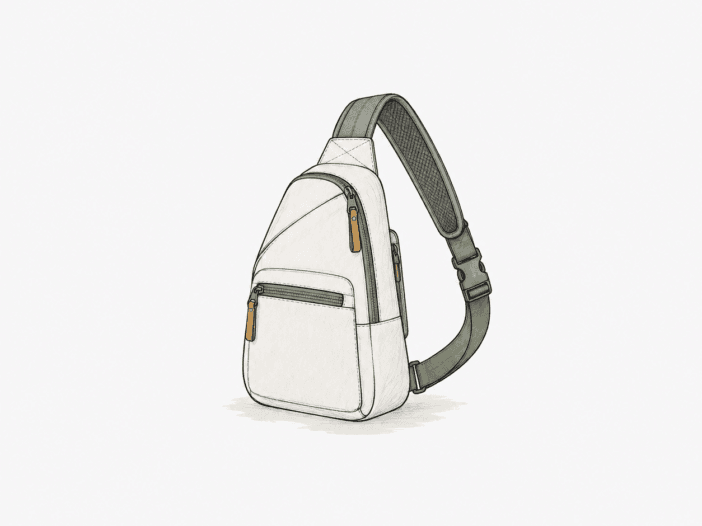
This sling works best for travelers who want hands-free carry for a passport, phone, wallet, power bank, glasses, snacks, and a few small extras on city days or international trips. The main trade-off sits right up front: security-focused closures and a tall, deep shape add peace of mind and real capacity, but they also slow down access, make organization trickier, and get less comfortable as you add weight.
Buyer reports treat the anti-theft features as extra deterrence, not a guarantee. The evidence covers repeated peace-of-mind stories, mixed results on clip and attachment reliability, and one case where a pickpocket still got through.
Product Snapshot
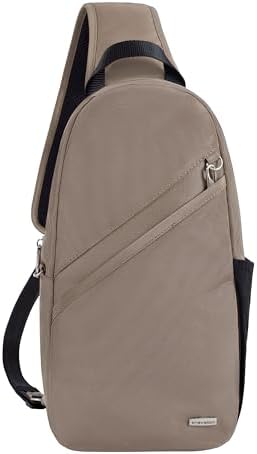
This design fits best as a compact travel sling. It does not behave like a small daypack with security features tacked on.
| Product detail | Decision relevance |
| 3.5 × 14 × 7 inches; 13.4 ounces | The tall, relatively narrow footprint carries useful sightseeing essentials without daypack bulk, but small items can settle deep in the main compartment. |
| One exterior locking zipper pull on the main compartment | The clip-based closure adds handling friction for unauthorized access, but the single-direction opening is also a recurring convenience complaint. |
| Reversible sling carry; maximum strap drop of 25 inches | Buyers can switch shoulders and rotate the bag front or back, although chest, neck, torso, and strap-tail fit vary by body shape. |
| Polyester; manufacturer-stated wire reinforcement in the strap and part of the body | This supports the product’s security-focused design intent, but buyer evidence does not independently verify slash resistance, RFID performance, waterproofness, or theft prevention. |
Buyer Evidence Metrics
Three clear signals show up in the numbers: bottle fit has a hard limit, security hardware sometimes trades convenience for control, and heavier or longer carry bumps up comfort friction for some buyers.
| Buyer Question | Metric | Evidence |
| Is the external bottle pocket consistently better suited to small or slim bottles than larger ones? | UBC 1.00 | Moderate · n=13 |
| How often do security-oriented zipper/clip features appear together with access friction? | TCR 0.38 | Moderate · n=13 |
| Is shoulder, neck, or back pressure more concentrated in extended or heavier carry? | CFL 1.25× | Moderate · n=9 |
How these metrics work:
- Use Boundary Consistency (UBC) measures how consistently eligible buyer evidence separates a supported use case from the condition where that use becomes more limited or conditional. UBC is not a measure of product quality or success probability.
- Trade-Off Coupling Rate (TCR) measures how often an evidence-supported strength and a specific friction appear together among eligible buyer evidence. TCR does not establish causality.
- Context Friction Lift (CFL) measures whether a known friction is more concentrated in a defined eligible context than in the eligible baseline. CFL is not severity or probability; its public n reflects the smaller eligible comparison group.
- n is the number of relevant, eligible, deduplicated buyer observations used for that metric—not the product’s total review count.
These are buyer-evidence signals, not product-performance scores. See how these buyer-evidence metrics work.
Fit–Friction Matrix
This sling handles compact sightseeing loads with the least friction. Try to use it like a bigger hydration, camera, or quick-access bag, and the complaints start stacking up.
| Buyer Setup / Context | Fit Signal | Main Friction |
| International or city sightseeing with phone, wallet, passport, power bank, glasses, snacks, and compact extras | Recurring Strong Fit | Small loose items can settle into the tall, deep compartment and take longer to retrieve as the bag fills. |
| Front-of-body carry in crowded travel settings, with added deterrence as the goal | Generally Works | The one-way zipper and clip handling can slow access, and the security features do not make the bag theft-proof. |
| Small or slim bottle in the external pocket | Recurring Strong Fit | Wider, taller, or larger bottles are repeatedly described as tight, unstable, or better carried inside the main compartment. |
| Light-to-moderate load during long walking or touring days | Generally Works | Shoulder, neck, or back pressure becomes more likely for some buyers as weight and carry duration increase. |
| DSLR or otherwise heavier camera-centered load | Conditional Fit | The bag may have enough physical capacity while the resulting weight becomes uncomfortable for extended carry. |
| Buyers sensitive to chest-strap path, neck contact, torso length, or excess strap tail | Conditional Fit | Body proportions materially affect where the strap and bag sit, even though the sling can switch shoulders. |
The Bottle Pocket Has a Clear Size Boundary
Buyers who stick to small or slim bottles get the best fit. Reports keep pointing to 9–12 ounce bottles and other narrow shapes as workable. Wider, taller, or bigger bottles usually feel tight or unstable.
UBC 1.00 does not mean every small bottle fits or every large bottle fails. It means eligible buyer evidence lines up on this boundary: small or slim bottles work more reliably, while bigger bottles usually need a compromise or end up inside the main compartment.
Security Hardware Adds Reassurance, but It Also Adds Friction
The anti-theft setup works best for buyers who want extra closure steps and close-to-body carry, not for anyone expecting guaranteed theft prevention. Zipper clips and the security-focused build keep coming up as peace-of-mind features, but the same evidence shows three limits:
- Some buyers find the single-direction zipper or clip handling awkward when rotating the sling forward for access.
- Several independent reports describe fabric-loop fraying, clip disengagement, or locking-component failures, while other owners report years of trouble-free use.
- One buyer reports a wallet being stolen in Rome despite believing the bag was secured, so the evidence does not support a pickpocket-proof claim.
TCR 0.38 describes a recurring but non-universal trade-off: access friction appears in a minority of eligible security-positive observations. At the same time, other buyers find the closures quick once they adapt.
Capacity Can Outgrow Carry Comfort
This sling holds more than it looks like it should, but usable capacity and comfortable capacity won’t differ much. Buyers report carrying an iPad Mini, a Fuji X100, a compact umbrella or light layer, and even a Nikon D3300 DSLR with kit lens.
The DSLR example shows where the comfort line sits: the camera fit, but the heavier load got uncomfortable after about an hour. CFL 1.25× means shoulder, neck, or back pressure shows up more often in longer or heavier carry than in the comparison group. Still, several buyers report comfortable long use with lighter loads.
What Buyers Should Check Before Buying
You can self-select this sling more easily if you check these six things before your trip:
- Bottle size: If you need a wide or tall refillable bottle, check your exact bottle against the pocket. Do not assume it will fit.
- Access direction: Make sure the single-direction main zipper lines up with the shoulder and the front- or back-facing orientation you’ll use most.
- Body fit: Check how the strap crosses your chest or neck, and whether the 25-inch max strap drop matches your torso and carry style.
- Loaded comfort: If you plan to carry a DSLR, heavier camera gear, or a dense load for hours, base your decision on carry comfort, not just capacity.
- Attachment hardware: Inspect the strap loops, clips, and locking pulls before a long trip. Durability reports are mixed, not all good or all bad.
- Security expectations: Pick this sling for extra deterrence and handling friction, not because you expect it to guarantee against pickpocketing, slashing, or theft.

Security may be the priority here, but other carry needs can point elsewhere. See the full best tech sling bags comparison before choosing.
