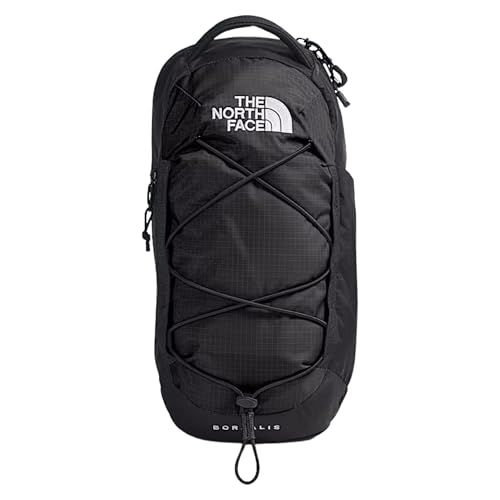
The North Face Borealis Sling holds 6 liters in a compact cross-body form. The structure and external pockets work best when your load stays intentionally small, and each interface—strap, bottle pocket, and phone pocket—matches the size and shape of what you carry.
Best when a small load and exact pocket fit matter more than spare capacity
- Best for: compact daily essentials when 6 L is enough, and you want a small sling with external bottle carry and separated small-item storage.
- Main deal-breaker: the one-size strap and stretch pockets set fixed physical limits. Body size, bottle diameter and height, and phone-plus-case thickness can push these features from functional to unusable if they exceed the built-in range.
If your priority differs: if your normal load already needs more room than a deliberately small 6 L sling, this is the wrong starting point.
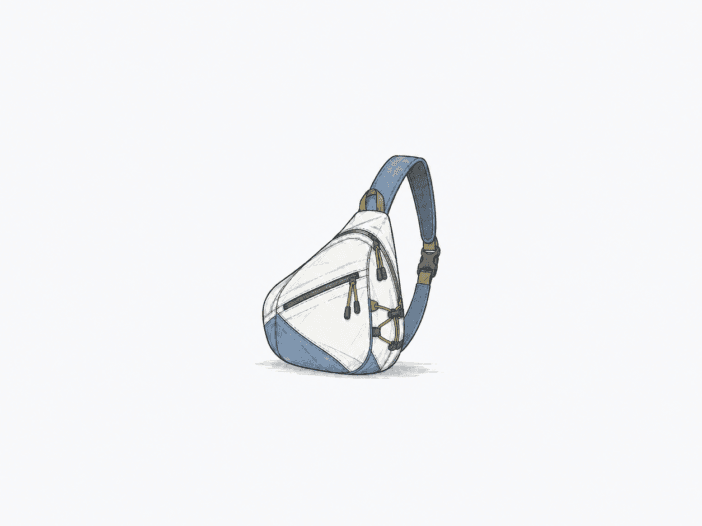
The one-size strap works only when your body and load stay inside its range.
The strap has a fixed maximum length and a set attachment angle, so the bag cannot reach the same position on every torso. Some builds have room to adjust, while others hit the strap limit, causing the bag to ride high near the neck or slide off the shoulder. A heavier load can press the strap edge into the collarbone, so the physical fit can become uncomfortable even when the bag remains technically wearable.
- Inside the range: the sling reaches the preferred cross-body position with room to adjust and stays stable under a normal load.
- Near the limit: fuller loads can increase collarbone pressure, especially when the bag already sits high.
- Outside the range: the longest setting still leaves the sling too high, too tight over layers, or prone to sliding.
Bottle fit depends on diameter, height, and the zipper path—not ounces alone.
The external pocket sets two physical limits: stretch determines the maximum bottle diameter, and bottle height determines whether it blocks the adjacent zipper. A bottle can fit by diameter but still interfere with zipper access if it is too tall.
A slim bottle can remain usable even with the main compartment loaded.
A Stanley 17 oz bottle around 2.8 inches wide still seats in the side holder with the main compartment loaded. That puts a slim bottle near the working end of the pocket: the stretch can accommodate the diameter without requiring the bottle to move inside the main compartment.
Extra height can turn a physical fit into an access problem.
A 12 oz Dasani fits without blocking the zipper, while the taller 16 oz Dasani enters the pocket but extends high enough to block easy zipper access. This shows that bottle height, not ounce capacity, sets the limiting dimension before the pocket physically rejects the bottle.
A bottle can fit physically and still fail at its job.
A S’well 9 oz bottle fits the pocket, but the water volume falls short for long hikes. Physical fit doesn’t guarantee practical hydration; the pocket can hold a bottle that doesn’t meet your water needs.
Six liters works for compact essentials, but rigid gear can eat it up quickly.
The main decision is whether your load fits within a sling’s physical limits or requires small-backpack capacity. The 6-liter volume matters less once rigid devices or cases fill most of the shallow interior depth.
Rigid gear can use the depth before the 6 L number sounds full.
The 6-liter body holds compact travel and commute essentials, but back padding and rigid objects reduce the usable depth for other items. When you pack densely, access becomes harder because non-compressible objects force other items to fit around them.
A Steam Deck in a Killswitch-style case fits inside, but fills nearly the entire main compartment and leaves no space for the rest of a typical fanny-pack load. This marks the capacity boundary: the device fits physically, but the remaining volume cannot support a practical everyday carry.
Dedicated device fit is safer with smaller tablets and handhelds.
An iPad Mini Gen 2 measuring 7.9 x 5.30 x 0.30 inches fits comfortably in the padded sleeve. That gives a clear small-tablet reference point; larger devices can behave differently depending on chassis, case, and compartment.
- 11-inch iPad Pro: fits in the main load together with a Bluetooth keyboard and water bottle.
- 11-inch iPad: does not fit in this device-fit result, so main-compartment entry should not be treated as sleeve compatibility.
Quick access is useful only when the pocket material and device clearance cooperate.
The organization system separates small items, but two physical factors control whether access stays quick: friction and zipper orientation in the storage pockets, and the combined width and thickness of your phone-plus-case in the shoulder-strap pocket. Frequent-access items sit in small spaces where hand path and available clearance limit practical retrieval without repositioning the bag.
Fleece protects small items but adds friction and holds liquid.
The fleece-lined front pocket cushions small essentials, but the material increases friction during insertion and removal, retains liquid after a spill, and dries slowly. This trade-off matters most when you need frequent retrieval or fast cleanup from a pocket with a soft lining.
Interior zipper orientation can force you to reposition the bag.
The interior mesh-pocket zipper runs left to right. When the sling is loaded, this orientation can restrict your hand path enough that you may need to remove and reorient the bag to retrieve items. The number of pockets does not guarantee fast on-body access.
- Front soft-lined pocket: useful separation, but friction and liquid retention work against fast, easy-clean access.
- Interior mesh pocket: organized storage remains useful, but a loaded sling can make on-body zipper access awkward.
The phone pocket is governed by chassis plus case, not screen size.
The shoulder-strap pocket stretches, but the clearance limit remains fixed. Usable fit depends on the total width and thickness of your phone and case, so two phones with similar screen sizes can fall on opposite sides of the fit boundary.
An iPhone 14 Pro in a protective case fits the roughly 3-inch-wide pocket with minimal margin. This near-limit fit sets a benchmark: if your phone-plus-case is larger, the pocket may only accept it tightly or may no longer allow practical quick retrieval.
| Phone | Strap-pocket behavior |
| Samsung S24 Ultra | Can be very snug or fail to fit. |
| iPhone 13 Pro Max | Does not fit; with an OtterBox Commuter case, it remains slightly too large. |
| iPhone 15 Pro | Fits the strap pocket. |
| iPhone 14 Pro Max | Fits comfortably with room for lip balm. |
Multi-year service checkpoints are encouraging, but they do not define a lifespan.
A 2-week travel period with wet exposure ended with quick drying and functioning zippers. Multi-year relentless use, including several machine washes, ended with no visible wear beyond a small stain. Those durations show what remained functional at those points; they don’t guarantee a service life or failure rate.
What to check before buying
- Wear it at the longest strap setting. Use your normal clothing and intended load, then confirm the preferred position without neck or collarbone pressure or sliding.
- Seat your exact bottle and operate the adjacent zipper. Confirm the bottle enters without forcing and the zipper still travels fully.
- Insert your exact tablet or handheld with its normal case. Use the compartment you actually intend to carry it in and confirm clean entry and closure.
- Fit your phone with its everyday case. Confirm it inserts, zips, and removes from the shoulder-strap pocket without forcing.
Choose it for disciplined compact carry, not small-backpack duty.
Choose it if:
- Your everyday load is intentionally small and stays comfortable within a 6 L sling.
- Your body, bottle, phone, and device fit the specific interfaces you plan to use.
- You value compact organization and external carry more than reserve capacity.
Skip it if:
- The one-size strap cannot reach your preferred position without pressure, tightness, or sliding.
- Your normal rigid or bulky load already consumes most of the usable interior.
- You need more room and a more structured carry; move to a 10 L rigid sling.
Check The North Face Borealis Sling on Amazon
When fit or load needs move beyond this sling, change the carry platform.
| If you need… | Look at… |
| More forgiving fit across petite, taller, broader, or longer/heavier carry needs | Osprey Daylite Sling — feels lighter and is preferred for comfort, but gives up the external bottle holder and exterior bungee. |
| Better petite-frame comfort when external bottle carry matters less | Patagonia Atom Sling — sits more comfortably on a petite frame, but lacks the external bottle holder. |
| More practical load room plus a different carry position | Oakley Extractor Sling Bag — addresses the larger-load and carry-position mismatch. |
Want to explore more tech slings? Visit our Best Tech Slings for detailed recommendations.
