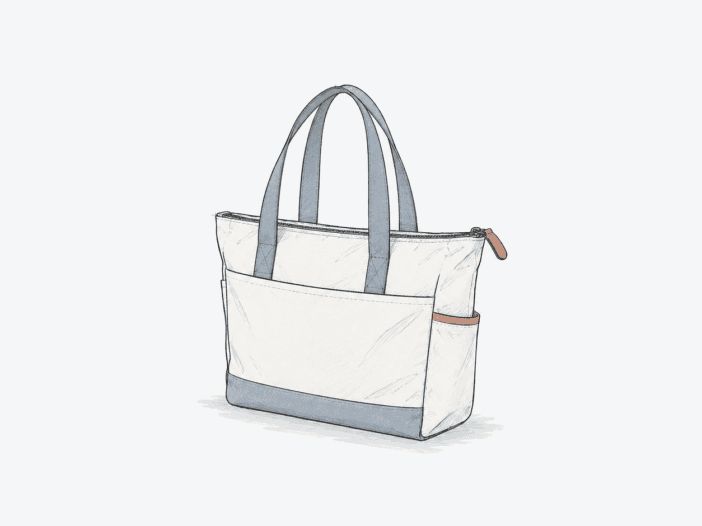
The Bellroy Tokyo Tote Compact suits buyers who carry a 13-inch-class laptop, charger, notebook, or papers, plus a few personal items and a bottle or compact umbrella. The 12L size keeps your work setup organized and slim. That compact footprint is both the main advantage and the main trade-off. You get a tidy, manageable tote, but you lose space when your routine calls for bulky lunch containers, extra clothes, tall bottles, or a larger laptop.
Evidence gets less consistent once you move past that core setup. Some 13-inch laptops fit tightly in the sleeve. Reports on 14-inch compatibility conflict, so do not assume a 14-inch device will fit. Light travel is possible, but the lack of a luggage pass-through means this tote does not pair well with a roller bag.

Product Snapshot: built around a compact load, not maximum volume
| Product detail | Decision relevance |
| 12L; 44 × 31 × 9 cm; 550 g | Supports a smaller work-tote profile; the narrow depth gives bulky items less expansion room. |
| Laptop compartment: 240 × 330 × 20 mm | Buyer evidence is strongest around 13-inch-class devices; 14-inch fit is contradictory and 15.6-inch dedicated-compartment fit is not supported. |
| 70 cm handles; anti-slip grip elements repeatedly noted by buyers | Shoulder stability is often praised, although some buyers want a longer or softer shoulder drop. |
| Full top zipper with internal bottle/umbrella organization | Helps contain and separate daily items; tall bottles or umbrellas can interfere with full closure. |
| No luggage pass-through or crossbody-strap clip loop; cannot stand unassisted | Important if roller integration, alternate carry, or self-standing structure is essential. |
Buyer Evidence Metrics: device size and load bulk are the clearest boundaries
| Buyer Question | Metric | Evidence |
| Does the evidence clearly separate 13-inch-class laptop use from larger-device friction? | UBC 0.95 | Strong · n=21 |
| Does a compact laptop-plus-essentials load remain workable before bulky items are added? | UBC 0.93 | Strong · n=30 |
| When compactness is praised, does a capacity or fit limit commonly appear with it? | TCR 0.25 | Strong · n=20 |
How these metrics work:
- Use Boundary Consistency (UBC) measures how consistently eligible buyer evidence separates a supported use case from the condition where that use becomes more limited or conditional.
- Trade-Off Coupling Rate (TCR) measures how often an observed product strength appears together with a specific friction among eligible buyer evidence.
- n is the number of relevant, eligible, deduplicated buyer observations used for that metric—not the product’s total review count.
- These are buyer-evidence signals, not product-performance scores, rankings, probabilities, or lab measurements.
See how these buyer-evidence metrics work.
UBC values don’t mean you have a 95% or 93% chance your setup will fit. Instead, these numbers show that eligible buyer evidence clusters around two boundaries: 13-inch-class devices versus larger laptops, and compact workloads versus bulkier carry. TCR 0.25 means capacity friction tied to compactness is real but not the main story. Many buyers who like the smaller footprint do not mention the paired space limitation.
Fit–Friction Matrix: 13-inch work carry is the clearest fit; larger or bulkier setups add conditions
| Buyer Setup / Context | Fit Signal | Main Friction |
| 13-inch-class laptop + charger + notebook/papers + wallet, keys, phone + short bottle or compact umbrella | Recurring Strong Fit | Some 13-inch laptops are described as tight in the sleeve, and spare volume depends on the rest of the load. |
| 14-inch laptop requiring reliable dedicated-sleeve fit | Mixed / Variant-Dependent | Bellroy guidance conflicts over time, while multiple buyer reports describe failed or too-tight 14-inch fit. |
| 13-inch laptop + bulky lunch, sweater, training clothes, or tall bottle | Conditional Fit | Narrow depth and top-zip clearance become the practical limits, although a few broader loads still worked. |
| Light travel without a roller-bag attachment requirement | Generally Works | The tote can handle some plane or trip loads, but it has no luggage pass-through and is not optimized for roller integration. |
| Lint-sensitive or pet-owning buyer considering a textured/Fine Weave exterior | Mixed / Variant-Dependent | Lint, dust, and pet-hair pickup recur in buyer reports; Bellroy says smoother Baida Nylon does not share the same early-use lint issue. |
What Buyers Carry With It: real loadouts show where the compact boundary sits.
| Observed setup | What worked | Boundary signal |
| Dell 13-inch laptop + cables, mouse, headset, wallet, bottle, keys, train pass, and a small lunch | A broad commute setup remained workable and organized. | Shows that 12L does not automatically mean minimal-only carry. |
| 13-inch MacBook Pro + charger, headset, small notebook, coffee cup, wallet, and keys | The daily work load fit and zipped. | Glass-container lunch and a taller bottle fell outside this buyer’s comfortable boundary. |
| 13-inch MacBook Air + iPad Air + 32 oz bottle | Both devices fit the work setup. | Adding the large bottle prevented the top zipper from closing. |
| Wallet, keys, bottle, umbrella, and an extra change of clothes on a Japan trip | This specific travel load fit successfully. | Useful counterexample, but not enough to erase the recurring bulky-load limit. |
What Buyers Compare It With: switching usually starts when space or travel integration matters more
| Compared option | Why it enters the decision | What the evidence says to watch |
| Bellroy Tokyo Tote 15L / larger Tokyo Tote | More room for a larger device or broader daily load. | More capacity can solve the Compact’s space issue, but one 5’2″ buyer found the 15L too large for their frame. |
| Bellroy Tokyo Wonder Tote | Luggage pass-through becomes a priority. | Bellroy points to it when roller integration is required; the evidence does not establish full feature equivalence. |
| Bellroy Tech Brief / System Messenger Bag | A luggage pass-through is required in a different carry format. | Bellroy suggests these as alternatives for that specific travel need; broader comparative performance is not established here. |
What Buyers Should Check Before Buying: verify your real load, not just the nominal capacity.
- Measure your actual laptop, not just the label. Evidence supports 13-inch-class devices most strongly. Do not count on a 14-inch laptop fitting; the dedicated compartment does not support 15.6-inch laptops in the supplied evidence.
- List out your bulkiest normal day before you buy. Lunch containers, sweaters, gym clothes, and other high-volume items are where the 12L layout usually hits its limit. Some buyers do fit broader loads, but most run into space issues with these bulkier items.
- Check the height of your bottle or umbrella, not just the diameter. Shorter items usually fit. Taller bottles or umbrellas can keep the top zipper from closing.
- Check which exterior material you are getting if lint or pet hair is a concern. Fine Weave shows up in early lint complaints. Bellroy calls Baida Nylon smoother, but most buyer reports do not specify which material they had.
- Check your must-haves for carry and security. There is no luggage pass-through and no crossbody conversion loop. The tote does not stand up on its own. A secure interior zip pocket is not evident in buyer evidence. Some buyers also find the handles shorter or firmer than they like.
Bottom Line: choose it for a trim workday, not for generous expansion margin
The Bellroy Tokyo Tote Compact makes the most sense for a 13-inch-class laptop and a controlled set of work essentials. Choose this tote when you value a smaller, organized carry over open-ended space. Evidence gets more conditional if you need a reliable 14-inch sleeve fit, carry bulky extras often, rely on tall bottles inside a zipped tote, or want luggage pass-through integration.

Want to see how the Bellroy compares with roomier, travel-ready, and convertible alternatives? Explore the best laptop tote bags for different carry needs →
