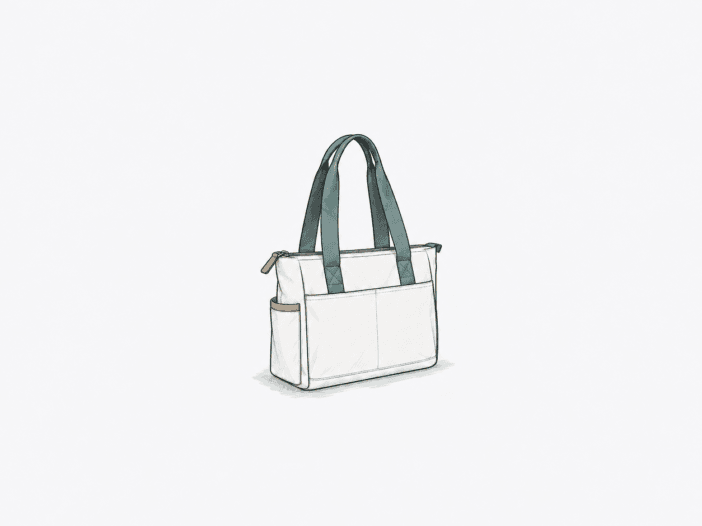
The tomtoc Versatile-T23 Tote works best for buyers who want organized, laptop-first carry without switching to a backpack. The main decision is not just total capacity. You need to match the tote size to your full daily load before bottle space, device bulk, shoulder weight, or packing geometry start creating problems.
Medium and Large have the strongest size-specific buyer evidence. Small shows only limited direct reports, so its practical boundary is less clear.

Product Snapshot
This tote family stands out for organized work and travel carry. Size choice drives most decisions, not any single feature.
| Product detail | Decision relevance |
| Size variants | Small, Medium, and Large; the evidence supports different load roles rather than treating them as interchangeable sizes. |
| Best-supported role | Laptop/tablet carry for work, study, commuting, and travel with chargers, documents, small accessories, and sometimes food or a bottle. |
| Device pattern | Standard 14–16-inch-class laptops are repeatedly workable; bulky protective cases and 17-inch devices become more conditional. |
| Organization pattern | Dedicated device storage, compartmentalized interior space, quick-access pockets, an internal bottle holder, top closure, and rolling-luggage integration recur in buyer reports. |
| Main trade-off | More carrying volume can shift the practical limit from “will it fit?” to bottle-space competition, top closure, stability, and shoulder comfort. |
| Protection boundary | Buyers report soft or padded device storage, but the evidence does not establish robust drop protection or consistently substantial bottom padding. |
Buyer Evidence Metrics
Device geometry sets the clearest evidence boundary. Standard 14–16-inch laptop setups fit more consistently than the broader question of total gear capacity.
| Buyer Question | Metric | Evidence |
| Do standard 14–16-inch laptops form a relatively consistent fit zone before bulky cases or 17-inch devices become conditional? | UBC 0.87 | Moderate · n=15 |
| Does a compact laptop-plus-essentials load separate cleanly from bulkier mixed loads? | UBC 0.62 | Moderate · n=13 |
| When buyers value spaciousness, how often does size, weight, or shoulder-load friction appear too? | TCR 0.56 | Moderate · n=9 |
| How often does the internal bottle-holder strength appear with bottle-fit or packing-space friction? | TCR 0.30 | Moderate · n=10 |
How these metrics work:
- Use Boundary Consistency (UBC) measures how consistently eligible buyer evidence separates a supported use case from the condition where that use becomes more limited or conditional.
- Trade-Off Coupling Rate (TCR) measures how often an observed product strength appears together with a specific friction among eligible buyer evidence.
- n is the number of relevant, eligible, deduplicated buyer observations used for that metric—not the product’s total review count.
These are buyer-evidence signals, not product-performance scores. See how these buyer-evidence metrics work.
UBC 0.87 does not mean an 87% chance your laptop will fit. It means eligible buyer evidence stays relatively consistent at the device-size boundary. The lower 0.62 load-volume UBC shows why size choice still matters. Some buyers carried much heavier mixed loads without trouble, while others ran into packing friction sooner.
Fit–Friction Matrix
Routine laptop and work item carry is the most reliable pattern. Friction increases when your setup gets unusually bulky, heavily loaded, or depends on using every internal pocket at once.
| Buyer Setup / Context | Fit Signal | Main Friction |
| Laptop or tablet + charger + documents/notebooks + small daily essentials for work or study | Recurring Strong Fit | Shoulder comfort becomes less predictable as the load gets heavier, and exact size still matters. |
| Medium + 14–16-inch-class laptop + routine work accessories | Generally Works | Device-fit reports are not perfectly consistent, and Medium-specific strap feedback includes thin/no-grip feel and isolated fraying concerns. |
| Large + laptop + second device or books/binders + bottle for higher-volume work or travel | Conditional Fit | Dense packing can make the bottle holder tight, interfere with top closure, or make the tote less stable when set down. |
| Small + 14-inch laptop + charger + pouch | Specific Example Only | One detailed Small setup worked, but adding a book or lunchbox may use up the remaining practical space; Small-specific evidence is sparse. |
| Airline under-seat carry paired with rolling luggage | Generally Works | Buyers value quick retrieval and luggage integration, but the tote gives up some carrying volume versus a backpack and under-seat fit is not established across every airline or aircraft. |
| Bulky-cased 16-inch laptop or 17-inch laptop | Conditional Fit | Fit moves toward the edge of the sleeve or main compartment, and bottle space can compete with device space. |
Variant Fit Patterns
Pick your size based on your full load, not just the laptop diagonal. The same laptop can fit easily in one setup but become a packing problem once you add books, lunch, a large bottle, or a bulky case.
| Variant | What buyer evidence supports | Main boundary |
| Small | A compact 14-inch laptop + charger + pouch setup is directly supported. | Evidence is very limited; one buyer found that a book or lunchbox could push beyond the practical remaining space. |
| Medium | Repeated work/commute use plus successful 14–16-inch laptop examples. | Exact laptop fit is inconsistent across reports, and strap refinement/durability is the clearest Medium-specific caution. |
| Large | Multi-item work, academic, and travel loads, including laptop + tablet + Kindle + bottle combinations. | Dense book/binder loads can turn the bottle holder, top closure, and stand-up stability into packing-dependent issues. |
Device fit is more predictable than total capacity.
If you want to know whether a standard laptop will fit, the evidence supports most 14–16-inch devices. The exceptions matter. One buyer squeezed a 16-inch MacBook Pro in a heavy-duty case into the padded pocket, but just barely. A 17-inch laptop became an edge case that competed with bottle space.
Total capacity is less predictable. Large and some unknown-size setups handled heavier loads than expected. That lower load-volume UBC shows why: a bulky setup is not always too much, but packing geometry matters more.
Extra space can shift the problem to your shoulder.
Spaciousness helps, but it is not free capacity. TCR 0.56 across nine eligible observations means five buyers saw spaciousness and a size, weight, or shoulder-carry caveat together. Four others stayed comfortable or kept the load light enough.
This does not prove the tote causes discomfort. Buyers who plan to use the larger carrying volume should check the loaded weight they will actually carry on one shoulder, not just whether everything fits inside.
The bottle holder is useful, but it does not guarantee extra space.
Most eligible bottle-holder reports did not mention a problem. TCR 0.30 means three out of ten eligible buyers saw the bottle-holder benefit come with bottle-fit or packing-space friction.
The practical boundary is clear. Slim or standard bottles fit more easily. Larger bottles or dense book and device loads can make the bottle holder compete for space inside the bag.
What Buyers Compare It With
Shoulder straps, not organization, draw the clearest direct comparison.
One Medium buyer explicitly compared the tote with the Bellroy Tokyo tote. The tomtoc was viewed positively for construction and organization, but the buyer preferred the Bellroy’s underside strap grips because they helped keep the straps from sliding off the shoulder.
Other buyers compared perceived quality with TUMI, but did not name a specific model. Treat this as a general quality reference, not a direct product comparison.
What Buyers Should Check Before Buying
Check your full carry setup before buying. Do not assume the size label answers everything.
- Pick your size based on your full daily load. Small only has sparse evidence beyond a 14-inch laptop, charger, and pouch. Large shows more buyer reports for multi-device and higher-volume work or travel loads, but dense packing can still create new friction.
- Measure your laptop with its case on. Standard 14–16-inch devices fit in most reports, but bulky 16-inch cases and 17-inch devices push toward the practical edge.
- Check your bottle and what sits next to it. Slim bottles are the safer bet. A larger bottle or tightly packed books and devices can make the internal holder compete for usable space.
- Focus on loaded shoulder weight, not empty-bag capacity. Buyer reports range from comfortable carry to shoulder pressure, thin or no-grip straps, and some strap-fraying concerns.
- Do not buy this tote for impact protection alone. Buyer reports disagree on how protective the laptop area feels. The evidence does not show a suspended sleeve or consistently substantial bottom protection.
- Do not assume the tote will always stand upright. Some buyers report flopping or tipping when weight is uneven. Others found it stable with specific loads. Treat self-standing as packing-dependent, not guaranteed.

If you are still deciding whether organization, capacity, or carry flexibility should come first, compare the best laptop tote bags side by side →
