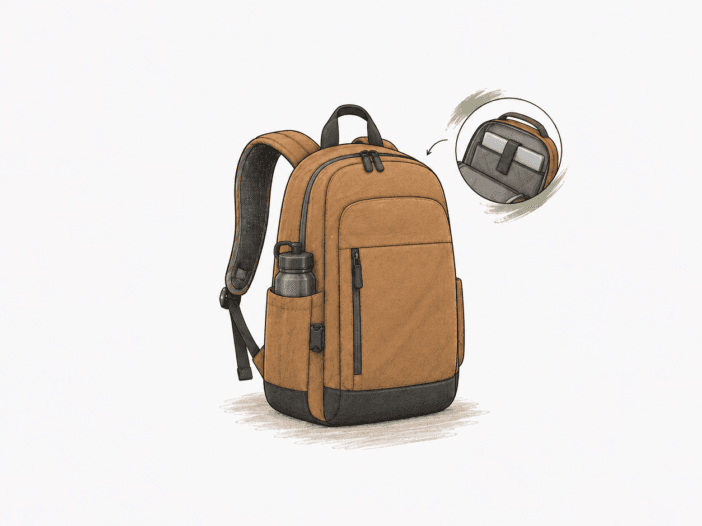
Most buyers use the Carhartt Classic Laptop Backpack for a moderate daily load: a 13–15-inch laptop or tablet, a few notebooks or textbooks, and the usual school or work gear. That setup comes up repeatedly in buyer feedback.
Capacity only helps if your gear actually fits. Some buyers report fitting a 16-inch laptop, but the evidence is mixed, so you cannot count on every 16-inch device working. Multiple reports say 17-inch laptops do not fit. If you carry several binders, wide bottles, heavier gear, or expect strong built-in laptop protection, buyer feedback points to more problems.
The real test is whether your setup matches what buyers report working. Roominess and durability matter only if your gear fits within the boundaries buyers describe.

Product Snapshot
| Product detail | Decision relevance |
| 25L capacity appears in the buyer evidence | This supports a compact everyday-carry frame, but the evidence does not independently verify the capacity as manufacturer data. |
| One Q&A answer gives dimensions of 12 × 17.5 × 8.75 inches | Useful as a rough size reference only; the evidence does not independently verify those dimensions. |
| Dedicated laptop sleeve | Repeated buyer reports support 13–15-inch-class devices; 16-inch fit is conditional, while repeated 17-inch reports indicate non-fit. |
| Laptop sleeve described as unpadded or thin | The sleeve separates a device from the main load, but the buyer evidence does not support assuming substantial impact protection. |
| Main compartment plus front organization | Buyer feedback supports simple daily organization; Q&A says there are no internal zippered pockets. |
| Side bottle pockets | Standard or slimmer bottles are supported more consistently than wider reusable bottles; bottle shape matters more than stated fluid ounces. |
| No roller-luggage pass-through in Q&A | The bag aligns more naturally with standalone daily or secondary travel carry than luggage-integrated travel. |
| Multiple buyers report water shedding or dry contents in rain | These reports support ordinary wet-weather use, but they do not establish a tested waterproof rating. |
Buyer Evidence Metrics
| Buyer Question | Metric | Evidence |
| Where does laptop-size fit change? | UBC 1.00 | Moderate · n=9 |
| How consistent is the side-pocket bottle boundary? | UBC 0.60 | Moderate · n=10 |
| Does rugged/stiff construction often appear with zipper-flap access friction? | TCR 0.50 | Limited · n=4 |
| Is shoulder-strap failure more concentrated in longer-duration evidence? | CFL 1.50× | Limited · n=4 |
How these metrics work: Use Boundary Consistency (UBC) measures how consistently eligible buyer evidence separates a supported use case from the condition where that use becomes more limited or conditional. Trade-Off Coupling Rate (TCR) measures how often an observed product strength co-occurs with a specific friction within eligible buyer evidence. Context Friction Lift (CFL) shows whether a known friction is more concentrated in a defined eligible context than in the eligible baseline; for CFL, public n reflects the smaller eligible comparison group. n is the number of relevant, eligible, deduplicated buyer observations used for that metric—not the product’s total review count. These are buyer-evidence signals, not product-performance scores. See how these buyer-evidence metrics work.
The laptop-size UBC of 1.00 does not mean a 100% chance that a laptop will fit. In the eligible evidence used for this metric, the observations consistently separated successful 13–15-inch use from the repeated 17-inch non-fit boundary. Because the 16-inch evidence is less settled, buyers near that size should still compare actual device dimensions rather than rely only on screen size.
The bottle-pocket UBC of 0.60 only holds in a narrow context. The eligible evidence shows a real shape-related boundary, but exceptions show up often enough that a simple rule like ’32 oz fits’ would overstate what buyer feedback actually shows.
Fit–Friction Matrix
| Buyer Setup / Context | Fit Signal | Main Friction |
| 13–15-inch-class laptop + notebooks/textbooks + ordinary daily essentials | Recurring Strong Fit | The laptop sleeve is described as lightly padded or unpadded, and sleeve-bottom tearing appears in recurring buyer feedback. |
| 16-inch laptop + ordinary daily essentials | Conditional Fit | Direct successful fit reports exist, but the evidence is not consistent enough to support universal 16-inch compatibility. |
| Binder-heavy school load or a “cram everything” setup | Limited Fit | Repeated feedback describes the bag as smaller or narrower than expected when multiple rigid binders or bulky items are involved. |
| Tools, work supplies, extra clothing, or lunch for mixed workdays | Generally Works | Several demanding-use reports are positive, but heavier carry also appears alongside comfort complaints and some strap, zipper, seam, or sleeve failures. |
| Secondary travel or day-bag use | Generally Works | Buyer reports support flight and day use, while one Q&A response says it is not large enough to be the only travel bag. |
| Standard or slim bottle with an ordinary daily load | Generally Works | Wider reusable bottles produce conflicting fit reports, so bottle geometry remains a practical boundary. |
The Clearest Fit Is a Moderate Daily Load
Most buyers use this bag for everyday school or work carry, not to max out the space.
Buyers report workable setups that include:
- a 13-inch laptop or MacBook with notebooks;
- a 15-inch laptop with textbooks;
- a laptop plus lunch and ordinary work items;
- a tablet or Chromebook with school materials;
- spare clothing, lunch, and some tools for a workday;
- everyday accessories carried alongside a laptop without the bag feeling oversized.
All these setups look different, but they share one pattern: a compact daily load, not a high-volume haul.
Feedback drops off when buyers try to pack several bulky binders or fill the bag with rigid items. In those cases, buyers call the backpack smaller or narrower than expected. Load shape and bulk, not just the 25L number, set the real capacity boundary.
Laptop Fit: 13–15 Inches Has the Clearest Evidence
The buyer evidence repeatedly supports 13–15-inch-class devices. Buyers specifically report successful use with 13-inch laptops, a MacBook Pro, a 14-inch Chromebook in a bulky case, and 15-inch laptops carried with books or notebooks.
Sixteen-inch laptops sit right on the edge. Some buyers fit a 16-inch device, but the evidence is too mixed to guarantee a comfortable fit for every 16-inch laptop. Width, thickness, case size, and corner shape all change the outcome, even when two laptops have the same screen size.
Seventeen-inch fit is much clearer in the opposite direction. Multiple buyer reports indicate that 17-inch laptops do not fit, and one manufacturer-tagged Q&A response states that the sleeve fits a 15-inch laptop rather than a 17-inch model.
If your laptop is close to the upper size limit, check its actual width, depth, and thickness. The screen size label alone does not guarantee a fit.
The Laptop Sleeve Organizes Better Than It Protects
The dedicated sleeve keeps your laptop in place, and buyers use it for that. But buyer feedback does not support treating the sleeve as strong built-in impact protection.
Several buyers call the sleeve unpadded or thin. Others report the bottom of the sleeve tearing, sometimes after about a month and sometimes after longer use.
That creates a clear distinction:
- For separation: the sleeve repeatedly works as a dedicated place for a laptop or tablet.
- For impact protection, the evidence is too weak to rely on the sleeve alone, especially if you carry an expensive laptop in crowded spaces or under heavy loads.
If device protection matters more than simple organization, consider adding a separate padded laptop sleeve.
Bottle Fit Depends More on Shape Than Ounces
Bottle-pocket fit depends on your bottle’s shape and size, not just the ounce label.
Some buyers report success with standard bottles, slim reusable bottles, and even certain 32 oz bottles. Other reports say a 24 oz Owala, a Hydro Flask-style bottle, a 40 oz bottle, or another wide reusable bottle does not fit well.
Fluid ounces alone do not predict fit. A narrow 32 oz bottle can fit, while a shorter but wider bottle might not.
If you carry the same bottle every day, check its diameter and shape. The ounce label does not predict pocket fit.
Rugged Construction Can Make Access Less Fluid
Several buyers call the material stiff, rugged, or heavy-duty. Some like the firmness because it feels durable and keeps the bag from feeling flimsy.
That same construction sometimes comes with an access trade-off. In the four eligible observations used for the TCR metric, two pair rugged or stiff construction with zipper-flap access friction, while two do not. A TCR of 0.50 describes co-occurrence in that small eligible sample. This does not prove that stiff construction makes it difficult to access the zipper.
The friction is clear. Some buyers say the stiff flap over the zipper makes it harder to open smoothly. One report says a bottle in the side pocket makes the zipper even harder to open. Another buyer says the rigid, boxy shape makes removing a laptop less smooth.
If you value structure, this trade-off may be fine. If you want quick, flexible access, check the zipper and pocket setup before buying.
Durability Evidence Is Strongly Positive in Places—but Not Uniform
Buyers describe the backpack surviving school, construction work, factory or site visits, cycling, motorcycle use, winter weather, and daily carry for months or even years. The feedback includes several substantial examples of durability.
Examples in the evidence include a construction-site report after about a year, a heavily used work bag still in use after nearly a year, a school bag reported intact after three years, and another heavily used bag still functioning after about two years, with only small holes and fraying.
Failure evidence shows up more than once. Buyers report shoulder-strap separation, stitching failure, zipper breakage or unraveling, side-panel tearing, and laptop-sleeve bottom failure.
The CFL of 1.50× means shoulder-strap failure was more concentrated in the longer-duration comparison group than in the shorter-duration group used for that metric. It does not mean every owner’s strap is 1.5 times more likely to fail after a certain period. The evidence also contains a three-year school-use report with sturdy straps, while some failures occurred much earlier.
The evidence shows both sides. Many buyers get long use from the bag, but durability doesn’t hold up across every unit or stress point.
Carry Comfort Depends More on Load and Body Fit Than the Positive Reviews Alone Suggest
Comfort feedback is mixed. Several buyers find the backpack comfortable for daily school or work and praise the straps.
One detailed negative report sets a clear boundary. That buyer describes thin straps and back padding, straps that felt short on a larger body with a coat, and discomfort under heavier loads. Another buyer says the bag felt stiff and uncomfortable before it broke in.
The evidence is not broad enough to set a universal body-fit rule. Still, if you expect heavy loads, wear bulky outerwear, or care about strap length and padding, check fit more carefully than someone carrying a moderate load would.
How Buyers Use It
Campus and school. This is the most recurring context in the evidence. Buyers carry laptops or tablets with notebooks, textbooks, binders, lunch, and bottles. Moderate loads are supported more consistently than binder-heavy ones.
Work and job-site carry. The feedback includes office use, construction, factory/site visits, tools, lunch, and spare clothing. Several demanding-use reports are positive, but the same heavier-use context makes strap comfort and stress-point durability more important to watch.
Wet-weather daily use. Buyers describe Oregon drizzle, Michigan winters, rainy walks to class, school use through rain and winter, and motorcycle exposure. Multiple reports say water beaded off or contents stayed dry. Because the evidence contains no tested waterproof rating, these observations support ordinary-weather confidence rather than waterproof certification.
Travel and day use. One buyer reports carrying two iPads, chargers, small items, and a 2XL coat on a Georgia-to-Montana flight. Other reports support day-trip and work-travel use. A Q&A response, however, says the bag is not large enough to serve as the only travel bag, and another says there is no roller-luggage pass-through.
What Buyers Carry With It
The most useful carry examples in the evidence show what 25L looks like in practice, not just on paper.
- 13-inch HP + 2017 MacBook Pro + two notebooks: one buyer reports this setup fitting in the dedicated laptop area with room left in the bag.
- Two iPads + chargers + small accessories + 2XL coat: one flight-use report says the front area handled the electronics while the main compartment held the coat and was only about half full.
- Extra clothes + lunch + some tools: construction and work commuters report using the bag for mixed workday loads rather than laptop-only carry.
- 32 oz Nalgene + med kit + hammock + straps + two meals + backpack stove: one day-use report fits this combination, but conflicting bottle reports mean this should not be treated as proof that every 32 oz bottle fits the side pocket.
These examples show the bag works for flexible daily packing. But the same boundary holds: moderate mixed loads fit more consistently than rigid, wide, or bulky setups.
What Buyers Should Check Before Buying
- Measure your laptop if it is 16 inches or larger. The evidence supports 13–15-inch devices, yields mixed but positive results for some 16-inch laptops, and consistently shows that 17-inch laptops do not fit.
- Decide if device separation is enough protection for you. Buyers use the dedicated sleeve for organization, but the evidence describes limited padding and recurring sleeve-bottom failures.
- Picture the shape of your daily load. Laptop-plus-notebook or work-essential setups fit more consistently than stacks of rigid binders or unusually bulky school loads.
- Check your bottle’s diameter instead of relying on ounces. The evidence includes both successful and failed large-bottle fits, so bottle geometry is the better predictor.
- Pay more attention to comfort if you carry heavy loads or wear bulky outerwear. Positive comfort reports exist, but detailed negative feedback points to thin padding, strap-length sensitivity, and shoulder discomfort under heavier conditions.
- Treat rain resistance as buyer-reported everyday performance, not certification. Multiple buyers report dry contents or water beading in rain, but the evidence does not show a tested waterproof rating.
The evidence supports the Carhartt Classic Laptop Backpack as a compact daily carrier for moderate school and work loads, especially with 13–15-inch laptops. As your setup moves toward larger laptops, binder-heavy loads, wide bottles, heavier carry, or stronger impact-protection needs, the fit becomes more conditional. At that point, measuring your actual gear matters more than trusting the product name, the capacity number, or the rugged look.
