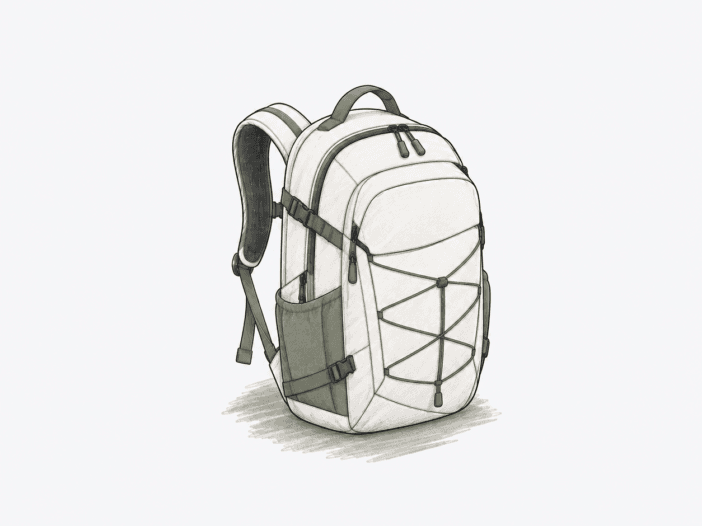
Buyers who carry a laptop, charger, notebooks or documents, a bottle, and daily work or campus gear will find the Borealis the best fit. The evidence shows that this laptop-first daily load aligns cleanly with comfort, support, and organization.
Packing the Borealis as a locker replacement, with several binders or textbooks, lunch, clothing, and other bulky items, yields mixed results in the evidence. Some heavy school loads fit, but others run into a stiff or slim packing shape, tighter access, or less usable space than expected.
Body fit shifts the decision for many buyers. Model-specific evidence indicates that the Men’s/Unisex Borealis has a larger back panel and wider shoulder straps than the Women’s version. The same evidence doesn’t support a single capacity, dimension, or laptop-size spec across all Borealis generations. Check the exact product details on the listing you plan to buy.
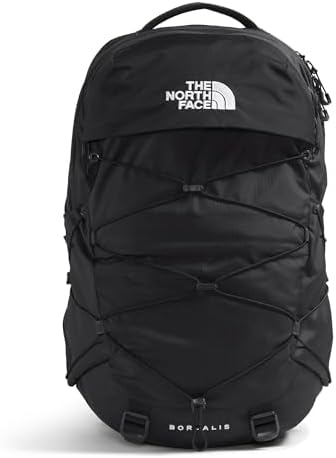
Product Snapshot
| Product Detail | Decision Relevance |
| Laptop-oriented daily carry | Repeated buyer evidence supports work, commute, and campus setups built around a laptop plus normal daily essentials. |
| Men’s / Unisex vs Women’s model | The comparison evidence indicates a larger back panel and wider shoulder straps on the Men’s model; the Women’s model is slightly smaller, with a differently shaped harness. |
| Dedicated laptop storage | Buyers repeatedly value the laptop area, and individual 15- and 16-inch devices are reported as fitting. Maximum-size and sleeve-dimension statements vary by listing and year. |
| Front/admin organization | Buyers often value small-item organization, but evidence also links heavier front-loading with top-heavy or unstable standing behavior. |
| Water resistance | Several buyers report satisfactory use in routine rain, while the Q&A explicitly states the pack is not waterproof and that heavier moisture can enter through zippers or stitching. |
Buyer Evidence Metrics
| Buyer Question | Metric | Evidence |
| Does a heavy school load create more capacity friction than a moderate daily/commute load? | CFL 2.00× | Moderate · n=8 |
| Does useful front/admin organization often appear with standing or balance friction? | TCR 0.80 | Limited · n=5 |
| Is there a consistent boundary between routine wet use and heavy-moisture protection? | UBC 1.00 | Moderate · n=11 |
| Does bottle size create a repeatable space or stability boundary? | UBC 0.89 | Moderate · n=9 |
How these metrics work: Context Friction Lift (CFL) measures whether a known friction is more concentrated in one eligible context than in a comparable eligible context. Trade-Off Coupling Rate (TCR) measures how often an observed product strength co-occurs with a specific friction within eligible buyer evidence.
Use Boundary Consistency (UBC) to measure how consistently eligible buyer evidence separates a supported use case from the condition under which that use becomes more limited or conditional. n is the number of relevant, eligible, deduplicated buyer observations used for that metric—not the product’s total review count. For CFL, public n reflects the smaller eligible comparison group. These are buyer-evidence signals, not product-performance scores. See how these buyer-evidence metrics work.
A CFL 2.00× signal does not mean a heavy school load is twice as likely to fail. In the eligible evidence, capacity friction shows up more often in heavy-school setups than in moderate daily or commute setups. Several buyers still report successful heavy school loads, so the evidence points to a context shift, not a hard capacity cutoff.
A TCR signal of 0.80 does not establish that the organizer causes instability. In the eligible evidence, useful front- or admin-office organization and top-heavy or standing friction often appear together. This trade-off matters most for buyers who load chargers and other dense items into the front section and want the pack to stand beside a desk or seat.
A UBC 1.00 weather signal does not mean a 100% chance of keeping contents dry. In the eligible evidence, routine or light wet exposure usually works, but heavy moisture or watertight expectations mark the point at which protection becomes conditional. One positive winter example also used Scotchgard, so that does not prove native waterproofing.
A UBC 0.89 bottle signal marks a practical boundary. Standard and smaller bottles fit cleanly in the evidence. Larger or wide-mouth bottles can push into interior volume or throw off standing balance. One buyer used a 64 oz Yeti with two laptops, so the evidence does not support a universal bottle-size ceiling.
Fit–Friction Matrix
| Buyer Setup / Context | Fit Signal | Main Friction |
| Laptop + charger + notebooks/documents + normal daily essentials for work or commuting | Generally Works | Space becomes less flexible as bulky food, clothing, or extra accessories accumulate. |
| Multiple binders/books + laptop + lunch or other bulky school items | Mixed / Variant-Dependent | Some heavy school setups fit, while others run into a slim or stiff packing shape, tighter access, and insufficient practical space. |
| Front/admin section carrying chargers, earbuds, pens, and other small items | Conditional Fit | Concentrating dense items high in the front can make the backpack top-heavy or less stable when set down. |
| 20–32 oz bottle alongside a normal daily load | Generally Works | Larger or wide-mouth bottles can push inward on the main compartment, and heavier bottles can worsen balance. |
| Light rain or routine wet-weather commuting with electronics inside | Generally Works | The evidence does not establish waterproofing; heavier or prolonged moisture can enter through zippers or stitching. |
Variant Fit Patterns
The evidence supports a real model-fit distinction, but it supports that distinction more strongly for body fit than for broader performance differences.
- Men’s / Unisex Borealis: A cross-model answer describes the Men’s version as having a larger back panel and wider shoulder straps. In a separate short-torso school-use question, the larger model was described as potentially too long depending on torso proportion. A later buyer also reported returning the unisex version because it felt too large before choosing the Women’s version.
- Women’s Borealis: Model-specific evidence describes a slightly smaller pack with a women-specific or more curved harness. In the limited direct comparisons, the smaller model worked better for buyers who found the larger version oversized.
- Generation check: One 2021 comparison gives 28 L for the Men’s version and 27 L for the Women’s version, while an older 2016 Women’s specification gives 25 L. Because the evidence spans multiple years and doesn’t consistently label generations, those figures shouldn’t be collapsed into a single current Borealis specification.
How Buyers Actually Use It
The most useful buyer reports list exactly what was inside the Borealis when it worked. Positive or negative labels alone do not tell you much about fit.
- Commute example: One buyer report used the Borealis with a Dell Latitude 5450 and a tablet, and described the capacity as ample for commuting. That is one specific setup, not proof that every similarly sized laptop will fit every Borealis generation.
- Bike-commute example: One buyer carried a 13-inch laptop, documents, a change of clothes, and cycling items. The separate laptop area was useful because it kept the computer and documents away from wet clothing.
- Laptop-heavy work example: One buyer carried a 16-inch MacBook Pro, a full-size Bible, precision tools, many adapters and cables, a bottle, and glasses. This is a useful upper-load example, but it remains one buyer’s configuration, not a universal capacity claim.
- School load outcomes split in the evidence. Some buyers fit multiple binders, notebooks, books, lunch, and other items without trouble. Others find the Borealis hard to load once bulky textbooks, binders, or a no-locker school day come into play. This conflict keeps heavy school carry in the Mixed or Variant-Dependent category, rather than calling it roomy or small.
The Organization Trade-Off Is About Weight Placement
Buyers praise the Borealis for keeping laptops and small accessories separate. Friction shows up when the front storage gets packed with too many dense items.
In the evidence behind TCR 0.80, front/admin organization and balance problems often occur together. Buyers describe the pack becoming top-heavy, leaning, falling over, or flopping when the front section carries substantial weight.
The real organization question is not pocket count, but where the weight lands. Pens, keys, a phone, and a few small accessories don’t load the organizer the same way several chargers, batteries, or other dense electronics do.
Weather Protection Has a Clear Ceiling
Evidence supports water resistance for routine use. It does not support calling the Borealis waterproof.
Several buyers report acceptable performance in ordinary rain, including for commuting and walking. However, Q&A explicitly states that the exterior has a water-resistant finish rather than a waterproof construction, and that heavier moisture can enter through zippers or stitching.
Buyers who carry a laptop in occasional rain find the evidence broadly reassuring. Buyers who need dependable protection during prolonged or heavy rain should add a dry bag, dry box, or other secondary protection rather than relying on the backpack alone.
Bottle Fit Is More Than “Does It Fit?”
Buyers report successful use with 20 oz, 26 oz, 32 oz, 40 oz, and even larger bottles. Physical fit is only part of the decision when carrying bottles.
- Standard and smaller bottles are repeatedly reported as straightforward.
- Larger or wide-mouth bottles can protrude into the main compartment, reducing usable interior space for other gear.
- A heavy bottle can shift the pack’s balance, making it less stable when standing upright.
- One buyer used a 64 oz Yeti with two laptops, so the evidence does not support declaring a universal maximum bottle size.
If you routinely carry a large insulated bottle, don’t just check whether it fits in the side pocket. Check how much space and stability it takes up once it is inside the pack.
What Buyers Compared It With
A few buyer comparisons in the evidence help clarify where the Borealis fits, but do not point to a universal winner.
- The North Face Recon: One buyer preferred the Borealis for laptop-oriented school or commuter use because of the suspended laptop area and reported standing behavior, while describing the Recon as potentially better suited to hiking. This is one buyer comparison, not a general product ranking.
- The North Face Jester: One smaller high-school user moved toward the Jester after the Borealis looked oversized, while another buyer considered the Jester before choosing the Borealis for bike commuting. Together, these examples reinforce that body fit and intended load can change the best match.
- Kelty Nomad 45: One buyer tried to downsize from a Kelty Nomad 45 to the Borealis but returned it because the access and usable space did not suit that load. That comparison warns against treating the Borealis as a smaller substitute for a much more open-volume travel pack.
What Buyers Should Check Before Buying
- Check the exact Borealis model and generation. The evidence distinguishes Men’s/Unisex and Women’s fits, while capacity, dimensions, and laptop-size statements vary across the years represented.
- Match the pack to your actual school or workload. In the evidence, laptop-first daily carry lines up more consistently than bulky no-locker school loads with several books, binders, lunch, and other large items.
- Check laptop fit by device dimensions, not screen size alone. Individual 15- and 16-inch devices appear in several buyer reports, but the sleeve dimensions and maximum-size claims vary by listing and year.
- If standing stability matters, keep dense accessories from dominating the front organizer. The eligible buyer evidence repeatedly links heavier front loading with top-heavy or unstable behavior.
- Treat the pack as water-resistant, not waterproof. Routine rain often works in the buyer evidence, but heavier moisture can reach the interior through zippers or stitching.
- Consider bottle size together with internal space. Large or wide-mouth bottles can fit but still push into the main compartment or change the pack’s balance.
Evidence supports the Borealis as the cleanest option for buyers who want a supportive, laptop-oriented daily backpack with compartment separation and a moderate load. The fit becomes conditional if you expect the same bag to carry a consistently bulky school setup, hold dense gear high in the front, fit very large bottles without losing space, or keep contents dry in heavy, prolonged rain.
