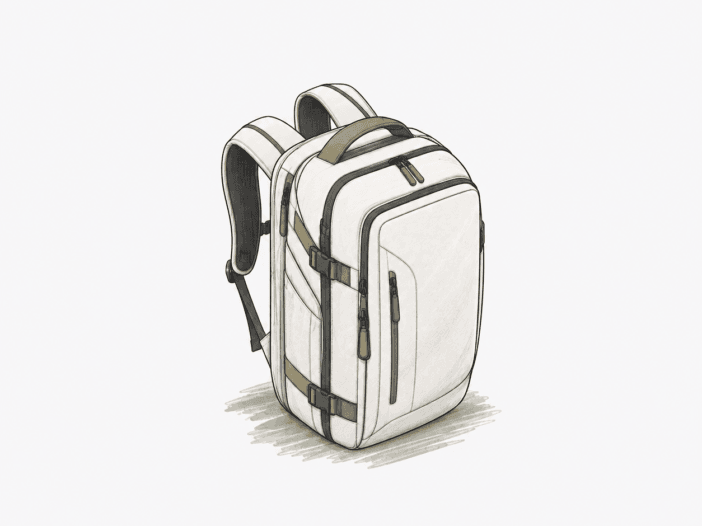
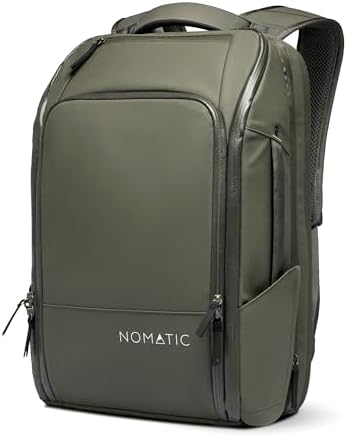
The Nomatic Travel Pack lets you carry work gear and short-trip clothing in one structured bag. Actual buyer setups include a laptop, tablet, chargers, documents, clothing, shoes, toiletries, and packing cubes all packed together.
Flexible capacity solves one problem but creates another. The larger Travel Pack starts at 20L and expands to 30L. Empty, it weighs 4.16 pounds. Expanded, the depth jumps from 6 to 9.5 inches. As you add weight or fill the bag close to its limit, especially for under-seat airline use, buyer feedback splits: some are satisfied, others run into frustration.
The 14L version covers a different use case. Smaller-frame buyers and a teacher carrying books report comfortable, organized carry, but there are fewer reports to draw from. Available evidence does not show the 14L’s expanded capacity, so treat this version as a more limited, purpose-built option instead of a scaled-down copy of the larger pack.
Product Snapshot
- Capacity: The larger version starts at 20L and expands to 30L, per manufacturer specs. That range covers a typical work-bag load and stretches to fit short-trip clothing and accessories.
- Weight: The 20L–30L version weighs 4.16 pounds empty, per manufacturer evidence. Buyer comfort reports are split at this number. Use it to check your own carry tolerance, not as a comfort guarantee.
- Dimensions: The 20L–30L version measures 18.5 by 12 by 6 to 9.5 inches externally, per manufacturer evidence. Expanded depth pushes the bag close to airline-fit limits.
- Organization: Manufacturer specs list 50% expansion, a mesh divider for clothing, and a fold-down laptop area for airport screening on the 20L–30L version. Buyers call out organization as a clear strength in most reports.
- Version caveat: Available evidence covers different product revisions and purchase channels. Check the zipper design, materials, waist strap, and bundled accessories on the exact unit you plan to buy.
Buyer Evidence Metrics
| Buyer Question | Metric | Evidence |
| Does expanding to 30L make under-seat fit more conditional? | CFL 1.20× | Limited · n=4 |
| Does mixed tech-and-clothing versatility often appear with weight, bulk, rigidity, or strap-load friction? | TCR 0.43 | Limited · n=7 |
| Does the evidence show a recognizable airline-fit boundary between the 20L base state and the expanded state? | UBC 0.63 | Moderate · n=8 |
How these metrics work: Context Friction Lift (CFL) measures whether a known friction is more concentrated in a defined eligible context than in the eligible baseline. Trade-Off Coupling Rate (TCR) measures how often an observed product strength appears together with a specific friction among eligible buyer evidence.
Use Boundary Consistency (UBC) measures how consistently eligible buyer evidence separates a supported use case from the condition where that use becomes more limited or conditional. n is the number of relevant, eligible, deduplicated buyer observations used for that metric—not the product’s total review count. For CFL, public n reflects the smaller eligible comparison group. These are buyer-evidence signals, not product-performance scores. See how these buyer-evidence metrics work.
Read those numbers as evidence signals, not success rates:
- UBC 0.63 is not a 63% probability of fitting under a seat. It indicates that the eligible evidence shows a moderately consistent boundary: the unexpanded state is generally easier to place, while expansion makes the outcome more dependent on the airline, aircraft, seat, and packed depth.
- CFL 1.20× does not mean the expanded bag is 20% worse. It means under-seat friction is somewhat more concentrated in the explicit expanded context than in the eligible comparison baseline. A fully expanded bag still fit snugly under a United 737-900 seat in one specific report.
- TCR 0.43 does not mean expansion causes discomfort. It shows that the mixed tech-and-clothing strength sometimes appears alongside weight, bulk, rigidity, or strap-load friction, while other eligible observations report the versatility without that same friction.
Fit–Friction Matrix
| Buyer Setup / Context | Fit Signal | Main Friction |
| 14L for school, work essentials, light travel, or a smaller-frame user | Specific Example Only | Several specific buyers reported comfortable, organized carry, but the 14L evidence base is too limited to establish a broad fit pattern. |
| 20L base with laptop, tablet, work accessories, and a modest amount of clothing | Generally Works | The 20L–30L version starts at a manufacturer-stated 4.16 lb empty, and one known 20L loadout produced painful shoulder-strap pressure. |
| 30L expanded with tech plus clothing, shoes, or toiletries for a short trip | Conditional Fit | Expansion increases usable packing range but reduces under-seat and personal-item margin; airline and aircraft geometry matter more. |
| 12.9–13-inch tablet with Pencil, keyboard, or case, in reports where the exact Travel Pack variant was not stated | Limited Fit | Multiple buyers reported the dedicated tablet sleeve becoming very tight or not fitting those accessory-equipped tablets. |
| Deep or larger laptop such as a Framework 16 with external GPU or a 17-inch laptop, in reports where the exact variant was not stated | Limited Fit | Those specific larger/deeper devices did not fit the dedicated protected laptop area in the supplied evidence. |
| Travel Pack paired with roller luggage, in reports where the exact variant was not stated | Conditional Fit | The pass-through can be useful, but some roller handles were too large and the horizontal mounting orientation can make access less convenient. |
Variant Fit Patterns
14L: works when smaller carry matters, but evidence is limited
The 14L shows a few encouraging examples, not a broad pattern:
- A 5-foot user reported that the bag felt comfortable and did not look overwhelming.
- A teacher carrying books reported stable carry without shoulder pain and liked the organization.
- A traveler using the 14L during a long flight layover liked the organization but criticized the thin straps, material feel, and zipper behavior around corners.
One buyer compared the 14L and 20L directly and chose the 20L, saying the 14L’s trade-offs didn’t save enough space to justify the switch. That is just one report, not a rule for everyone. The practical takeaway: pick the 14L if your setup actually needs the smaller format, not just because it is the smaller option.
The available evidence does not pin down the 14L’s expanded capacity or show a strong long-term durability pattern.
20L base: clearest crossover from work to short trip
The 20L-to-30L version fits best when you start with work tech and add clothing. Buyers report setups with laptops, tablets, chargers, documents, headphones, books, and short-trip clothing.
One heavy work setup included three laptops, over-ear headphones, books, and computer accessories, all without using the expansion space. That example shows the bag’s organizational capacity, but it does not mean the same load will feel comfortable for every buyer.
Under-seat fit in the 20L state is usually better than in expanded mode, but not guaranteed. Some buyers report successful unexpanded under-seat use, including on American Airlines, while another 20L report says the bag did not fit. One buyer notes that the rigid construction makes it harder to squeeze around seat hardware.
30L expanded: more packing room, less airline margin
The expanded mode is where the Travel Pack’s crossover role stands out. One buyer packed workout clothes, a change of clothes, a toiletry bag, running shoes, a 15-inch MacBook, notebooks, and lunch. Other buyers describe 2–3 day work or leisure trips with the same work-focused organization.
Extra depth changes the airline fit boundary. Manufacturer guidance says a fully expanded bag can fit under seats on several airlines, but Spirit is called out as a case where the depth may not be enough. One buyer got a fully expanded, packed bag under a United 737-900 seat, but it was a snug fit.
Available evidence does not support a blanket ‘fits under the seat’ claim. The more you use the 30L expansion, the more under-seat fit depends on the airline, aircraft, and how you pack the bag.
How Buyers Use It
Most buyers use the Travel Pack for the gap between daily carry and full luggage.
- Work plus short business travel: Buyers combine laptops, tablets, files, chargers, and clothing in one bag for short trips.
- Daily work carry: Some owners use the same organization for commuting, but lighter-load users sometimes say the bag is heavier or bulkier than they want to carry.
- Air travel: Under-seat use comes up often, but the outcome changes with expansion, how full the bag is, the aircraft, and the seat shape. Check your own airline and seat before assuming a fit.
- Short one-bag trips: Clothing, shoes, toiletries, and packing cubes appear alongside tech in multiple specific examples.
Location-specific examples sharpen those patterns, but do not guarantee the same result everywhere:
- A buyer flying frequently into Washington, DC, used the bag for 3–4 day work trips with packing cubes and reported using it under the seat on smaller planes.
- A buyer on a Portugal trip packed shoes, clothing, toiletries, a book, and other essentials and reported successful under-seat use.
- A buyer traveling for three weeks across Honshu and Kyushu in Japan valued the capacity but described the bag as heavy for everyday carry.
- A New York snow-belt commuter carried dress shoes and a 16-inch MacBook Pro and reported good weather shedding, although the broader rain evidence remains mixed.
What Buyers Carry With It
The available evidence shows three practical load patterns:
- Work-tech load: laptop, tablet, chargers, cables, files or notebooks, water bottle, and small accessories.
- Short-trip extension: clothes, toiletries, shoes, or packing cubes added around the tech load when more capacity is needed.
- Modular organization: specific buyers mention Nomatic packing cubes, a tech pouch, and a toiletry/wash pouch as removable organization pieces.
Device fit needs a separate check. Screen size alone does not tell the whole story.
A Samsung Galaxy Tab A 10.1 fits one tablet pocket. By contrast, several 12.9- to 13-inch tablets became tight or did not fit when a Pencil, keyboard, or case was attached. Those larger-tablet reports do not specify the exact Travel Pack variant, so treat them as a product-family caution, not a known-variant spec.
Laptop fit shows a similar boundary. 16-inch MacBook examples are positive, but a Framework 16 with an external GPU (11.5-inch depth) and a separate 17-inch laptop did not fit the protected laptop area. Those non-fit reports come from evidence where the exact Travel Pack variant was not established.
What Buyers Compare It With
Two direct comparisons add useful decision context:
- North Face Refractor: One buyer kept the Nomatic because its organization and expandable business/leisure packing better matched that buyer’s use, even though the North Face was judged more favorably for materials.
- MARK RYDEN Business Backpack: Another buyer returned the Nomatic and kept the MARK RYDEN because that buyer prioritized easier compression into airline sizing limits, device carry, and lower cost.
Other individual reviews mention Tumi, Swissgear, Bange, AER Duffel 2, Incase Icon, and a Huckberry Everyday Backpack. Available evidence does not support turning those mentions into a ranked comparison.
What to Check Before Buying
- Check airline fit using your bag’s real packed depth. The unexpanded 20L state has several successful under-seat reports, but at least one non-fit. Expansion makes the result more conditional, not guaranteed.
- Decide if a 4.16-pound empty bag fits your carry tolerance. That number comes from manufacturer evidence for the 20L–30L version. Buyer experience is mixed. Some report comfortable extended carry, while others mention shoulder fatigue, thin-strap pressure, or that the bag is too much for lighter daily loads.
- Measure your actual laptop and tablet with accessories attached. Buyer evidence shows that cases, keyboards, pencils, and device depth often matter more than the screen-size label.
- Check your roller handle before depending on the luggage pass-through. Some buyers report tight fits, including one Travelpro Elite handle that did not fit.
- Verify the exact product revision and included accessories. Available evidence covers different revisions and purchase channels, so zipper design, materials, waist-strap inclusion, and bundled accessories are not consistent enough for a single family-wide promise.
- Treat weather protection as conditional. Some buyers report good rain shedding or dry contents, but one buyer reported serious water ingress after about 20 minutes of side rain. Available evidence does not establish waterproof performance.
The Nomatic Travel Pack fits best when you need structured work organization that can stretch into short-trip capacity. The 20L-to-30L version covers the widest range, but that flexibility means more baseline weight, less compressibility, and tighter airline-fit margins as you expand the bag. The 14L is a better fit if you need a smaller format, but buyer evidence for that version is much thinner.

