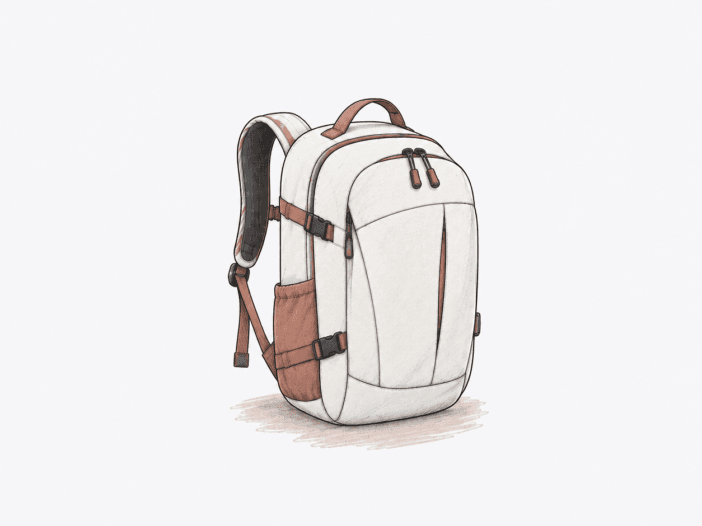
Buyer reports suggest the Pacsafe Vibe 25 works best as a security-focused city or day-trip backpack, or as an airline personal item. It fits best when you carry a laptop or electronics, documents, water, and light daily essentials.
Capacity hits a wall quickly if you try to use the Vibe 25 for more than city or day-trip loads. Buyers carrying just daily essentials found the bag practical. But when they packed it as a full carry-on or overnight bag, several ran out of space, with the front compartment losing usable room first.
The real test is not the 25-liter label. What matters is whether your actual load matches the moderate, security-focused day-carry setups buyers keep reporting.

At a Glance
- Best-supported role: international city travel, destination day use, work trips, and airline personal-item carry.
- Best-supported load pattern: laptop or electronics, charger/cables, documents or valuables, water, and light daily items.
- Main capacity boundary: buyer evidence only supports reliable use when the main compartment stays underfilled. Filling the main compartment for carry-on or overnight loads, and easy organization, drops off fast.
- Security pattern: lockable access, anchoring to a fixed object, and RFID storage are recurring reasons buyers valued the bag.
- Main cautions: buyers split on weight perception, the bag is not proven waterproof, and there is not enough strap-fit evidence from shorter users to support a general body-size recommendation.
Product Snapshot
| Product detail | Decision relevance |
| 25L travel backpack | Buyer evidence supports a compact daypack/personal-item role more consistently than a fuller carry-on or overnight role. |
| Security system described in the supplied product information | The supplied description lists Exomesh stainless-steel wire mesh, a detachable anchoring shoulder buckle, a Roobar zipper-locking point, and an RFID-blocking pocket. Buyers repeatedly valued the resulting security-focused carry experience. |
| Multi-purpose 13-inch laptop/hydration sleeve | A 13-inch sleeve is the supplied product fact. Individual buyers also report fitting 15-inch and 16-inch computers, but those isolated examples do not establish general larger-laptop compatibility. |
| Stated empty weight: 2.14 lb | The weight figure comes from the supplied product description. Buyer perception is mixed: some call the bag lightweight, while others describe it as heavy or heavier than expected. |
| Waterproofing not established | Several buyers report some water shedding or short rain tolerance, but heavy-rain travel evidence still points to using external protection. |
Buyer Evidence Metrics
| Buyer Question | Metric | Evidence |
| Does front-compartment space become more constrained when a laptop or fuller main load is already present? | CFL 1.50× | Limited · n=4 |
| How consistently does buyer evidence separate successful day/destination use from more conditional carry-on or overnight use? | UBC 1.00 | Moderate · n=9 |
| How often does compact-carry usefulness appear together with fuller-load capacity friction? | TCR 0.29 | Limited · n=7 |
| Does shorter-user strap adjustment show a recurring fit boundary? | CFL — | Very Limited · n=2 |
How these metrics work: Context Friction Lift (CFL) measures whether a known friction is more concentrated in a defined eligible context than in the eligible comparison baseline.
Use Boundary Consistency (UBC) to measure how consistently eligible buyer evidence separates a supported use case from the condition under which that use becomes more limited or conditional.
Trade-Off Coupling Rate (TCR) measures how often an observed product strength co-occurs with a specific friction within eligible buyer evidence.
For CFL, public n reflects the smaller eligible comparison group; for UBC and TCR, n is the number of relevant, eligible, deduplicated buyer observations used for that metric—not the product’s total review count. These are buyer-evidence signals, not product-performance scores. See how these buyer-evidence metrics work.
A UBC 1.00 signal does not guarantee that the Vibe 25 will always work for day use or always fail for overnight use. Across the nine eligible buyer reports, this metric consistently distinguished workable day- or destination-use from the point at which fuller carry-on or overnight packing created friction. One buyer said one or two nights of essentials should fit, but did not actually use the bag that way.
The CFL 1.50× signal only covers a narrow case. In the eligible evidence, front-compartment friction occurred more often when a laptop or a fuller main load already took up most of the bag. The public comparison group only includes four observations, so this is a limited-evidence relationship, not a universal capacity rule.
If you need a short harness setting, adjust the strap yourself. Only two eligible buyer reports address this, so there is no numeric CFL value for shorter-user fit.
Fit–Friction Matrix
| Buyer Setup / Context | Fit Signal | Main Friction |
| Laptop or electronics + charger/cables + documents/valuables + water for city or day-trip use | Recurring Strong Fit | Capacity becomes less forgiving when bulky clothing or other additions make both the main and front compartments compete for space. |
| Airline personal item paired with a separate larger carry-on | Generally Works | Multiple buyers report under-seat use, but the supplied evidence does not provide product dimensions or airline-specific limits that would support a universal under-seat claim. |
| Vibe 25 used as the main carry-on or overnight bag | Conditional Fit | Several buyers report that filling the main compartment reduces front-compartment usefulness or makes the overall 25L role feel too small. |
| Shorter wearer who needs substantial strap shortening | Mixed / Variant-Dependent | One shorter user reported comfortable shoulder carry, while a 168 cm buyer reported that the straps could not be shortened enough. Evidence is too sparse to generalize by height. |
| 15-inch or 16-inch laptop setup | Specific Example Only | Individual buyers report successful fit, but the supplied product description specifies a 13-inch sleeve, so broader larger-device compatibility is not established. |
How Buyers Use It
Most buyers use the Vibe 25 for moving through busy cities and travel environments with a moderate daily load. It rarely serves as a maximum-capacity one-bag solution.
A few examples make that pattern clearer:
- Rome and the Vatican: one buyer used the bag in heavy crowds with two water bottles and a sweater. That buyer specifically valued the layered zipper-locking options and the ability to anchor the shoulder strap to a fixed object.
- Guatemala, Mexico, Japan, and Thailand: one buyer carried a MacBook Air, a battery pack, charging wires, passports, cards, water, snacks, and a light jacket, and still reported room for souvenirs. That same buyer used a poncho over the bag in heavy rain and explicitly did not regard the backpack as waterproof.
- Peru and Ecuador: one buyer used the bag all day for three weeks and reported no general quality problem, but experienced repeated rain-flap zipper jamming; one jam was severe enough that the flap had to be cut to free the zipper.
- Greece and Italy: one buyer described the Vibe 25 as lightweight, easy to lock, and able to fit under airline seats.
- Asia and Europe work trips: one buyer carried a MacBook Pro and other electronics and specifically valued the secure zippers and compartments.
These are buyer-reported examples, not controlled tests. Still, the pattern suggests the Vibe 25 performs best as a secure destination daypack.
What Buyers Carry With It
The evidence shows several practical load patterns.
- Laptop travel setup: MacBook Air, battery pack, charging wires, passports/cards, water, snacks, and a light jacket.
- Airline personal-item setup: 13-inch Dell Inspiron 2-in-1 in the Vibe 25, with a separate duffel serving as the larger carry-on.
- Camera + clothing setup: one buyer placed a Canon M3 camera case and two small pouches in the front section while carrying a sweater, three shirts, pants, and two scarves in the main compartment.
- Sightseeing setup: water, hat or sweater, snacks, toiletries, and souvenirs appear across several day-trip examples.
- Bottle example: one buyer reported that a 26 oz Yeti Rambler fit in a side pocket with room to spare. The evidence does not directly establish compatibility with a 32 oz bottle.
The key pattern for buyers is that fitting individual items does not guarantee the whole load stays organized. Friction shows up when you fill the main compartment and still expect the front compartment to hold real volume.
Weight and Comfort Stay Mixed
The product description lists an empty weight of 2.14 lb. Buyer reactions split: some call the Vibe 25 lightweight, others call it heavy. There is no single weight verdict here.
Some buyers explicitly describe the backpack as lightweight. Other buyers call it heavy before loading, heavier than expected, or unsuitable for longer hauling distances.
Comfort reports are also context-dependent:
- one 6 ft 3 in buyer reported comfortable all-day carry with a 7–8 kg load;
- several other buyers reported comfortable shoulder carry during travel;
- one 168 cm buyer reported that the shoulder straps could not be shortened enough.
The evidence supports mixed perceptions of weight and fit. No universal comfort claim holds up in the buyer reports.
Security Is the Clearest Strength—But It Adds Interaction
Security is the most repeated positive theme in the buyer evidence.
Buyers specifically valued:
- locking the main and front zipper pulls;
- anchoring the bag to a chair, table, pole, or other fixed object;
- carrying passports or cards in RFID-shielded storage;
- having fewer exposed compartments to monitor in crowded places;
- choosing whether to leave one compartment easier to access while securing another.
The security-focused design adds some interaction cost. One buyer needed a video to learn the features and later forgot how some worked. Another buyer reported a loosened or broken zipper-lock component. Another buyer reported repeated zipper-flap jams.
These reports do not show a general durability failure. They do show that the security and closure system creates a real usability trade-off, not just an extra feature.
Weather Protection Has a Clear Boundary
The buyer evidence does not support describing the Vibe 25 as waterproof.
Some buyers saw water bead on the exterior or said the bag handled a short burst of heavy rain. These reports only support limited water shedding.
During heavier travel, one buyer in Guatemala and Thailand used a poncho over the backpack and said it was neither waterproof nor meaningfully water-resistant for that situation. Another buyer recommended extra protection, even though they thought the nylon shed water well.
If you expect regular heavy rain, plan for external rain protection. The evidence does not support treating the backpack itself as a waterproof barrier.
What Buyers Compare It With
- Pacsafe Vibe 30L: one owner of both bags said the 25L felt noticeably smaller despite the nominal 5L difference and preferred the larger Vibe 30L when more capacity was needed.
- A larger Pacsafe carry-on: one buyer who found the Vibe 25 limiting as a carry-on bought a larger Pacsafe for that role and kept the Vibe 25 for daily use after reaching the destination.
- Pacsafe Metrosafe LS250: one reviewer mentioned it only while discussing similar curved-base geometry. The evidence doesn’t support a broader performance comparison.
This comparison pattern matters because most buyers switch bags when they need more capacity, not because they reject the Vibe 25’s security features.
What Buyers Should Check Before Buying
- Define the role first. Buyer evidence is strongest when the Vibe 25 is a secure daypack, destination bag, or airline personal item. Evidence becomes more conditional when it must serve as the main carry-on or an overnight bag.
- Check your full load, not just the laptop. A laptop might fit, but the charger, tablet, clothing, camera gear, or front-pocket items often create the real capacity limit.
- Treat larger-laptop fit reports with caution. The product listing states it’s a 13-inch sleeve. Reports of 15-inch and 16-inch computers fitting come from isolated buyers, not general compatibility evidence.
- If you need a short harness setting, check strap adjustment yourself. One shorter buyer reported comfort, but a 168 cm buyer could not shorten the straps enough. There is not enough evidence for a general height rule.
- Plan for heavy rain separately. Buyer reports show some water shedding, but do not establish waterproof protection.
- Decide if the security workflow fits your habits. Lockable access and anchoring are the main strengths, but some buyers report friction when learning to use the features, zipper flaps, or lock components.
Bottom Line
Buyer evidence most strongly supports the Pacsafe Vibe 25 for someone who wants a security-focused international city/day-trip backpack or airline personal item and usually carries a laptop or electronics, documents, water, and moderate daily essentials.
The evidence does not show the Vibe 25 lacks useful capacity. The real boundary is more specific: capacity gets less forgiving when you fill the main compartment and still expect real front-compartment space, or when you push the 25L format toward a full carry-on or overnight role.
This decision is clear for most buyers. If your setup is a moderate day-carry, buyer evidence supports the security-and-organization concept. If you need fuller packing, larger-device fit, a shorter harness, or regular heavy-rain protection, the evidence becomes more conditional.
