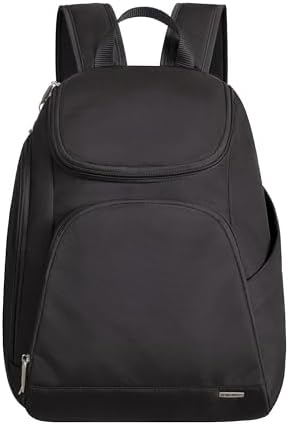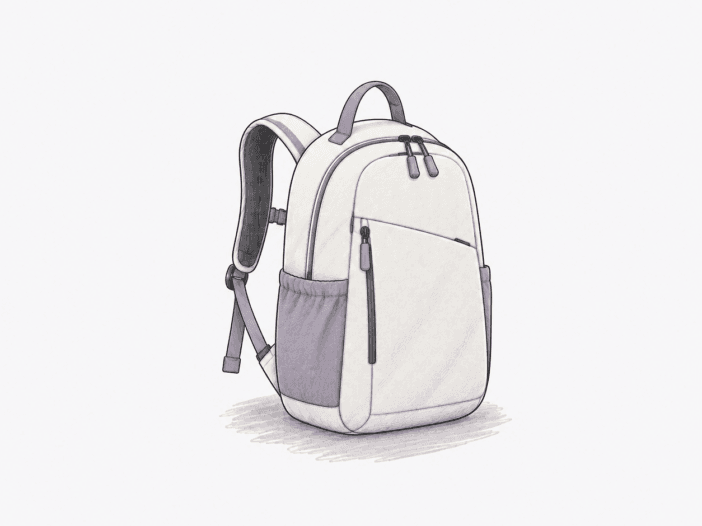
Buyers pick Travelon Anti-Theft Classic Backpack for compact, security-focused carry. Maximum capacity is not the main draw.
Most buyers use the Travelon Anti-Theft Classic Backpack for city sightseeing, crowded transit, day trips, airline personal-item carry, and daily commuting. The typical load is modest: a tablet or small laptop, chargers, travel documents, a water bottle, an umbrella, a camera or small camera kit, and a light layer.
Compact size brings real trade-offs. Zipper clips add an extra step every time you open a compartment. The tapered upper opening makes fit inconsistent for larger laptops. Buyers who need full-size backpack volume, a trolley sleeve, a chest strap, or reliable heavy-rain protection will hit clear limits.
Buyer evidence does not show a stable, decision-relevant variant. Some buyers mention pocket or padding changes between purchases, but the evidence does not clarify if those differences come from color, production run, or another configuration change.

Product Snapshot
| Product detail | Decision relevance |
| 12 × 16 × 6 in | The compact profile matches the recurring day-travel and under-seat use pattern, although airline limits still vary. |
| 1 lb 6 oz | The bag starts relatively light; loaded comfort still depends on the carried load and individual fit. |
| Capacity listed as 13 L in some manufacturer answers and 14 L in another | The evidence does not support treating either number as a stable current capacity. Real load fit is more useful than the nominal liter figure. |
| Water-resistant rather than waterproof | Buyer rain reports are mixed, so heavy-rain protection should not be assumed. |
| Slash-resistant shoulder straps and clipped exterior zippers | These features support the security-focused use pattern, but the clips can make access slower or more deliberate. |
| No trolley sleeve; no chest/sternum strap | These omissions matter for buyers who rely on rolling-luggage integration or extra stabilization under heavier loads. |
Buyer Evidence Metrics
| Buyer Question | Metric | Evidence |
| How consistently does small-device fit become more conditional around 13.5–15-inch-class laptops? | UBC 0.78 | Moderate · n=18 |
| How often does positive security-clip evidence also include slower, stiffer, or more deliberate access? | TCR 0.57 | Moderate · n=14 |
| How often do compactness-positive reports also explicitly describe hitting a capacity ceiling? | TCR 0.15 | Strong · n=20 |
How these metrics work: Use Boundary Consistency (UBC) measures how consistently eligible buyer evidence separates a supported use case from the condition where that use becomes more limited or conditional. Trade-Off Coupling Rate (TCR) measures how often an observed product strength appears together with a specific friction among eligible buyer evidence. n is the number of relevant, eligible, deduplicated buyer observations used for that metric—not the product’s total review count. These are buyer-evidence signals, not product-performance scores. See how these buyer-evidence metrics work.
The UBC 0.78 signal does not mean a 78% chance that a laptop will fit. In the eligible evidence, 11–13-inch-class devices fit repeatedly, while larger devices become more conditional. That boundary is not absolute. Several buyers report fitting a 14- or 15-inch device, but Travelon and other buyers also report failures or very tight fit in the same size range.
The TCR 0.57 security-access signal shows a real trade-off, not a defect. Many buyers value the zipper clips for deterrence or peace of mind, but access friction comes up often enough that buyers who open compartments constantly should expect it as part of the design. Other buyers describe the clips or zippers as easy or smooth, so the friction is not universal.
The TCR 0.15 compactness-capacity signal is easy to misread. This number does not mean capacity limits are unimportant. It means buyers who praise the compact footprint rarely mention a capacity ceiling in the same report. Separate buyer evidence still shows a clear boundary when loads get bulky, multi-person, or closer to full-size backpack use.
Fit–Friction Matrix
| Buyer Setup / Context | Fit Signal | Main Friction |
| City sightseeing or public transit with a tablet/small laptop, charger, bottle, umbrella or light layer | Recurring Strong Fit | Security clips can slow access, and a fuller main cavity can require more rummaging. |
| Airline personal-item or under-seat role with a moderate essentials load | Generally Works | Airline rules are not universal, and the backpack has no trolley sleeve. |
| Roughly 11–13-inch-class device plus compact accessories | Generally Works | The tapered upper opening reduces margin as device dimensions increase. |
| 13.5–15-inch-class laptop | Mixed / Variant-Dependent | Travelon rejects 15-inch fit and several buyers report tight or failed fit, while other buyers report successful 14- or 15-inch carry. Exact dimensions matter more than screen-size labels alone. |
| Bulky multi-person, extended-trip, or full-size-backpack-style load | Limited Fit | The compact body loses capacity margin as clothing, larger devices, or multiple people’s gear accumulate. |
| Travel where dependable heavy-rain protection is required | Conditional Fit | Travelon describes the bag as water-resistant, not waterproof, and buyer reports include both dry interiors and wet contents in heavy rain. |
How Buyers Actually Use It
Most buyers use this bag as a secure day companion, not as a small one-bag travel pack. Buyer reports most often describe:
- City walking and sightseeing. Philadelphia, London, Spain, Italy, Switzerland, Southeast Asia, and other travel contexts appear in the evidence. These are specific buyer examples, not claims that the bag performs identically in every destination.
- Crowded transit and urban movement. Buyers concerned about pickpocketing or unnoticed zipper access repeatedly value security clips. One Marrakech report describes an attempted pickpocket failing to open the clipped zipper before the wearer noticed; that is one buyer experience, not proof against theft.
- Airline personal-item use. Multiple buyers report under-seat carry. One buyer specifically reports fitting the Air France sizer at Paris Charles de Gaulle, but that single observation should not be generalized to every airline or aircraft.
- Everyday commuting and purse-replacement use. Some buyers continue using the backpack after travel because the compact profile, padded straps, and security features also suit daily carry.
What Buyers Carry With It
Buyer loadouts show why the bag feels roomier than it looks, as long as you keep your load compact.
Commonly reported combinations include:
- a tablet or small laptop with chargers and cables;
- travel documents, wallet, phone, glasses, and small personal items;
- a water bottle plus an umbrella or light sweater/jacket;
- a DSLR or smaller camera setup with selected accessories;
- snacks, toiletries, books, or small purchases added around the core load.
Named buyer examples include an iPad Pro 11, Bose over-ear headphones, and several MacBook Air sizes. These examples show what individual buyers carried; they are not universal compatibility guarantees.
This backpack handles a full day-use or personal-item load. Bulky objects eat up space much faster than a mix of smaller travel essentials.
Security Is Useful—But It Changes the Access Experience
Security-focused buyers are the strongest match for this design. Zipper clips, slash-resistant construction, and RFID-related features are repeatedly associated with greater perceived security in crowds.
These security features create the most common usability trade-off. Some buyers call the clips stiff, two-handed, tricky, or slow when they need quick access. Others describe the clips as smooth or easy to use.
The real buying question is not whether the clips are good or bad, but how often you need to open the bag while moving. If you want deterrence in crowds, the extra step may be worth it. If you reach for tickets, a phone, or a wallet all the time, you will notice the friction more.
Laptop Fit Has a Real Boundary—But Not a Clean Screen-Size Cutoff
Tablets and smaller laptops fit most consistently in the buyer evidence. Fit for 13.5- to 15-inch devices is inconsistent.
Travelon says a 15-inch laptop does not fit this model. Several buyers also report the tapered top opening blocks or complicates fit for larger devices. Still, some buyers manage to carry a 14-inch or even 15-inch laptop, sometimes with tight clearance or by packing carefully.
The safer decision rule is:
- treat 11–13-inch-class devices as the more consistently supported range in the buyer evidence;
- treat 13.5–15-inch-class devices as conditional;
- verify the laptop’s actual width and height, not just the advertised screen diagonal;
- remember that getting the device through the tapered opening is part of the fit problem, not just whether the interior is technically tall enough.
Long-Term Use Is Encouraging in Some Reports, but Not Uniform
Durability evidence doesn’t point to a single outcome in buyer reports.
One buyer reports over a decade of use. Another reports almost four years of regular service. These long-use examples show the backpack can last for years in some setups.
Other buyers report early failures with the grab handle, zipper, security clip, or stitching. Both patterns show up in the buyer evidence. Durability is mixed: not a clear failure rate, and not a universal long-life claim.
What Buyers Should Check Before Buying
- Measure your laptop. If your device is in the 13.5 to 15-inch range, check its actual width and height against the bag opening. Do not trust the screen-size label to match real fit.
- Decide how much access friction you can live with. Zipper clips add deterrence, but some buyers find them slower, stiffer, or easier to use only with two hands.
- Match the bag to a day-use load. Buyer evidence is strongest for a tablet or small laptop, travel essentials, a bottle, umbrella, light layer, and compact accessories. This bag does not suit bulky, multi-person, or extended-trip packing.
- Do not buy this backpack if you need a trolley sleeve or chest strap. It lacks those features, and several buyers miss them while traveling or carrying heavier loads.
- Plan for heavy rain separately. The product is water-resistant, not waterproof, and buyer reports on heavy rain are mixed.
- Check the current interior layout if pocket setup matters to you. Two buyer reports mention configuration differences between purchases, but the evidence does not show whether color, production run, or another factor caused them.