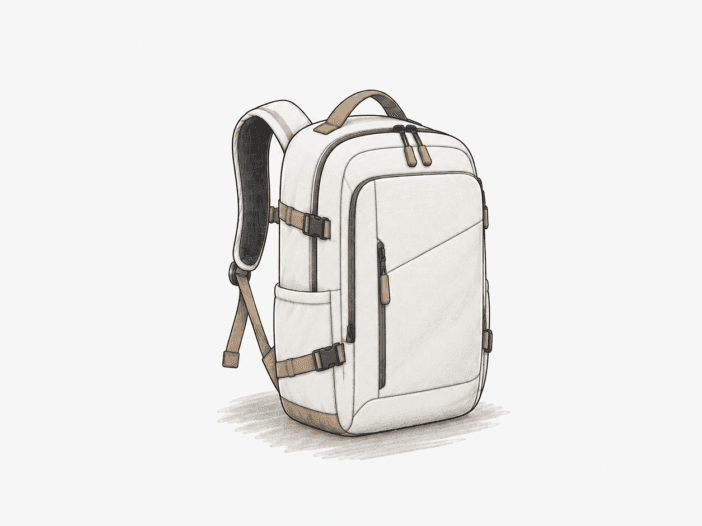
Most buyers use the Tomtoc Navigator-T66 40L for multi-day air travel, packing clothing, toiletries, a laptop, and usually a tablet or other tech in one bag. In these real setups, the 40L works as a carry-on-first, one-bag travel backpack. Fully packed, the 40L rarely fits under an airline seat without issues.
Fewer buyers report on the Tomtoc Navigator-T66 28L. The available 28L setups lean toward lighter under-seat travel and tech-heavy everyday carry, but the sample is too small to give the same confidence as the 40L evidence.
The main trade-off remains the same: the Navigator-T66 has an open interior that adapts to clothing and tech, but buyers who want built-in organization for small items usually add packing cubes or pouches.

Product Snapshot
| Product detail | Decision relevance |
| 40L variant | Manufacturer evidence identifies a 40L version, but several buyers independently perceived practical capacity closer to roughly 35–38L. Those estimates are buyer observations, not standardized volume measurements. |
| 40L size and weight | Manufacturer answers give two slightly different dimension sets: 20.5 × 13 × 8.66 in and 20.47 × 13.39 × 9.06 in. Manufacturer-stated weight is 2.65 lb, while one buyer reported 2 lb 4 oz. The evidence does not resolve either difference. |
| 40L device support | Manufacturer evidence states support for a 17-inch laptop/tablet setup. Buyer examples include 15- and 16-inch laptops carried with tablets and travel loads. |
| 28L variant | Manufacturer evidence states 2.53 lb and compatibility with a 15.6-inch laptop. One explicit 28L buyer fit a 16-inch laptop, but one buyer-specific fit does not establish universal 16-inch compatibility. |
| Evidence balance | Explicit evidence is substantial for the 40L and limited for the 28L. Feedback that does not identify the capacity variant is not reassigned to either version. |
Buyer Evidence Metrics
| Buyer Question | Metric | Evidence |
| How consistently does under-seat use become more conditional as the 40L approaches a full load? | UBC 1.00 | Limited · n=5 |
| How often does spacious, open storage appear together with small-item organization friction in eligible 40L evidence? | TCR 0.83 | Limited · n=6 |
| How often does successful multi-day 40L use appear together with buyer perception that practical capacity is below the nominal 40L? | TCR 0.62 | Moderate · n=13 |
Here’s how these metrics work. Use Boundary Consistency (UBC) shows how often eligible buyer evidence draws a clear line between a supported use case and the point at which that use becomes more limited or conditional. Trade-Off Coupling Rate (TCR) tracks how often a product strength and a specific friction show up together in eligible buyer reports. n counts the number of relevant, eligible, deduplicated buyer observations for that metric, not the total review count. These are buyer-evidence signals, not product-performance scores. See how these buyer-evidence metrics work.
A UBC of 1.00 does not mean the Tomtoc Navigator-T66 40L always fits or never fits under an airline seat. All five eligible buyer reports for this metric drew the same line: under-seat use worked better with a restrained or compressed load, but got more conditional as the bag filled. Airline rules and seat shapes still vary.
The two TCR values do not prove one thing causes another. They show how often a specific strength and friction appeared together in the eligible 40L buyer evidence.
Fit–Friction Matrix
| Buyer Setup / Context | Fit Signal | Main Friction |
| 40L: roughly 3–7 days of clothing + laptop/tablet + toiletries, used mainly as a carry-on | Recurring Strong Fit | Buyers who carry many loose accessories may need pouches or packing cubes because built-in small-item segmentation is limited in recurring evidence. |
| 40L: less-than-full or compressed load when trying to place the bag under an airline seat | Conditional Fit | Under-seat success varies with packing level, airline rules, and seat geometry; the evidence does not support a guaranteed fit for personal items. |
| 40L: fully packed load where under-seat placement is essential | Limited Fit | Multiple 40L observations shift toward protrusion, failure to fit comfortably, or overhead-bin use as the bag approaches a full load. |
| 40L: buyer needs every liter implied by the nominal 40L label | Conditional Fit | Several buyers still completed multi-day trips successfully, but multiple independent observations indicated a practical capacity closer to 35–38 L. |
| 40L: heavier load carried for longer airport or walking stretches | Conditional Fit | Shoulder padding is often described positively, but the lack of a hip belt becomes more relevant as load and carry duration increase. |
| 28L: laptop/tablet plus camera gear or lighter under-seat travel | Specific Example Only | Explicit 28L evidence is sparse, and available examples expose camera-organization, bottle-pocket, and device-size boundaries that are not yet strong recurring patterns. |
Variant Fit Patterns
40L: strongest evidence for multi-day carry-on travel
Buyers use the Tomtoc Navigator-T66 40L to pack clothing and tech in one bag for trips from a few days up to about a week. Actual packing results depend on clothing size, shoe bulk, and packing style.
Representative 40L buyer setups include:
- a 16-inch MacBook Pro, iPad, chargers, sneakers, toiletries, and about five days of clothing;
- a 15-inch work laptop, 12.9-inch iPad Pro, toiletries, and roughly three days of clothing;
- a 16-inch Surface Book plus a travel load, with extra pouches used to control smaller accessories;
- clothing-heavy multi-day loads where the open main compartment was paired with packing cubes or pouches rather than extensive built-in dividers.
The 40L evidence points to flexible carry-on packing as the main strength, not highly structured internal organization.
Treat the 40L label as nominal. Several buyers used the 40L for multi-day trips but estimated real usable space closer to 35–38L. These are buyer perceptions of usable space, not measured internal volume.
28L: useful signals, but not enough evidence for broad conclusions
Fewer buyers report on the Tomtoc Navigator-T66 28L. One detailed example: a buyer packed a 16-inch laptop, iPad, Sony A7III, five lenses, a portable charger, and smaller items with room left over. That same buyer wanted more internal compartmentalization for camera gear, so this example supports available space more than camera-specific organization.
Under-seat use for the 28L depends on how much you pack. One buyer fit a laptop plus a few items under an airline seat, but a full load of clothes, toiletries, and work items needed to go in the overhead bin.
Stay conservative on device fit. Manufacturer specs say the 28L fits a 15.6-inch laptop. One buyer fit a 16-inch device, but that does not guarantee every 16-inch laptop will fit.
How Buyers Use the Tomtoc Navigator-T66
The buyer evidence points to a few distinct ways the Navigator-T66 is used:
- One-bag air travel: The 40L is repeatedly used for clothing, toiletries, and tech in the same carry-on rather than splitting the load between a roller and work bag.
- Business travel: Buyer examples combine a laptop and work accessories with a short clothing load, allowing the same bag to move between meetings and airports.
- Packing-cube travel: Buyers who like the open main compartment often create their own structure with packing cubes or pouches instead of relying on built-in dividers.
- Under-seat travel: The evidence is conditional. Less-filled or compressed setups can work, but as the bag fills, it is more likely to protrude or require placement in the overhead bin.
Specific airline examples show why that last qualifier matters. One fully loaded 40L was placed under a United Airlines seat but protruded. Another 40L buyer reported British Airways and Ryanair travel without bag-related boarding problems. These experiences are useful examples, not universal guarantees of airline fit.
What Buyers Carry With It
A few buyer loadouts make the Navigator-T66’s practical role clearer than the capacity label alone:
- 40L, five-day tech-and-clothing setup: 16-inch MacBook Pro, iPad, chargers, sneakers, toiletries, and about five days of outfits.
- 40L, work-travel setup: 15-inch laptop, 12.9-inch iPad Pro, several days of clothing, toiletries, and work accessories.
- 28L, tech/camera setup: 16-inch laptop, iPad, Sony A7III, five lenses, portable charger, and smaller accessories. This is one explicit buyer example, not a recurring 28L pattern.
These setups show the main organization trade-off. If you already use packing cubes, tech pouches, or a camera insert, the open interior adapts well. If you expect lots of built-in small compartments, this layout may feel less convenient.
What Buyers Compare It With
The evidence includes several named comparison contexts, but each reflects an individual buyer decision rather than a controlled product comparison.
- Nomatic 40L: One buyer considered the Nomatic for its organization and design, then chose the Tomtoc for the combination of travel functionality and value.
- Osprey Porter 46L: One buyer used the Tomtoc as a replacement candidate while looking for a more professional-looking bag that could still carry a substantial travel load.
- Aer travel pack: One buyer liked the Tomtoc’s value and comfort but preferred Aer’s organization enough to return to Aer.
- Tomtoc T67: One buyer chose the T66 partly because of its design and dual bottle carriers.
- Peak Design 20L: The explicit 28L buyer came from a more camera-oriented setup and found the T66 more travel/duffel-like and less specialized for camera organization.
These buyer comparisons reinforce the Navigator-T66’s main role: open, adaptable travel packing, not highly specialized internal organization.
What Buyers Should Check Before Buying
- Decide if you need carry-on fit or guaranteed personal-item fit. The 40L works as a carry-on in repeated buyer setups, but when fully packed, it doesn’t guarantee under-seat use.
- Treat the ’40L’ label as nominal, not a measured volume. Multiple buyers saw practical capacity closer to 35–38L, even when using the bag for multi-day travel.
- Count your loose accessories. Recurring 40L evidence points to limited small-item segmentation as a friction for buyers carrying chargers, cables, pens, keys, passports, and similar items. Most buyers end up adding pouches or cubes to manage these.
- Think about how long you will carry a heavy load on foot. Several buyers like the padded harness, but the lack of a hip belt matters more if you plan to carry heavier or longer loads.
- For the 28L, check your laptop’s exact dimensions. Manufacturer specs support a 15.6-inch laptop, and one buyer fit a 16-inch device, but the evidence does not show universal 16-inch compatibility.
- Check current warranty and weather-protection details if they matter to you. The evidence includes conflicting warranty references. The only explicit manufacturer weather wording appears in unknown-variant evidence as splash-resistant, not fully waterproof. Do not generalize that wording to a specific capacity variant without confirmation.
The Tomtoc Navigator-T66 works best as an adaptable travel carrier rather than a tightly structured organizer. For the 40L, repeated buyer feedback supports multi-day carry-on use, but under-seat fit becomes less reliable as the load grows. For the 28L, the available examples are helpful, but the sample remains too limited to draw broad conclusions.
