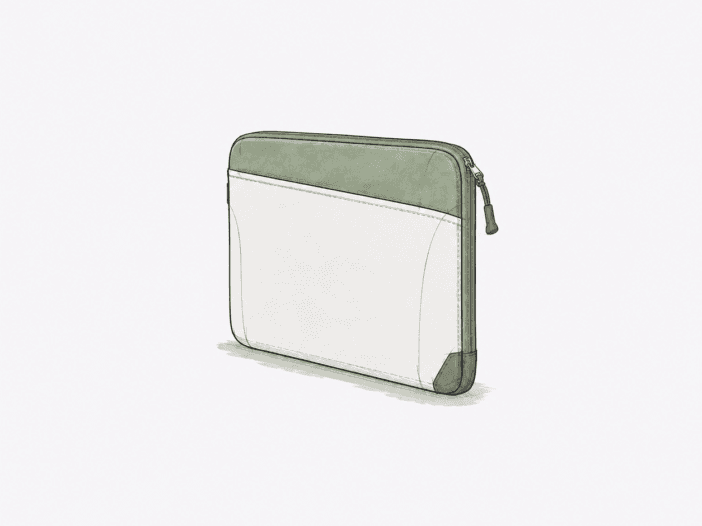
The Osprey Daylite Laptop Sleeve solves a common problem for buyers who need a basic layer of protection that moves easily between backpacks and bigger bags, carrying a laptop plus a few small accessories. The main risk comes from trusting the 14-inch or 16-inch label to guarantee a fit.
Buyer reports show that actual laptop width, thickness, corner shape, and proportions matter more than the size label. One 15-inch MacBook Air fits the 14-inch sleeve, but a smaller-diagonal Surface runs tight in the same size. Two Lenovo laptops, both near the 16-inch class, give opposite results in the 16-inch sleeve.

Product Snapshot
Treat this as a pack-friendly sleeve with basic organization. It is not a system that guarantees fit by screen diagonal, and it is not a rugged case.
| Product detail | Decision relevance |
| Buyer-reported 14-inch and 16-inch variants | Use the size label as a starting point, then check the laptop’s actual geometry. |
| Short-side/vertical access and grab handle | Supports quick insertion and removal when the sleeve is used inside a larger bag. |
| Soft-lined, padded main compartment | Buyer reports support scratch and light-bump protection, but heavy-impact performance is unresolved. |
| External accessory pocket | Most defensible for compact chargers, cables, and small or flat mice; bulkier loads are more conditional. |
| Evidence depth | 91 unique buyer contributions exist, but only six explicitly identify the purchased sleeve size, so variant-specific conclusions remain deliberately narrow. |
Buyer Evidence Metrics
The real value here comes from boundaries, not scores. Each metric uses a small set of eligible buyer reports, so the numbers stay private.
| Buyer Question | Metric | Evidence |
| Can one laptop fit materially better in the 14-inch sleeve than the 16-inch sleeve? | UBC — | Very Limited · n=1 |
| When buyers use the accessory pocket successfully, does limited pocket space also appear? | TCR — | Very Limited · n=3 |
| Can two laptops near the 16-inch class produce different fit outcomes in the 16-inch sleeve? | UBC — | Very Limited · n=1 |
How these metrics work:
- Use Boundary Consistency (UBC) measures how consistently eligible buyer evidence separates a supported use case from the condition where that use becomes more limited or conditional.
- Trade-Off Coupling Rate (TCR) measures how often an observed product strength appears together with a specific friction among eligible buyer evidence.
- n is the number of relevant, eligible, deduplicated buyer observations used for that metric—not the product’s total review count. Because each public n here is 1–3, the numeric metric value is suppressed.
These are buyer-evidence signals, not product-performance scores or probabilities. See how these buyer-evidence metrics work.
Fit–Friction Matrix
The sleeve works best when you check your device’s shape, keep accessories compact, and make sure your main bag has room for the loaded sleeve.
| Buyer Setup / Context | Fit Signal | Main Friction |
| Laptop in a correctly sized sleeve used as a removable layer inside a compatible backpack, duffel, or carry-on | Generally Works | Host-bag fit is not universal; some buyers with unspecified sleeve variants reported the sleeve itself was too large for a backpack compartment. |
| 16-inch variant + 16-inch MacBook Pro + compact charger/cable or small flat mouse | Generally Works | The outer pocket is useful for compact accessories but evidence does not support treating it as high-volume organization. |
| 14-inch variant + thin laptop whose width and corner shape stay within the usable sleeve shape | Conditional Fit | A 13.4 × 9.6-inch Surface became extremely tight around the radiused corners even though its diagonal size sounded compatible. |
| 15-inch laptop tested across both sleeve sizes | Specific Example Only | One buyer found the 14-inch size the better fit and the 16-inch size too loose; one observation cannot establish a general switching rule. |
| 16-inch sleeve + different Lenovo laptop geometries | Specific Example Only | A Lenovo P1 Gen 5 fit while a Lenovo P15 Gen 2 did not, showing that nominal size alone can miss proportion and form-factor differences. |
| Laptop already filling the main compartment + bulkier accessories in the front pocket | Conditional Fit | Pocket usefulness falls as the main fit becomes tighter or the accessories become thicker and more irregular. |
The Size Label Is Not the Real Fit Test
Pick between the 14-inch and 16-inch sleeves based on your laptop’s actual shape, not just the screen size.
14-inch version: Some thin laptops with bigger diagonals can fit, but corner clearance decides the outcome.
The 14-inch evidence is limited but telling. One buyer fit a 15-inch MacBook Air snugly and slid it into an Osprey Daylite 26+6 laptop area. Another cross-size report found a 15-inch laptop fit better in the 14-inch sleeve than in the 16-inch.
A thin Surface at 13.4 by 9.6 inches had the opposite result. The laptop fit inside, but rounded corners made the zipper hard to close. That same buyer avoided adding a charger or mouse to the front pocket because the main compartment was already tight.
The real takeaway is not that the 14-inch sleeve fits all 15-inch laptops. A thin, well-shaped device can fit even with a bigger diagonal, but a wider or squarer laptop will hit the sleeve’s limits faster.
16-inch version: MacBook Pro fits are workable, but not every 16-inch-class laptop will fit the same way.
Two direct 16-inch observations describe a 16-inch MacBook Pro fitting with some clearance. Those buyers also used the outer pocket for a charger and cable or a small/flat mouse, which supports the sleeve’s role as a compact laptop-plus-essentials carrier.
Fit changes when laptop proportions shift. In one direct comparison, a Lenovo P1 Gen 5 fit the 16-inch sleeve, but a Lenovo P15 Gen 2 did not. That is just one report, not a universal rule, but it shows why you need to check your laptop’s dimensions and shape before trusting the 16-inch label.
It Works Best as a Protective Layer Inside Another Bag
Most buyers use the sleeve to move a protected laptop between bigger bags, not as a standalone laptop bag.
Buyers mention the vertical or short-side opening makes it easy to slide the sleeve into backpacks, duffels, carry-ons, messenger bags, and other large bags. The laptop stays in its own lined compartment during the move.
The sleeve adds bulk around your laptop, so check that your main bag can handle the loaded sleeve. Some buyers found the sleeve didn’t fit inside a Tom Bihn Synapse 19 or an Osprey Nebula backpack, though the exact Daylite size wasn’t clear. Still, the lesson holds: test the loaded sleeve in your bag before you commit.
The Accessory Pocket Rewards a Small Load
The front pocket works best for true extras: a charger, cable, dongle, small power bank, or compact mouse.
Known-size evidence supports carrying a charger and cable in the 16-inch version, a charger plus a small or flat mouse in another 16-inch example, and a wireless mouse in the 14-inch configuration from a cross-size comparison. Unknown-variant reports add similar examples, including compact electronics and tablets, but those cannot establish size-specific capacity.
Pocket usefulness depends on accessory shape and how much space your laptop takes up. Thick chargers, bulky mice, headphones, or extra devices can make the sleeve bulge or ruin the clean fit that draws buyers to this sleeve.
Treat the Padding as Everyday Protection, Not Proven Drop Armor
Buyer reports back up scratch protection and basic cushioning for everyday bumps, but not confidence for heavy impacts.
Soft lining and padded construction receive recurring positive comments, and some buyers describe the sleeve as useful for bumps inside a larger bag. But the protection evidence is mixed: one known 14-inch buyer criticized limited additional corner protection, one known 16-inch buyer described only a little padding, and unknown-variant evidence includes both positive cushioning reports and a complaint of laptop damage after an approximately 20-inch/50-cm drop.
That does not show a general failure rate or prove the padding is weak. It does mean you should not treat the Daylite as a rugged drop-protection case based on current evidence.
What Buyers Should Check Before Buying
The quickest way to avoid fit problems is to check your whole carry setup, not just your laptop’s screen size.
- Measure your laptop. Check width, depth, thickness, and corner shape. Buyer reports show that diagonal screen size alone can mislead.
- Test the sleeve inside your main bag. A sleeve that fits your laptop can still be too big for your backpack’s laptop area.
- Keep your accessory load realistic. Compact chargers, cables, and small or flat mice work best. Bulky accessories are more likely to crowd the pocket or distort the sleeve.
- Set your protection expectations to match the evidence. The sleeve has buyer-reported padding and soft lining, but heavy-impact and drop protection are not established.
- Do not assume waterproofing. Some buyers report water resistance or light rain use, but others warn against trusting it in wet conditions. No tested waterproof rating appears in the evidence.
- Think about how often you will carry the sleeve by itself—most buyers like the handle, but a few mention roughness, asymmetry, or awkward balance. If you plan to carry it by hand often, pay closer attention to this detail than if you mostly use it inside a backpack.
Still deciding whether host-bag integration matters more than padding or structure? See the full Best Laptop Sleeves comparison →
