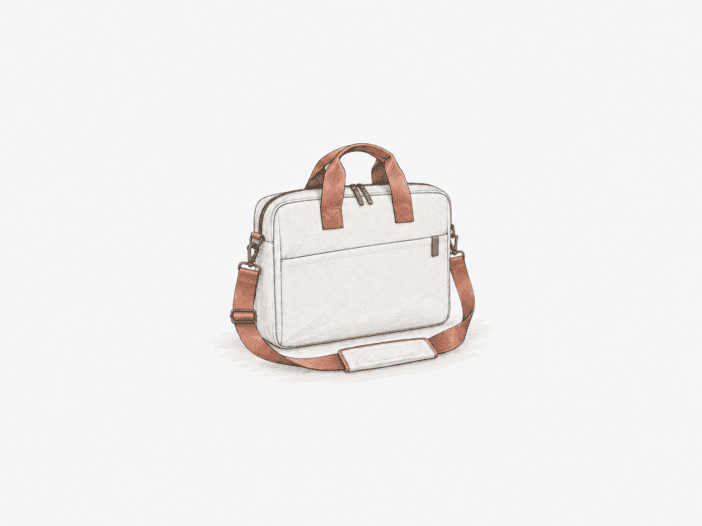
The Lenovo T210 works best for buyers who want to carry a laptop, charger, documents, and a few small accessories without hauling around a bulky backpack. Size choice changes the outcome. The 15.6-inch version has the strongest evidence for daily work and school loads. The 17-inch version adds extra space for 15.6- to 16-inch-class laptops, but buyer reports flag limited impact padding as a clear trade-off. The 12-inch version handles compact daily loads, but anyone stretching past the labeled size should check the actual laptop pocket dimensions instead of trusting the size name.

Product Snapshot
The T210 is a straightforward, device-first bag. Its value comes from matching the size to your actual daily load, not from maximizing protection or squeezing in extra volume.
| Product detail | Decision relevance |
| 12-inch, 15.6-inch, and 17-inch sizes | Screen-size labels are only a starting point; actual device dimensions and the dedicated pocket can change fit. |
| Laptop + charger + documents + compact accessories | This is the most consistently supported load pattern across known sizes. |
| Simple divided storage with an outer organizer | Supports straightforward separation of a laptop, papers, and small accessories without complex organization. |
| Water-repellent fabric | Useful for light exposure, but the evidence does not establish waterproofing or prolonged heavy-rain protection. |
| Shoulder carry with plastic attachment parts documented in the evidence | Plastic hardware does not prove failure, but size-unspecified reports include both breakage and non-failure examples. |
Buyer Evidence Metrics
The clearest metric signal is about load boundaries, not overall product quality. Device-centered carry stays consistent. Once you start packing bulkier or more complex loads, the bag’s behavior changes and becomes less predictable.
| Buyer Question | Metric | Evidence |
| In reports where the purchased size was not stated, does device-centered carry separate cleanly from bulkier loads? | UBC 0.75 | Moderate · n=12 |
| Does the 17-inch thin/light profile recur with limited impact padding? | TCR — | Very Limited · n=2 |
| In size-unspecified reports, is strap-hardware failure concentrated where plastic attachment hardware is explicitly identified? | CFL — | Very Limited · n=3 |
How these metrics work:
- Use Boundary Consistency (UBC) measures how consistently eligible buyer evidence separates a supported use case from the condition where that use becomes more limited or conditional.
- Trade-Off Coupling Rate (TCR) measures how often an observed product strength appears together with a specific friction among eligible buyer evidence.
- Context Friction Lift (CFL) measures whether a known friction is more concentrated in a defined eligible context than in the eligible baseline. For CFL, public n reflects the smaller eligible comparison group.
- n is the number of relevant, eligible, deduplicated buyer observations used for that metric—not the product’s total review count.
These are buyer-evidence signals, not product-performance scores, probabilities, or rankings. See how these buyer-evidence metrics work.
UBC 0.75 does not mean you have a 75% chance your load will fit. In the eligible size-unspecified evidence, this score means device-centered essentials fit fairly consistently, but three examples with larger loads still worked. That prevents any universal capacity rule.
Fit–Friction Matrix
Use your actual device and load—not the size name alone—as the decision point.
| Buyer Setup / Context | Fit Signal | Main Friction |
| 12-inch bag + compact laptop/Chromebook + charger, mouse, and notes | Generally Works | Larger-than-label devices may fit the main area while feeling tighter in the dedicated laptop pocket. |
| 15.6-inch bag + laptop(s) + charger + paperwork for work or school | Recurring Strong Fit | No recurring friction established in the available size-confirmed evidence; protection and long-term durability remain under-observed. |
| 17-inch bag + 15.6- to 16-inch-class laptop + documents or extra electronics | Generally Works | Two size-confirmed buyers considered the padding too limited for stronger drop-oriented protection. |
| T210 with laptop + compact charger/accessories, purchased size not stated | Generally Works | Capacity becomes less predictable as books, extra cables, or bulky peripherals are added; larger-load counterexamples also exist. |
| Routine shoulder carry, purchased size not stated | Mixed / Variant-Dependent | Plastic attachment hardware appears in the evidence; two failures coexist with a non-failure hardware observation and lighter strap complaints. |
| Short or light rain exposure | Conditional Fit | The fabric is water-repellent, but prolonged heavy rain is not established as safe and may saturate the bag. |
Variant Fit Patterns
The 15.6-inch and 17-inch versions solve different buyer problems. The 12-inch size is the most sensitive to exact measurements.
- 12-inch: Best for compact, device-first carry. One 14-inch MacBook Pro fit in the main compartment, but the dedicated laptop pocket ran tight. If you plan to stretch past the labeled size, check the pocket dimensions before buying. Direct evidence for this size is limited.
- 15.6-inch: This size has the most buyer evidence for daily work, college, and commuting loads. Buyers report fitting a laptop, power cord, paperwork, notebooks, and small accessories without making the bag bulky. One size-confirmed example carried two laptops, power cords, and paperwork.
- 17-inch: This version gives extra space for 15.6- to 16-inch-class laptops and more room for documents or extra electronics. For a stated ThinkPad E16 footprint, both the 15.6-inch and 17-inch sizes fit, but the 15.6-inch is a closer fit, and the 17-inch is roomier. The trade-off stands out: two independent 17-inch buyer reports describe minimal padding for impact protection.
Where the T210 Makes the Most Sense
The T210 makes the most sense when you want low-bulk transport, not heavy-duty protection.
Buyer reports put the T210 in work, school, short-commute, and light-travel routines with a laptop and basic tech essentials. The evidence gets less predictable when buyers try to use it as a high-volume hauler. Some buyers with no size requirements hit limits with extra books, cables, or peripherals. Others managed to carry two laptops, an external monitor, or even a laptop with extra shoes.
This contradiction matters. Capacity depends on the size you buy and the shape of your load. Unusually large success stories do not guarantee the same result for every T210 version.
Protection and Carry Hardware Need More Caution Than Capacity
Extra room does not equal extra protection. The 17-inch version makes that difference especially clear.
Two size-confirmed 17-inch buyers called out the thin, light profile and raised concerns about limited padding. Similar padding concerns show up in size-unspecified reports, but those cannot be pinned to the 12-inch or 15.6-inch versions.
Shoulder hardware needs the same evidence check. Plastic attachment parts are documented. Two size-unspecified buyers reported clip or attachment-ring failures during normal use. Another buyer saw plastic clips and rings but did not have a failure. This pattern means you should check the hardware before buying, not assume every T210 strap will fail.
What Buyers Should Check Before Buying
The safest way to buy is to match the T210 to your exact device, daily load, and protection needs.
- Measure your device, not just the screen size. This step matters most if you plan to stretch the 12-inch bag past its label or if you are choosing between the 15.6-inch and 17-inch for a 16-inch-class laptop.
- Pick the 15.6-inch for a closer everyday fit or the 17-inch for more space. For a ThinkPad E16 footprint, both sizes fit in the evidence, but the 17-inch gives you more room.
- Do not assume extra room means better drop protection. The 17-inch version’s padding trade-off is the clearest size-specific limitation.
- Check the shoulder attachment hardware if you plan to carry the bag on your shoulder often. Plastic parts are documented. Failure reports are rare and appear only in size-unspecified cases.
- Treat water repellency as a buffer for light weather, not as full waterproofing. Light rain is fine. Prolonged heavy rain is not.
- List your bulky extras before picking a size. Laptop, charger, papers, and compact accessories fit most consistently. Books, extra cables, large peripherals, or multi-device loads can change the answer.
Bottom Line
The Lenovo T210 works best as a light, straightforward laptop carrier for daily device-centered loads. The 15.6-inch version has the clearest support for routine work and school use. The 17-inch version trades a roomier fit for more visible padding. The 12-inch version rewards careful dimension checking if you use it with larger devices.
Buy the T210 for simple carry and size it around your actual daily load. If you need strong drop protection, predictable heavy-load capacity, or guaranteed shoulder-hardware strength, the buyer evidence is more conditional.
Still deciding whether simple device-first carry is enough? Compare the Lenovo T210 with other laptop briefcases built around slimmer loads, more organization, and heavier work setups.
