The Kenneth Cole REACTION Out of the Bag Manhattan is designed to carry a large, expandable mobile-office load, not a minimalist laptop carry. Your decision comes down to four physical factors: whether your laptop chassis actually fits with sleeve clearance, whether you need the three-gusset capacity, whether you can manage a heavy shoulder load, and whether you accept that zipper, seam, and strap longevity can vary.
Best when you need a mobile office more than a slim briefcase
Best for: laptop, tablet, files, books, chargers, and other mostly flat office gear that can use the separated compartments and expansion.
| Decision check | What matters |
| Laptop fit | Chassis dimensions matter more than screen size. 15–15.6-inch-class laptops can fit, but clearance varies; a 17-inch laptop does not fit. |
| Capacity vs. bulk | Three-gusset construction plus 1.5-inch expansion suits laptop, tablet, files, and other flat office gear. Minimal ultrabook loads can make the bag feel oversized, while a rigid 3-inch object is condition-dependent. |
| Long-term durability | Zipper, seam, and shoulder-system failures can appear around 2–2.5 years, although independent examples remain intact substantially longer. |
| Heavy-load carry | The bag starts at 3.2 lb empty. Dense or unbalanced loads can increase shoulder tilt, strap twist, slipping, and tipping; trolley or hand carry is more stable. |
Main deal-breaker: hardware can become the service-limiting factor around the two- to 2.5-year mark, even though some bags remain structurally intact for much longer.
If your priority differs: choose a thinner briefcase for an ultrabook-centered load; skip this format if a 17-inch laptop or a reliably shared 3-inch rigid object is mandatory.
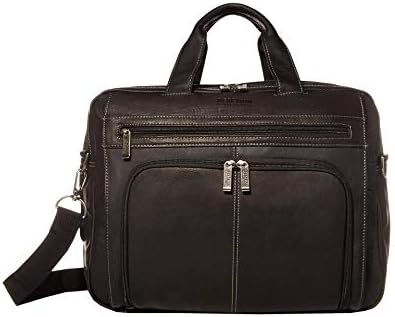
The three-gusset body earns its size only when you use the space.
The layout works best with flat office gear. Separate sections keep a laptop apart from thick files, and the expansion adds 1.5 inches of depth for overflow. A 3-inch rigid container is less predictable: it can fit in some expanded setups, but not reliably once a laptop and accessories already fill the structured space.
If your load centers on an ultrabook, a thinner Samsonite briefcase reduces the footprint: the two-gusset version is about 0.5 inch narrower. That smaller size only addresses bulk; capacity and durability remain separate considerations.
- Dense office load: with a laptop, tablet gear, a Kindle, and travel accessories loaded, a Galaxy S7+ fits too; if that resembles your kit, the larger footprint earns its space.
- Rigid bulk: a 3-inch object becomes condition-dependent once laptop and accessory space is already committed.
- Minimal load: the three-gusset footprint can feel excessive when the carry is centered on an ultrabook and modest accessories.
Laptop fit depends on chassis clearance more than screen size.
The stated 15.6-inch class is a practical upper limit, not a universal fit. The laptop pocket measures 15.25 x 11.5 x 1.5 inches, and narrow sleeve clearance increases friction during insertion. Extra chassis thickness uses up the remaining clearance, even if the screen diagonal seems compatible.
A 14-inch MacBook Air fits in a two-laptop load with another 14-inch laptop, a portfolio, files, and peripherals. If your machine is in that smaller chassis range, the sleeve leaves more usable clearance.
Near the upper limit, measure width, depth, and thickness: a 15-inch-class machine can get snug, a 17-inch laptop won’t fit, and a 16-inch MacBook still requires a chassis-dimension check.
Hardware is the durability risk before the leather body necessarily is
With sustained use, zippers, seams, and the shoulder system can become the service-limiting parts. After about two years of daily carry, corner zippers may need repeated repair, and the shoulder-pad covering can tear.
With hard use and frequent travel over the same period, zipper teeth can separate from the carrier cloth and the pad can crack. Around 2.5 years of regular use with some travel, stitching and zippers can also fail.
Tooth-to-carrier separation is one specific zipper failure path. Other failures affect different components, so treat the zipper, seams, and shoulder system as variable wear points instead of assuming a single failure mechanism.
Long intact runs show how widely durability can vary.
The bag can remain structurally intact after 2 years of daily office use and can stay in service for 3 years at more than 100,000 air miles per year.
Longer benchmarks include intact stitching after more than 5 years of daily work and global travel in hot, wet, and sub-freezing conditions, and a bag that remained usable after 10 years across offices, job sites, and airplanes. These outcomes show that long-term component durability can vary widely.
Balanced packing is what keeps the soft briefcase upright.
The soft base does not provide rigid self-support. When weight concentrates in one compartment or high in the bag, the center of mass can move outside the stable footprint, so a normally upright briefcase can lean or fall. If you work from the bag beside a desk or seat, upright stability depends on how you pack it.
- Balanced load: the briefcase can stand when weight stays centered.
- Front-, side-, or top-heavy load: expect it to lean or tip.
Heavy shoulder loads expose the strap’s tilt, twist, and slip points.
Ordinary shoulder carry is comfortable with the padded adjustable strap, but heavier loads make the attachment system less predictable. Off-center attachment can tilt the bag, the soft strap can twist at the clips, and the pad can slide on your shoulder. If you routinely carry dense office loads, trolley or hand carry is the more stable choice.
- Adjustment range: the removable padded strap extends to 52 inches for a better fit.
- Dense or unbalanced load: use the trolley strap or handles when carry stability matters more than hands-free movement.
The 3.2-lb starting weight makes the trolley strap more valuable.
The briefcase starts at 3.2 lb before you add a laptop, files, or accessories, so dense office loads add to an already significant empty weight. The rear trolley strap shifts that trade-off for travelers with rolling luggage by moving airport movement away from your shoulder.
- Desk-to-car carry: the weight is easier to justify when the walk is short.
- Rolling-luggage travel: the rear pass-through can reduce shoulder time with a loaded bag.
Under-seat use can work, but the next aircraft still decides clearance.
A packed briefcase carrying a 15-inch MacBook Pro can fit under an airplane seat. If your load is similar, under-seat use is plausible, but expansion, overpacking, seat hardware, and aircraft geometry can all reduce clearance. You still need to check the current carrier rule for your actual itinerary.
Rain, organizer layout, and bottle carry are smaller but real constraints.
These are not the main reasons to buy or skip the bag, but each can change daily fit when the requirement is non-negotiable.
- Rain: full-grain leather isn’t water-resistant. Routine exposed carry requires a protector, wax, or a cover instead of assuming weatherproofing.
- Organizer layout: files, laptop, and accessories get useful separation, but pocket details vary, and it lacks a dedicated key clip.
- Bottle carry: there is no external holder for a larger 24- to 32-oz bottle, so hydration uses internal space or another carry solution.
What to check before buying
- Measure your laptop chassis: compare width, depth, and thickness with the current laptop-pocket dimensions.
- Confirm the exact configuration: match style 524465, exterior and pocket dimensions, and organizer layout to the listing you are buying.
- Check current warranty support: verify zipper, seam, and shoulder-system coverage plus the claim process.
- Check your itinerary: compare the current personal-item rule and expected under-seat clearance with the packed bag.
Choose it for a real mobile office, not minimalist carry or predictable hardware life.
Choose it if:
- Your daily load is mostly laptop, tablet, documents, books, chargers, and other flat office gear.
- Your exact laptop chassis leaves comfortable insertion clearance inside the verified pocket dimensions.
- You value expandable business capacity enough to accept the larger, heavier briefcase format.
Skip it if:
- A 17-inch laptop or a rigid 3-inch object must fit reliably with the rest of your workload.
- You want a slim ultrabook briefcase rather than a three-gusset mobile-office format.
- Predictable zipper, seam, and shoulder-system service beyond the documented failure checkpoints is non-negotiable.
Check Kenneth Cole REACTION Out of the Bag Manhattan on Amazon
If expandable capacity is only one part of your decision, see how it compares with other work-focused options in our Best Laptop Briefcases roundup.
