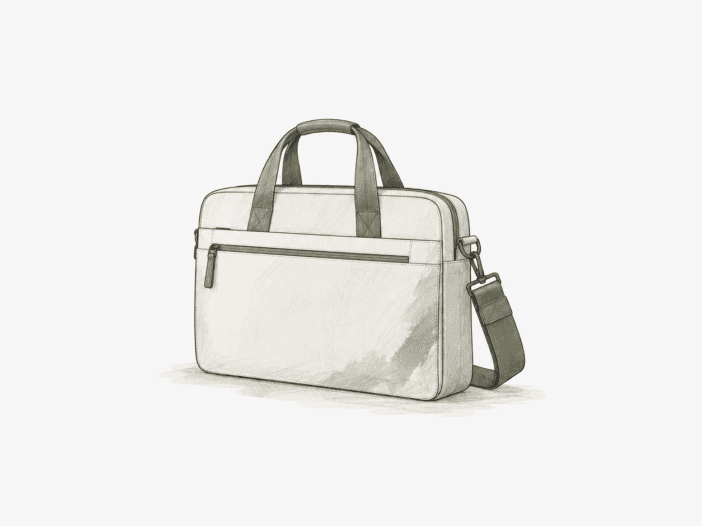
The Bellroy Tokyo Work Bag is a 20 L briefcase-style commuter designed for a 16-inch laptop, organized office storage, a bottle pocket, and two carry modes. The structure supports a disciplined workday load.
Physical limits show up when laptop thickness, bulky overflow, or extended one-shoulder carry push the geometry or attachment points beyond the intended office range.
The main decision is whether your exact laptop, recurring load, and shoulder-carry pattern fit the bag’s geometry without making clearance, pressure, or the strap attachment the structural limit.
Best when your workday load stays compact, and shoulder carry stays moderate
Best for: office commuters carrying a compatible laptop, documents, bottle, charger, and small daily essentials without routinely filling the bag to its limits.
| Decision check | What matters |
| 16-inch laptop fit | Chassis thickness matters more than screen size; thicker 16-inch laptops can lose clearance and usable cargo depth. |
| Packing efficiency | The 20 L layout works best for organized office essentials, not bulky clothing, thick files, or flexible overflow. |
| Shoulder carry | Heavier loads can concentrate pressure or make the bag tilt and bounce if the strap or anchor geometry sits poorly. |
| Long-term durability | The main bag can remain intact while friction and load wear the shoulder-strap attachment earlier. |
Main structural limit: a thick 16-inch laptop or a heavy one-shoulder load can push the bag’s clearance, concentrate pressure, and increase stress on the strap attachments.
If you need backpack-like 20 L packing flexibility, stable heavy messenger carry, or a 16-inch workstation that only fits by forcing the sidewall, the Tokyo Work Bag’s structure won’t meet those requirements.

The 16-inch claim only works if your chassis clears the inward crease.
Laptop compatibility has two gates: the chassis must seat in the padded area, and it must leave enough adjacent depth for the rest of the workload. The first asks whether the laptop fits cleanly; the second asks whether the fit preserves useful cargo space.
A 16-inch ThinkPad P1 defines the clean-fit end of the range.
A 16-inch ThinkPad P1 fits the padded inner pouch, so the nominal 16-inch claim is achievable with a full-size work laptop. That clean fit establishes the working end of the boundary without making screen diagonal a universal predictor for other chassis shapes.
The bottle-pocket crease makes extra thickness consume cargo depth.
One end of the interior creases inward to create space for the external bottle pocket, so a thicker laptop reduces clearance where the shell loses depth. A 16-inch MacBook sets the best-fit reference for this boundary. Anything thicker can become tight and start using up the cargo depth next to the sleeve.
The exact laptop must seat without forcing the sidewall and still leave enough room for the recurring workload. Two laptops with the same screen size can therefore produce different practical outcomes because extra chassis thickness affects both sleeve clearance and adjacent cargo volume.
- 16-inch MacBook Pro: fits with peripherals and several smaller tech items.
The 20 L rating behaves more like organized office space than open overflow.
The fixed organization makes the bag efficient when your load matches its layout, but it divides the 20 L into spaces that cannot all expand at once. As tight pockets and the main cavity fill, bulky items compete for the same fixed depth, making the remaining volume harder to access before the shell is fully packed.
The structure rewards a repeatable office load, not variable overflow. If your load often includes bulky clothing or thick files, treat the 20 L as organized capacity, not backpack-like free volume.
- 32 oz Nalgene: fits within a load that also includes a 16-inch laptop, sunglasses case, pencil pouch, wallet, charger, and other small items.
- Mixed office load: laptop, wires, paper stacks, miscellaneous items, and a sweatshirt can bring the bag to about 95% of practical capacity.
- Thick files: folders work better than files more than a few inches deep; fill-to-the-brim packing is a poor match for this layout.
Shoulder carry has two different limits: pressure and off-axis stability.
Comfort and stability depend on separate physical factors. The strap distributes load acceptably when the padded section stays under the weight, and the bag hangs neutrally. Pad position and anchor geometry can each create a different structural failure in shoulder carry.
Pad migration can leave narrow webbing carrying the pressure.
The shoulder pad is small enough to slide away from the pressure point. Once that happens, force transfers from the padded section to thinner, narrower webbing, concentrating the load against the body.
With a laptop, a small bottle, and two books, that concentrated pressure can become pronounced even though the bag is nowhere near a theoretical 20 L maximum.
If the stock strap concentrates pressure under your normal load, a wider aftermarket shoulder strap can spread that force. This improves comfort but does not eliminate the risk of wear at the strap connection.
Rear-biased anchors can make the loaded bag tilt, bounce, or rub
The attachment points pull from the rear or edge instead of a centered, opposing-side suspension. Under some one-shoulder loads, this shifts the bag off-axis, so it can bounce while walking or tilt into the hip or leg.
If you need a hand on the grab handles to steady the bag during your normal walk, the messenger-style carry doesn’t provide hands-free stability.
The shoulder attachment can age faster than the rest of the bag.
The durability risk is localized. Shoulder load transfers through a small attachment zone, and the hook or buckle repeatedly rubs the surrounding fabric, concentrating stress where hardware, stitching, and material meet. This connection can fray, spread, or wear through while the larger bag body remains intact.
The durations below are separate operating conditions, not a single lifecycle. An intact exterior does not guarantee that the shoulder connection is equally healthy. Load and local friction can make the attachment the earlier service-life limiter.
| Use condition | What stayed intact or degraded |
| Heavy laptop for 2 months | Shoulder-strap stitching began coming unsewn; loaded carry was uncomfortable. |
| Light office carry plus about ten overnight trips over 8 months | Fraying progressed to a hole where the shoulder-strap buckle meets the bag. |
| Everyday use for almost 1 year | Main material remained durable, while constant hook friction wore the local attachment area. |
| Travel at least twice a month for 18 months | Exterior still appeared new under that separate travel pattern. |
Bottle fit is governed by diameter, not ounce capacity.
The side pocket is a fixed opening, so bottle cross-section matters more than ounce capacity. Bellroy states the pocket is 18 centimeters high by 11 centimeters wide, and confirmed examples include both a compact bottle and a much larger one.
An estimated 3.5-inch diameter is only a rough reference, not a manufacturer-verified cutoff. If your bottle is near that diameter, compare its actual width with the pocket instead of relying on ounce capacity.
- 18 oz Hydro Flask: fits the side pocket easily.
- 32 oz Nalgene: with the bottle assigned to external carry, it fits in the outer end pocket; it can also ride inside the bag.
Organization is strongest by category, not by tiny-item separation.
The layout gives larger categories clear homes, but deep shared pockets don’t hold every small object in place. Sunglasses, earbuds, and common office items are easy to separate; camera batteries, SD cards, and other small pieces can migrate together inside the long pouch and become harder to retrieve by feel.
If your kit includes many tiny accessories, you may still need a secondary organizer even though the broader categories are well separated.
- Apple AirTag: the dedicated internal slip pocket holds an Apple AirTag, giving it a fixed location outside the deep shared pouches.
- Front compartments: close with a zipper rather than a snap.
Rain, lockability, standing stability, and front styling are narrower secondary limits.
Weather resistance is finite. The main zipper is water resistant, and the interior can remain dry in rain, but whole-bag waterproofing is unverified. Lockability is limited. The zipper pull has a hole, but there is no compatible opposing loop for a small padlock, so the main opening cannot form a padlockable pair.
- Set-down stability: the bag can tip over instead of remaining reliably upright.
- Front styling: the work-bag format can read more office-oriented than the Tokyo tote backpack, but the divided front compartment and visible front slit can still be the deciding objection.
- If front layout alone is the problem: Via Work is the named cleaner-front switch; this change addresses front appearance only, not laptop fit, shoulder comfort, capacity, or durability.
What to check before buying
- Fit your exact laptop: seat it in the padded sleeve, close the bag normally, and confirm the remaining cargo depth still works.
- Pack your full workday load: confirm the pockets you need still close and remain accessible.
- Walk your normal distance: confirm the loaded pad stays centered and the bag doesn’t persistently tilt, bounce, or rub.
- Check the attachment: look for fraying, spreading stitches, or abrasion around the shoulder hook and buckle.
- Match rain protection to your commute: make sure the required exposure doesn’t exceed the bag’s weather-resistance level.
Choose it for disciplined office carry; skip it for thick laptops or heavy shoulder duty.
Choose it if:
- Your exact laptop fits cleanly and leaves enough room for the rest of your recurring office load.
- Your packed workday stays close to documents, bottle, charger, and small essentials rather than bulky overflow.
- The loaded shoulder carry remains comfortable and stable for your normal walking distance.
- You accept checking the strap-attachment area as a separate durability zone.
Skip it if:
- A thick 16-inch workstation forces the sidewall or consumes too much adjacent cargo depth.
- You routinely need backpack-like 20 L flexibility for thick files, clothing, or variable overflow.
- A heavy one-shoulder carry creates persistent pressure, tilt, bounce, or rubbing.
- Localized shoulder-attachment wear is a risk you won’t monitor or accept.
See the Bellroy Tokyo Work Bag on Amazon
Closest alternatives if the Tokyo Work Bag misses your priority
| Alternative | Best if… |
| Via Work | You want a cleaner front layout without the Tokyo Work Bag’s divided front compartment and visible front slit. |
| Tokyo tote backpack | You prefer a tote-backpack format and do not need the Tokyo Work Bag’s more office-focused briefcase layout. |
If you are weighing the Bellroy against other briefcases for different workloads and laptop-fit needs, compar
