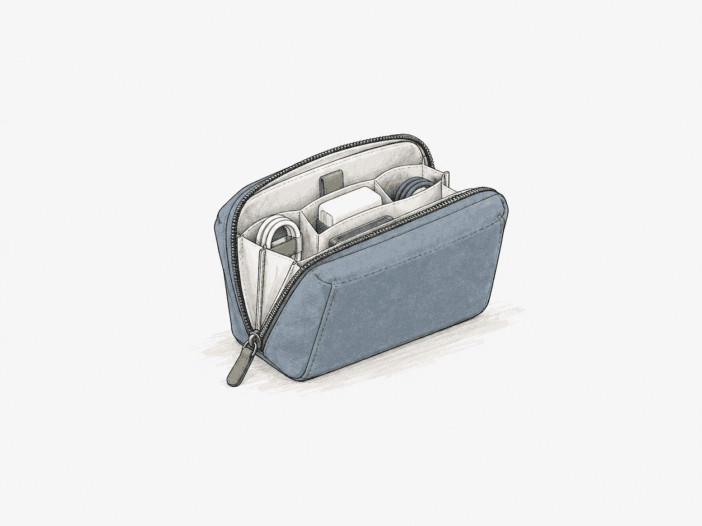
The Peak Design Tech Pouch is structurally optimized for compact accessories, not for loads dominated by thick power hardware. Your decision depends on three physical constraints: whether the pouch’s external dimensions fit your intended host bag, whether bulky items can fit in the divided interior without preventing closure, and whether secondary features like zipper operation or strap attachment match your carry needs.
Buy it for compact tech only if the packed footprint also fits your bag.
Best for: Cables, adapters, batteries, charging bricks, and other compact accessories that benefit from separated storage.
| Decision check | What matters |
| Small vs Regular | Small is 1 L at 24 × 11.5 × 9 cm; Regular is 2 L at 24 × 15 × 10 cm. Choose from both accessory volume and available host-bag space. |
| Packed closure | Thick adjacent chargers and a fully populated interior can compete for closing space, so pocket count does not equal fully usable packed capacity. |
| Host-bag fit | Regular can be too large for constrained carry; the pouch’s structured external footprint can be a blocker even when its internal capacity is useful. |
| Frequent access | Zipper operation can range from smooth to finicky, making packed zipper feel worth checking when repeated access is important. |
| Early durability | Construction remained robust after about 4 months of daily work carry plus a Europe trip, but that evidence does not establish a multi-year lifespan. |
Main deal-breaker: The structured pouch occupies a fixed volume in your host bag, and thick items or a filled interior can exceed the closure limit, preventing the pouch from closing securely.
If your load consists mainly of bulky power accessories or you need every partition usable at once, the Tech Pouch won’t meet those requirements.

Size the pouch by host-bag footprint, not liters alone.
Small measures 1 L, 24 × 11.5 × 9 cm, and 195 g. Regular measures 2 L, 24 × 15 × 10 cm, and 288 g. The interior can hold three MacBook Pro charging bricks, four to five USB-C cables, and an Ethernet cable, with room to spare. Still, it must fit within your host bag alongside other contents.
Host-bag space can override the initial size choice. In a 10 L sling, the Regular pouch exceeds the available space, while the Everyday Backpack 20L provides enough room for the Regular to fit without crowding. When your host bag is space-constrained, the pouch’s external footprint becomes the primary fit constraint.
At the other end, the Small pouch may take up unnecessary space in lightweight one-bag packing with only a few cables and charging blocks. Yet, it can also be undersized for larger accessory loads. Select the variant that matches both your minimum and maximum packing constraints.

The divided layout works best when thickness is distributed.
The internal dividers separate compact accessories, but usable storage decreases when thickness is concentrated in the center. As you close the pouch, the middle dividers collapse inward, so bulky chargers placed side by side compete for central space. Filling every partition can prevent the zipper from closing. The number of pockets matters less than how you distribute your load.
- Compact accessories: Cables, connectors, adapters, batteries, and small chargers can occupy separate positions without filling every partition.
- Adjacent bulky chargers: Center sections can begin to interfere with each other as the pouch closes.
- Every partition filled: Maximum pocket occupancy can push the pouch past comfortable closure.
Secondary details can still change the fit after capacity works.
After 4 months of daily work carry and travel exposure, the construction and accordion organization showed no structural failure. This duration establishes a minimum durability benchmark for that period and exposure, but does not confirm multi-year lifespan.
- Zipper operation: The zipper can operate smoothly or may require more precise alignment. For frequent access, confirm zipper travel meets your physical access needs.
- Added-strap carry: With a compatible strap, the pouch functions as a small bag or removable travel-access piece. The strap or sling is not always included, so confirm attachment compatibility before relying on this feature.
What to check before buying
- Confirm the size: Check whether the exact listing is Small or Regular, then compare its external dimensions with your available host-bag space.
- Test packed closure: Load your thickest chargers in their intended positions and close the pouch without forcing or major rearrangement.
- Verify strap carry: Check the exact listing contents and confirm that your intended strap attaches securely to the pouch.
- Check zipper travel: Pack the received pouch as intended and confirm the zipper feel suits your access frequency.
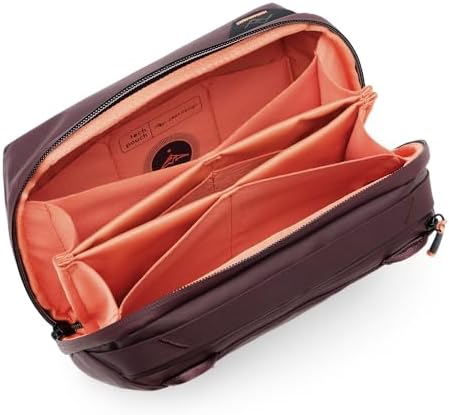
Choose it when separated access matters more than open-space flexibility.
Choose it if:
- Your load is mainly compact cables, adapters, batteries, and chargers that benefit from dedicated positions.
- The selected Small or Regular footprint leaves enough room in your primary carry bag.
- You are comfortable distributing thicker items instead of filling every internal partition.
Skip it if:
- Bulky power accessories dominate your load, or Small cannot accommodate the intended setup.
- Your host bag is already space-constrained enough that a structured pouch would crowd other essentials.
- You need every pocket filled at once or require sling-style carry without confirming the strap setup.
See the Peak Design Tech Pouch on Amazon
If you want to see how this structured organizer compares with more compact, higher-capacity, and backpack-first options, explore our Best Tech Pouches roundup.
