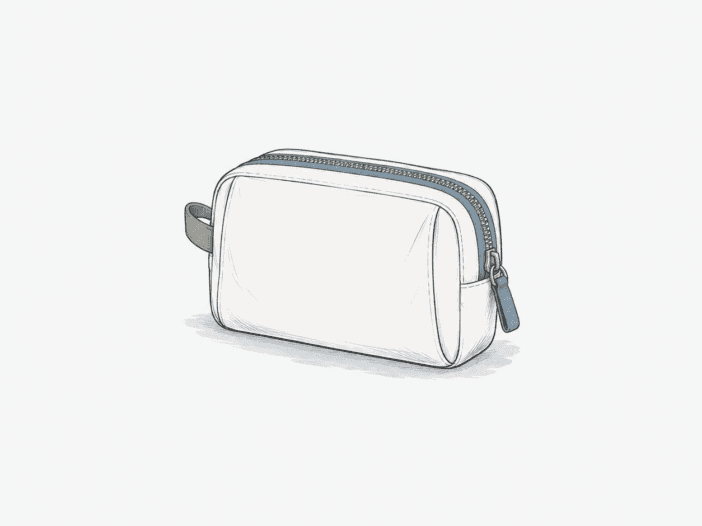
The tomtoc Light-T12 Pouch keeps cables, chargers, slim batteries, and small essentials from scattering inside a larger bag. Its modular structure lets you move your entire kit between bags without unpacking or rebuilding, keeping everything together in one step.
Compactness sets a hard physical limit: the Light-T12 cannot accommodate thick or rigid gear beyond its narrow depth. Internal dividers keep items separated, but the actual capacity, pocket fit, and protection depend directly on the size and shape of your chargers, power banks, and electronics as they get bulkier.
Compact kits are the sweet spot; dense power stacks are not.
Best for: Cables, compact chargers, slim batteries, and small daily essentials that fit in one transferable organizer inside a larger bag.
| Decision check | What matters |
| Practical capacity | The 1 L configuration suits compact, relatively flat tech kits; thick chargers and large power banks can tighten closure and push the pouch outward. |
| Power-accessory fit | Overall pouch space does not guarantee pocket-level fit; thicker charging gear may need the larger full-side compartment rather than smaller sewn-in pockets. |
| Protection boundary | Padding varies by configuration, so treat the Light-T12 primarily as an organizer rather than dedicated impact protection for sensitive electronics. |
| Upright desk use | The pouch can stand with a well-balanced, bottom-heavy load, but standing stability is not guaranteed when weight shifts upward. |
Physical limit: Thick chargers, large power banks, a mouse, or several rigid electronics can exceed the pouch’s closure and pocket access, making the fit impractical.
If you need more internal depth, only a larger tech organizer provides the space you need. If you need impact protection more than low bulk, a padded electronics case gives you a higher level of cushioning.

Narrow depth—not item count—sets the practical capacity ceiling.
The Light-T12 works best with mixed compact kits: cables, adapters, and slim batteries can share the available volume without pushing the shell outward. The capacity limit isn’t about item count; it shows up when several rigid objects compete for the same internal depth and start pushing each other across adjacent pockets.
In the 1 L configuration, stacking a MacBook 96W brick with a thick power bank pushes the body outward, tightens zipper clearance, and puts more load on the seams. Flatter accessories use the narrow profile efficiently because they do not force the sidewalls apart.
If your everyday kit is compact and flat, the Light-T12 stays within its practical range. When a thick charger, large power bank, mouse, or stack of rigid items makes closure or pocket access difficult, only a larger tech organizer provides the internal depth you need, but it will take up more space in your host bag.
| Loadout | Capacity outcome |
| iPhone 17 Pro with keys, AirPods, toiletries and other small essentials | The mixed daily kit fits as one transferable organizer load. |
| MacBook 96W brick plus a thick power bank in the 1 L pouch | Tight fit; the zipper closes with more resistance as the body bows outward. |
| iPhone Air with wallet, keys, AirPods, tissues, battery bank and work badge | The compact essentials load fits together without the bulky-stack conflict. |
Pocket geometry decides whether small parts and power gear stay usable.
The internal layout answers two related questions: whether small accessories stay controlled, and whether a specific power accessory fits the compartment you actually want to use. Both depend more on local pocket geometry than on the pouch’s overall capacity.
Open pockets suit ordinary cables better than tiny loose parts.
Pockets and elastic sections keep common cables, chargers, and earbuds separated, so you spend less time searching for loose items.
Very small adapters are less secure in short or open stretch pockets, and thick braided cords press hard against tight elastic loops and can be awkward to insert. The layout favors standard cable organization, not zip-secure containment for tiny pieces or bulky cords.
A power accessory can fit the Light-T12 and still miss the intended pocket.
Overall, room does not guarantee pocket-level compatibility. A thick charging block can exceed the sewn-in side compartment but still fit the larger full-side space, because the smaller opening and usable width become the constraint before the pouch’s total volume does.
The Anker 737 is not confirmed for the T12 Small: while there is general room for plugs, cords, and AirPods, the exact pocket fit is not established. If that accessory is central to your kit, pocket-level fit, not outer pouch dimensions, is the deciding factor.
Upright desk use depends on base width and where the weight sits.
The Light-T12 stands upright only when the base is wide enough, and the load keeps the center of mass low. Top-heavy packing reduces stability.
Compared with the Bellroy Classic Pouch, the Light-T12 sits upright less reliably because of its narrower base. If you need upright desk use, treat standing stability as a function of how you pack the pouch, not as a guaranteed feature.
Protection is a useful buffer, not a substitute for dedicated protection.
The Light-T12 provides some buffer against everyday bumps and light wetting, but neither impact padding nor weather resistance is enough to treat it as a fully protective electronics case. Each protection limit is separate.
Padding varies enough that sensitive electronics need a higher bar.
Some configurations include padding or a semi-hard structure for ordinary bag carry, but others have little or no padding around hard drives and power adapters. Because padding varies, the organizer structure alone does not guarantee impact isolation.
If you need dedicated cushioning for hard drives or other sensitive electronics, only a padded electronics case provides the necessary protection, at the cost of added bulk and weight.
Water resistance covers light wetting, not sustained exposure.
Water-resistant fabric and zipper construction form a barrier against minor spills, light rain, and changing weather. This is not sealed waterproof construction, so the Light-T12 acts as a weather buffer, not as protection for sensitive electronics under sustained wet conditions.
Water resistance does not resolve PFAS chemistry.
Water resistance and treatment chemistry are separate questions. Available PFAS statements conflict: one answer is uncertain, another states a small amount is present. The product-level PFAS state remains unresolved based on current statements.
Durability checkpoints are encouraging, but they do not define a lifespan.
After 2 weeks under a heavy daily tech load, the pockets retained their shape. After 1 month of travel, another unit remained near-new. After 4 weeks of travel, organization stayed intact.
Separate use periods also remained satisfactory for months, with one independent couple-of-years durability checkpoint. These benchmarks show continued function at those points, not a guaranteed service life or predicted failure date.
The modular value is strongest inside a larger carry system.
Beyond basic cable storage, the Light-T12 works as a reusable module. You can move it among host bags, use it to contain peripheral overflow beside a device sleeve, or organize a compact camera kit. Each scenario creates a different physical boundary, so the Light-T12 works best when one of these specific uses applies.
Bag-to-bag transfer reduces repacking, but the host bag still costs space.
Keeping one accessory kit in a single module cuts down on repeated searching and repacking when you move between backpacks, work bags, crossbodies, suitcases, or travel bags. In very small or minimalist host bags, the pouch’s own footprint and thickness take up a more noticeable share of the available space.
A device sleeve can keep protection separate from accessory storage.
With a Surface Pro 8 sleeve protecting your primary device, the Light-T12 holds the docking station, USB accessories, and small external hard drive that do not fit in the sleeve. If you already use that sleeve workflow, the Light-T12 solves peripheral overflow, but you carry two separate pieces instead of one integrated case.
Compact camera kits fit the role better than general camera carry
The camera use case stays at pocket or action-camera scale. Larger camera bodies and lenses fall outside the established fit range.
- Osmo Pocket 4p: Fits with its accessories, keeping the load inside the compact-camera working range.
- Action-camera kit: Two action cameras, four batteries, microphones, memory cards, and cables fit as an accessory-scale kit.
What to check before buying
- Confirm the exact size and internal layout. Match the selected configuration and received pocket arrangement to the load you plan to carry.
- Match the bulkiest power accessory to its intended compartment. Compare compatible dimensions or test the exact pocket before relying on overall pouch room.
- Inspect padding around sensitive electronics. Make sure the received unit provides enough cushioning where a hard drive or other impact-sensitive device will sit.
- Check the current first-party material disclosure if PFAS matters. Use the exact configuration’s current chemical or treatment information rather than water-resistance wording.
Choose it for compact modular carry; skip it when depth or protection dominates
Choose it if:
- Your everyday kit is mostly cables, compact chargers, slim batteries, and other relatively flat accessories.
- You want one small organizer that can transfer between larger bags without repacking each accessory.
- Conditional upright use and organizer-level protection are enough for your workflow.
Skip it if:
- Thick chargers, large power banks, a mouse, or several rigid electronics regularly crowd the same loadout.
- Hard drives or other sensitive electronics need dependable dedicated impact padding.
- Reliable self-standing behavior matters, no matter how you pack the pouch.
Check the tomtoc Light-T12 Pouch on Amazon
Choose a different setup when standing stability, bulky gear, or device protection matters more.
The Light-T12 works best when compact organization is the priority. A different product or carry setup makes more sense when the problem shifts to reliable desk-standing, substantially bulkier electronics, or dedicated protection for the primary device.
| Bellroy Classic Pouch | Reliable self-standing matters more; its wider base provides stronger standing support than the narrower Light-T12 geometry. |
Not sure whether a compact pouch is enough for your charging setup? Compare it with other organization styles and capacity levels in our Best Tech Pouches roundup.
