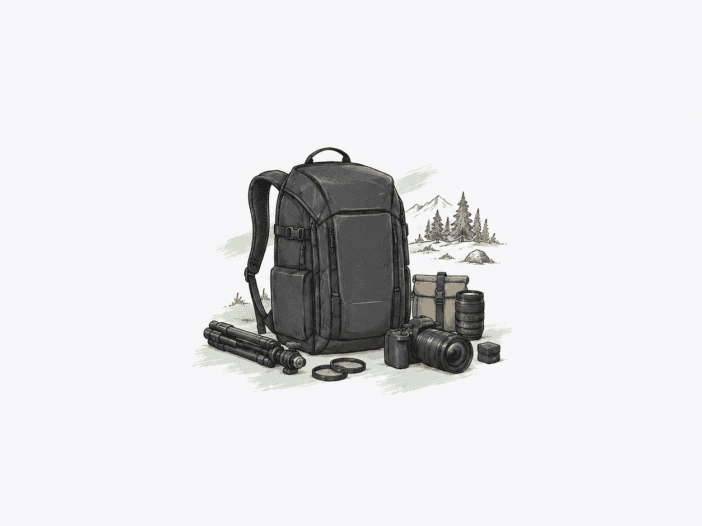
Buyers get the most out of this pack when they need to haul a full camera and tech kit—plus a few days of clothing—in one go. Reports describe setups with multiple camera bodies, several lenses, a drone or gimbal, laptop or tablet, batteries, chargers, and clothing all fitting inside.
That capacity comes with a clear trade-off: as you pack more gear, weight and bulk ramp up fast. Buyers carrying lighter loads, walking long distances in the city, or with smaller frames report more mixed results.
Capacity choice changes the fit. The 35L stands out in the evidence for high-capacity loads, while the 25L shows up less often in buyer reports but looks better for buyers who want a smaller pack for daily use or tighter airline rules.

Product Snapshot: The capacity story is clearer than the portability story
| Product detail | Decision relevance |
| Camera backpack family with 25L and 35L variants | The two capacities should not be treated as interchangeable; the evidence supports different portability expectations. |
| 35L expands to 42L; 22 × 13.5 × 9 in; 5.75 lb empty | High carrying capacity comes with meaningful empty weight and less margin under strict airline limits. |
| 35L includes adjustable dividers and two device sleeves | Supports mixed camera/device organization, but manufacturer answers conflict on the exact main-compartment internal dimensions. |
| 25L | Buyer evidence suggests a smaller-footprint role, but no official dimensions or sleeve limits are available in the evidence. |
| Camera cube, rain cover, and several accessories are separate purchases | Buyers should verify exactly what is included rather than assuming the full modular system comes with the pack. |
Buyer Evidence Metrics: The evidence points to a use boundary, not a universal fit score
These metrics use deduplicated buyer observations where the pack capacity was not identified. They describe recurring unknown-variant patterns and should not be read as 35L- or 25L-specific results.
| Buyer Question | Metric | Evidence |
| Does the pack align more consistently with high-gear, multi-day, or production use than with daily/light carry? | UBC 0.88 | Strong · n=24 |
| Does high-capacity or one-bag utility often appear together with heavy/bulky portability friction? | TCR 0.70 | Strong · n=20 |
| Is burdensome size/weight more concentrated in daily or city carry than in multi-day/high-gear travel? | CFL 2.19× | Moderate · n=8 |
The takeaway is simple: this pack’s capacity only pays off if you actually fill it. The numbers here do not mean you have an 88% chance of a good fit, a 70% chance of a weight issue, or a 2.19× jump in severity.
How these metrics work:
- Use Boundary Consistency (UBC) measures how consistently eligible buyer evidence separates a supported use case from the condition where that use becomes more limited or conditional.
- Trade-Off Coupling Rate (TCR) measures how often an observed product strength appears together with a specific friction among eligible buyer evidence.
- Context Friction Lift (CFL) measures whether a known friction is more concentrated in one eligible context than in the comparison baseline. It is not a severity or probability measure; public n reflects the smaller eligible comparison group.
- n is the number of relevant, eligible, deduplicated buyer observations used for that metric—not the product’s total review count.
These are buyer-evidence signals, not product-performance scores. See how these buyer-evidence metrics work.
Fit–Friction Matrix: Match the pack to the load before judging the weight
| Buyer Setup / Context | Fit Signal | Main Friction |
| Large camera/tech kit plus clothing for multi-day or one-bag travel | Recurring Strong Fit | High capacity frequently comes with a heavy or bulky loaded carry. |
| Production or commercial shoot with multiple bodies, lenses, drone/gimbal gear, and devices | Recurring Strong Fit | The footprint and weight become more noticeable when the load has to move far on foot. |
| Light camera kit for daily, around-town, or extended city carry | Conditional Fit | Empty and loaded bulk can outweigh the benefit of the available capacity; some daily-use buyers still report acceptable carry. |
| Airline overhead carry-on use | Mixed / Variant-Dependent | Airline dimensions, weight allowances, under-seat requirements, and capacity choice can change the outcome. |
| Frequent rear-compartment access during a shoot | Conditional Fit | Several buyers disliked having to place the outward-facing front panel down, creating scuff and abrasion concern. |
Variant Fit Patterns: The 35L is better documented; the 25L is more uncertain
35L: High-capacity evidence is clear, but airline margin is part of the purchase
Only the 35L comes with a full set of manufacturer specs in the evidence. It expands from 35L to 42L, weighs 5.75 pounds empty, and measures 22 by 13.5 by 9 inches on the outside. One buyer loaded a 70–200 lens plus three more lenses and still had space left.
That extra space only helps if you’re willing to deal with the size and weight. Carry-on results are mixed. NOMATIC calls the 35L a carry-on camera pack, but one buyer used it with airline-specific checking, and another returned a 35L v2 after running into airline size concerns.
Watch for a spec conflict before you buy. Two manufacturer answers list different main-compartment internal dimensions. If you need an exact fit, do not trust either number until you can confirm it yourself.

25L: A smaller-footprint signal exists, but device fit needs direct verification
Evidence for the 25L is sparse. One buyer who sent back a 35L v2 switched to the 25L for daily use and cleared several boarding checks.
Laptop fit in the 25L is hit or miss. One buyer fit a large laptop depending on what else was packed, but another could not fit an 11-by-15-inch laptop. Without official 25L sleeve dimensions in the evidence, you cannot rely on listed laptop size alone.
What a Real High-Load Setup Looks Like
Buyer reports make the pack’s intended role easier to understand than the capacity number alone:
- One setup combined two caged cameras, three L-series lenses, a MacBook Pro, four external drives, chargers, and batteries.
- Another combined a camera body, six lenses, a flash, filters, grip, batteries, two SSDs, a 15-inch MacBook Pro, an iPad Pro, a tripod, and roughly three days of clothing.
- A third combined a 1DX Mark III, Mavic 3 Cine with four batteries and controller, Ronin RS2, multiple lenses, and a microphone after previously dealing with multiple bags.
These setups come from specific buyers, not a blanket guarantee for every load. They show why some owners put up with the pack’s weight: it lets them ditch two or three separate bags.
How Buyers Use It: Full-kit transport is the recurring role.
The evidence repeatedly points to three practical patterns:
- Travel and production: Buyers use the pack when they need multiple bodies, lenses, drone or gimbal equipment, devices, batteries, chargers, and clothing in one place.
- One-bag consolidation: Several buyers describe replacing two or three separate bags with one larger carry.
- Destination split: Some buyers leave the main pack at a hotel or reserve it for full-equipment shoots, then use a smaller NOMATIC sling or convertible insert for lighter daily camera carry.
That last pattern draws the main line: this pack solves the transport problem, but it is not always the bag buyers want to carry all day once they reach their destination.
What Buyers Should Check Before Buying
The safest move is to check what part of your setup causes friction, not just whether your gear fits inside.
- Decide if you will actually use all that capacity. If you usually pack light, the bag’s size and weight will stand out more than its storage.
- Make sure you know which size you are looking at. Most buyer reports do not say 25L or 35L, so do not treat general patterns as specific to one variant.
- Check your airline, route, and carry-on needs. Some buyers fit the pack in overhead bins, but others hit weight limits, under-seat problems, a Spirit Airlines failure, or 35L size issues.
- Measure your actual laptop, especially if you are considering the 25L. Buyer reports don’t agree, and the evidence includes no official 25L sleeve measurements.
- Check what accessories come in the box. The camera cube, rain cover, and some organizers are sold separately.
- Consider how rear access and weather will affect your use. Some buyers did not like having to lay the front panel down for rear access. Wet-weather reports range from gear staying dry in rain to some dampness and slow drying.
If high capacity feels like more than you need—or you want to compare its travel trade-offs with smaller options—find the right camera backpack for your setup.
