
Choosing a Farpoint by the number on the bag can lead to the wrong setup. The Osprey Farpoint range runs from 40L to 80L, but the real choice depends on laptop depth, split volume, daypack loading, and how the bag travels.
The 40L carries the laptop-size question. The 55L and 70L split their total volume across the main bag and daypack. The 80L sits in a checked-travel conversation.
Scorecard
The Osprey Farpoint lands in the Excellent tier — strong overall, but still tied to the variant limits below. The biggest buying problems are not family-wide; they depend on which size is being considered.
| Field | Value |
|---|---|
| DVSS Score | 89.89 |
| Satisfaction Tier | Excellent |
| Dissatisfaction Score | 6.57% |
| Critical Dissatisfaction Rate | 5.22% |
Based on buyer feedback patterns, not hands-on testing. See how this scoring works.
At 5.22%, the serious-warning share is low enough that the limits below should be read as decision checks, not automatic dealbreakers. The scorecard does not prove laptop fit, carry comfort, durability, protection, weather resistance, or airline acceptance for every Farpoint size.
The score makes the most sense when the Farpoint is treated as a travel-carry system with size-specific limits, not as one bag that simply gets larger by liters.
Quick Take
- Best For: Travel-first shoppers who match the Farpoint size to laptop depth, packing style, and trip role.
- Not For: Anyone expecting the 16-inch laptop label or 55L/70L size label to answer everything.
- Top Strength: The harness and frame setup suits airports, stairs, trains, and public transport better than roller-first travel.
- Main Limitation: The 40L laptop sleeve, 55L/70L split capacity, and 80L checked-bag shape all need a closer look.
Decision Matrix
| Your Farpoint choice | What matters before buying |
|---|---|
| 40L for laptop carry | Laptop depth matters more than screen size alone. |
| 55L or 70L for more capacity | The daypack is part of the total volume. |
| 55L for the included daypack | Dense laptop-and-water loads can pull differently. |
| Airline travel | Each size has a safer travel role. |
| Biggest number solves the choice | The labels hide different breakpoints. |
The 40L is the laptop-size check
The 40L choice starts with sleeve geometry, not screen size.
16-inch screen size is not enough
A deeper laptop body can outgrow the 40L sleeve.
The laptop sleeve opening and depth control whether the computer sits fully inside the 40L. A deeper chassis can hit the sleeve edge before the laptop settles into place. That makes fit a chassis-depth issue, not just a screen-size issue.
In some setups, a deeper 16-inch laptop can turn the 40L sleeve from a travel convenience into a fit problem.
- Smaller tech setup: iPad Air plus a 14-inch PC sits in the cleaner fit range.
- Thin 16-inch case: A 16-inch MacBook Pro with a thin case appears only as a tighter case.
- Deeper laptop body: This is where the sleeve can leave the laptop protruding.
This table separates screen-size confidence from the actual sleeve outcome.
| Laptop or device setup | What the 40L sleeve supports |
|---|---|
| iPad Air plus 14-inch PC | Cleanest smaller-tech case |
| 16-inch MacBook Pro with thin case | Possible, but tighter with another device |
| Deeper 16-inch laptop | Can protrude instead of sitting cleanly |
Choose the 40L for smaller tech first; treat deeper 16-inch laptops as a fit risk.
Fit tells you whether the laptop goes in; packing pressure tells you what happens once clothes and shoes fill the cavity.
Packing pressure changes laptop confidence
The sleeve is not the whole laptop-protection story.
The padded sleeve separates the laptop from the main packing space, but it also sits beside the travel load. When clothes and shoes fill the cavity, that packed load can press toward the flat laptop surface. The sleeve helps, but the surrounding load still changes the pressure around the computer.
- Packed clothing load: Clothes and shoes are the specific load that changes the laptop situation.
- Laptop-first travel: The risk matters most when the computer is the item that needs the most care.
- Protection confidence: The sleeve helps, but the packed cavity still changes the result.
The table separates sleeve confidence from the packing state around it.
| 40L packing setup | Laptop-carry reading |
|---|---|
| Light laptop load | Cleaner sleeve confidence |
| Clothes and shoes packed tightly | Added protection or another bag deserves comparison |
| No laptop on the trip | Sleeve space becomes a packing tradeoff |
Use the sleeve as part of the choice, not as the whole protection answer.
The 40L is simple, not pocket-heavy
Simple packing works only if small items have somewhere else to go.
The 40L pocket layout needs pouches
The 40L packs simply, but it does not organize like an office bag.
The main compartment works better with packing cubes than with loose small tech. The rear pouch tucks under compression straps, so it stores items better than it feeds quick bottle access. Chargers and cables also need a planned home instead of floating inside the main space.
- Large-phone warning: The belt pocket setup changes between iPhone 8 and iPhone 13.
- Tech-admin load: Battery packs, charging cables, contact lenses, and a water bottle expose the sparse layout.
- Fragile small item: Sunglasses need separate crush protection if they matter.
- Rear-pouch stash: A sweater or snacks work better there than frequent bottle access.
This table separates stash space from quick reach.
| Item you reach for | What the 40L storage does |
|---|---|
| iPhone 8-sized phone | Belt pocket support is more plausible |
| iPhone 13-sized phone | Too large for the belt-pocket setup |
| Bottle in rear pouch | Stored, but not quick to grab |
| Chargers and small tech | Better handled with a separate pouch |
The 40L works better with pouches than with loose tech and admin items.

The 55L and 70L labels are split-capacity labels
The bigger labels do not always mean bigger main compartments.
55L is a two-bag size
The 55L number includes the daypack.
The 55L label points to a two-bag setup, not one expanded cavity. The 15L daypack carries part of the total, while the main bag stays closer to the 40L class. That matters when the extra room is expected inside the main compartment itself.
The 55L can look like the roomier choice, then put that extra room in the daypack instead of the main bag.
- 55L size split: The 55L works as a 40L-class main bag plus a 15L daypack.
- Cross-bag expectation: The Porter 46 comparison shows how liter labels can mislead.
The size table shows where the extra liters actually live.
| Farpoint size label | What the main bag actually gives you |
|---|---|
| 40L | One carry-on-style main bag |
| 55L | 40L-class main bag plus 15L daypack |
| 70L | 55L main bag plus 15L daypack |
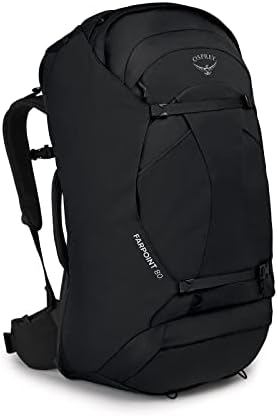
| 80L | Larger single checked-travel main bag |
Choose the split sizes only when the daypack is part of the plan.
The label explains where the space lives. The next question is whether that daypack works for the way the load will be carried.

70L is still split capacity
The 70L number also includes the daypack.
The 70L label works the same way as the 55L. The daypack supplies part of the total, so the main bag should not be read as one clean 70L cavity. When one larger main compartment is the goal, the 80L becomes the closer Farpoint comparison.
- 70L size split: The 70L works as a 55L main bag plus a 15L daypack.
- One-main-bag setup: The 70L can still disappoint someone who wanted one larger cavity.
This table separates the main-bag expectation from the better Farpoint setup.
| Main-bag expectation | Better Farpoint setup |
|---|---|
| One larger 70L cavity | Not the safest match |
| 55L main plus daypack | Better match for the 70L setup |
| One bigger main travel bag | The 80L is the closer Farpoint comparison |
The 70L is stronger as a split extended-travel setup than as a one-cavity size upgrade.

The daypack changes what the main bag does
The daypack helps most when its load stays realistic.
Dense daypack loads change the 55L
A loaded 55L daypack can move differently than a light one.
The 55L daypack attaches to the main bag through multiple points. A light personal-item load can stay manageable, but dense items pull on the attachment system differently. When a laptop and water sit in the daypack, the attached bag can sag away from the main pack.
At a full 13kg/29lb load, one 55L setup put pressure at the neck instead of disappearing into the harness. After a month of travel, a fully packed front daypack became a moving load instead of a quiet personal item.
- 2L water plus laptop: Dense loading is the setup that changes the attached carry.
- Security checkpoint: Non-quick-release loops can make the modular setup slower.
- Front carry: A full front daypack can become a moving load against the body.
- Short-trip packing: Top-only access can turn quick packing into digging.
- Separate daypack outcome: One regret case moved away from the attached setup.
The daypack table separates light personal-item use from dense attached carry.
| Daypack load | What changes on the 55L |
|---|---|
| Light plane essentials | Strongest use case for the included daypack |
| Laptop plus 2L water | Can sag when attached to the main bag |
| Full front carry | Can bounce instead of staying quiet |
| Daily backpack replacement | A separate daypack may fit the job better |
The 55L daypack is strongest when it stays light, separate, or clearly part of the boarding setup.
The cabin fit changes by variant
The right Farpoint size depends on how it boards or checks.
Overhead is cleaner than under-seat
Each Farpoint size has a safer travel role.
The Farpoint sizes do not behave the same in travel use. The loaded 40L body is better supported as an overhead-bin bag than as an under-seat personal item. The 55L changes shape by separating the main pack and daypack, while the 70L and 80L move farther away from standard cabin certainty.
- 40L Europe fee case: Strict airline sizing can still create a paid mismatch.
- 55L personal-item case: A rigid personal-item test can fail when the setup is wrong.
- 70L separated exception: One airline success does not make it a standard carry-on bet.
- 80L checked-bag case: Checked handling changes when the soft body is overstuffed.
This table keeps cabin, extended, and checked roles separate.
| Farpoint size | Safer travel role |
|---|---|
| 40L | Overhead-first carry-on |
| 55L | Main pack overhead, daypack under seat |
| 70L | Extended travel before strict carry-on |
| 80L | Checked-travel backpack |
Pick the Farpoint size by travel role, not by the largest number that seems carryable.
Comfort is strong until load and body fit change it
The harness is a strength with load and body limits.
Full load and body fit change comfort
The harness is a strength, but not an all-body guarantee.
The shoulder straps, load lifters, hip belt, and frame move travel weight across the body. The frame also holds the bag away from lumpy packing, which helps carry comfort but works against soft compression. Load size and body shape still decide how the carry feels.
- 13kg/29lb full load: The neck-pressure case keeps the heavy-load limit visible.
- Full front daypack: A packed front bag can bounce instead of settling.
- Waist extender case: Larger waist or belly fit can require more strap length.
- Wide shoulders: The 80L can feel wrong even when the capacity is right.
- Public-transport travel: The positive case is strongest when backpack carry replaces rolling.
This table separates supported carry cases from body-fit and load-state warnings.
| Carry condition | Comfort boundary to notice |
|---|---|
| Adjusted moderate travel load | Strongest comfort signal |
| Full 13kg/29lb two-bag load | Neck pressure becomes visible |
| Larger waist or belly fit | Strap length can become the limit |
| Wide-shoulder 80L carry | Capacity does not prove body fit |
| Soft-compression packing need | Frame structure may work against you |
Treat comfort as a Farpoint strength only after the load, body fit, and compression needs match.
The 80L is a checked-travel bag with listing and shape limits
The 80L needs checked-bag expectations, not carry-on assumptions.
Overstuffing changes the 80L
The 80L is a soft checked-travel choice, not a suitcase promise.
The 80L works best as a large soft travel pack. When the main body is overstuffed, it can round out instead of keeping a flatter luggage shape. That rounded shape can meet checked-bag handling in a less predictable way.
During checked-bag handling, an overstuffed 80L became lumpy enough to create a conveyor and oversized-bag dispute.
- Two-week loadout: Clothes, jacket, shoes, and a smaller backpack fit in the large-load case.
- Rome Fiumicino / ITA: The overstuffed shape created a checked-bag dispute.
- Turkish Airlines contrast: One airline outcome did not repeat the same problem.
- Daypack question: The 80L daypack signal is not clean enough to promise inclusion.
This table separates large-load support from daypack and checked-shape assumptions.
| 80L packing state | Checked-bag consequence |
|---|---|
| Large load packed flatter | Stronger checked-travel reading |
| Overstuffed rounded shape | Can create handling friction |
| Daypack expected | Do not assume inclusion |
| Suitcase-like conveyor certainty needed | Compare structured luggage |
The 80L makes the most sense as a large soft travel pack, not a guaranteed suitcase replacement.
Compact boundaries before buying
Thin claims stay as limits, not promises.
Weather, hydration, and durability stay limited
Some claims stay as buying limits, not promises.
The Farpoint material available here does not establish waterproof laptop protection, a clean hydration-ready design, or controlled long-term durability. These points can matter, but they should not become stronger promises than the product details support.
This table keeps thin claims from becoming stronger than they are.
| Claim area | How far the article can go |
|---|---|
| Waterproof laptop protection | Not established for this Farpoint setup |
| Hydration-ready use | Not established as a designed feature |
| Zipper durability | Limited to cautious product-side wording |
| Long-term quality | Not controlled testing |
Use these points as limits, not as reasons to buy the bag.
Who should skip the Farpoint
| Skip this setup | Why the Farpoint may miss |
|---|---|
| Deeper 16-inch laptop must fit cleanly | The 40L sleeve does not cover every chassis. |
| One large 55L or 70L main compartment expected | Those labels include daypack volume. |
| Dense attached 55L daypack load needed | Laptop plus water can change how the daypack carries. |
| Strict under-seat or standard carry-on certainty needed | The safer travel role changes by variant. |
| Overstuffed checked 80L expected to behave like a suitcase | The soft body can become lumpy in checked handling. |
| Broad-body or full-load comfort certainty needed | Harness strength still depends on body fit and load. |
Buy or skip?
Buy the Osprey Farpoint if you want travel-backpack comfort and you are willing to match the variant to laptop depth, split-capacity expectations, daypack load, and travel role. The tradeoff is physical: the same frame, harness, detachable daypack, and soft travel body that make the Farpoint useful also create the sleeve, capacity, access, and checked-bag limits. Skip it, or compare alternatives, if you want the size label alone to guarantee laptop fit, main-bag capacity, airline fit, or checked-bag behavior.
Check the Price
See More Options
If the Farpoint’s split capacity, laptop sleeve, or sparse pockets are the mismatch, these comparisons keep the next choice close to the problem.
- For a broader comparison, see larger laptop backpacks with clearer size and pocket tradeoffs.
- If the 40L sleeve depth is the problem, compare separate laptop protection when 16-inch chassis depth is the risk.
- If the 40L pocket layout is the issue, compare charger and cable organizers for the Farpoint’s sparse pocket layout.
