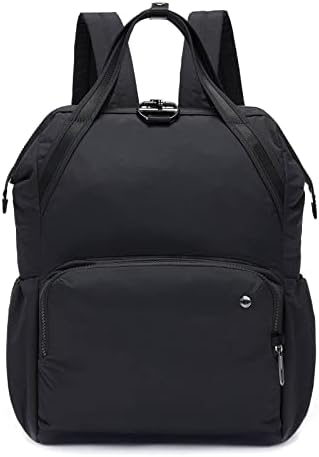
A 17L anti-theft laptop backpack can sound like a simple compact travel answer. The Pacsafe Citysafe CX 17L is more specific than that: it works best for smaller tech carry, slower secure access, and polished travel use. The laptop sleeve, front pocket, top opening, straps, bottle pockets, and rain limits all need closer reading before buying.
Scorecard
The Pacsafe Citysafe CX 17L lands in the Excellent tier — strong overall, but still narrow enough that laptop size, access speed, strap fit, and rain use need a closer look.
| Field | Value |
|---|---|
| DVSS Score | 86.53 |
| Satisfaction Tier | Excellent |
| Dissatisfaction Score | 8.65% |
| Critical Dissatisfaction Rate | 6.45% |
Based on buyer feedback patterns, not hands-on testing. See how this scoring works.
Around 6.45% of buyers flagged a serious enough problem to actively warn others, so the sleeve, pocket, strap, and weather limits below matter before buying.
The main question is not whether the bag looks like a strong compact travel pick. It is whether your laptop body, valuables storage, walking load, bottle shape, and rain needs fit the way this 17L design behaves.
Quick Take
- Best For: Compact tech carry with smaller laptops, tablets, documents, travel basics, and slower secure main storage.
- Not For: Clean 16-inch sleeve fit, fast one-handed access, heavy all-day shoulder carry, or waterproof tech protection.
- Top Strength: Polished travel styling with layered main-compartment security and useful compact organization.
- Main Limitation: The 17L label, anti-theft setup, and wide opening can sound broader than the bag’s actual limits.
Decision Matrix
| Your Pacsafe CX 17L setup | What to know before buying |
|---|---|
| Compact laptop or tablet | This is where the sleeve has the most room. |
| 16-inch laptop body | Sleeve fit needs caution before buying. |
| Wallet or passport in front pocket | Main storage is the safer place. |
| Heavy all-day shoulder carry | Strap fit depends on body and load. |
| Sustained rain or repeated overstuffing | Added protection or another setup may fit better. |
Where the laptop sleeve stops before the bag runs out of space
The 17L label does not settle laptop fit.
16-inch LG Gram versus slim 15-inch bodies
The sleeve can stop being the safe place before the bag feels full.
The laptop sleeve sets the first limit because total bag capacity is not the only fit question. Smaller laptop and tablet bodies can sit in the sleeve, but taller or wider bodies can run out of sleeve clearance while the main compartment still has room. The structured top opening adds another limit because a laptop near the top can make the zipper harder to close.
In some setups, the wrong laptop body can make the sleeve a poor match before the bag itself feels full.
A secure laptop travel setup can look right at first, then the computer reaches the bag body while the sleeve or top opening becomes the real limit.
- 16-inch LG Gram: Misses the sleeve and leaves only a main-compartment fallback.
- Thin 15-inch Lenovo: Fits the pocket but turns closure into the next problem.
- Tight laptop body: The 14.01 x 10.74-inch case shows why body dimensions matter.
- Smaller Apple and tablet bodies: MacBook 12, MacBook 13, and iPad Pro cases sit on the safer end of the fit range.
The 17L label does not make the sleeve a safe fit for every 15- or 16-inch laptop body. Use this table to separate device setup from what the sleeve can safely promise.
| Laptop or tablet setup | Where the 17L sleeve stops |
|---|---|
| MacBook 12, MacBook 13, or iPad Pro size | More room in the sleeve |
| Slim 15-inch laptop body | Possible fit, but closure still needs caution |
| 14.01 x 10.74-inch laptop body | Treat the sleeve as tight |
| 16-inch LG Gram class | Do not assume sleeve fit from the 17L label |
The safest order is laptop body first, capacity label second.
Why secure storage also slows the owner
Security depends on which part of the bag you use.
Steel-post opening and the top zipper path
The opening favors visibility more than speed.
The structured top opens wide, so the interior becomes easier to see. The zipper wraps around that shaped opening instead of running like a simple straight closure. Top wiring also holds the shape and can squeeze soft expansion, while the metal around the top adds weight that the shoulder straps still have to carry.
The personal-item size can be appealing, but repeated standing access slows down when the secure top opening needs more hand control.
- Thin 15-inch Lenovo: The laptop case turns closure into the follow-up problem.
- Standing access: The closure can become easier to finish on a surface.
- Two-hand use: Secure opening can demand more hand control than expected.
- First opening: A small learning curve can show up early.
The wide opening helps visibility, but it does not make the zipper faster. Use this table to separate what the shaped opening helps from what it slows down.
| How you use the opening | What changes |
|---|---|
| Open the bag on a surface | Better view into the interior |
| Close it with a laptop near the top | Slower closure is more likely |
| Pack soft items above the frame | Shape control can squeeze expansion |
| Need constant quick access | A separate quick-access option may fit better |
This opening is strongest for controlled packing and weaker for fast repeated access.
Main lock versus front pocket zipper tuck
Valuables and quick-access items do not belong in the same place.
The main compartment and front pocket do not close the same way. The main storage uses the slower security setup, while the front zipper tucks into place without the same lock behavior. That makes the front pocket better for quick, lower-risk items than for valuables.
The front pocket looks useful for quick travel items, but it becomes a poor valuables pocket when the main compartment is the security standard.
- Wallet, passport, and phone: These are the risky front-pocket temptations.
- Crowded travel: Quick access can become a weaker storage choice.
- Attempted opening: The main storage case shows why slower access can matter.
- Repeated standing use: The secure area can frustrate items needed again and again.
The anti-theft setup does not mean the front pocket locks like the main compartment. Use this table to decide which pocket should carry which kind of item.
| Where the item goes | How secure that pocket is |
|---|---|
| Main compartment | Slower, stronger place for valuables |
| Front pocket | Better for low-value quick items |
| Added small lock with Roobar setup | Extra restraint for more control |
| Items needed again and again | Better outside the slowest storage area |
Keep valuables with the slower locked storage and keep quick-access items lower risk.
Layered deterrence is not theft-proofing
The security build is best read as resistance, not certainty.
The security details do not all solve the same problem. A strap attachment can hold the bag to fixed furniture, while wire mesh or cable reinforcement can resist a quick cut. Those parts can make a grab-and-go theft harder, but they do not prove the bag cannot be cut, opened, or stolen.
Cut-resistant details can make the bag feel safer, but they are still deterrence rather than a guarantee.
- Chair, table leg, or pole: Stationary anchoring is the clearest extra security use.
- Cut-and-run concern: Reinforcement supports deterrence, not a guarantee.
- Small added lock: The strongest closure setup may include an extra item.
Cut-resistant details support deterrence, not a promise that the bag cannot be cut. Use this table to separate each security detail from what it actually adds.
| Security detail | What it really adds |
|---|---|
| Strap attachment | Helps restrain the bag to a fixed object |
| Wire mesh or cables | Supports a cut-resistance role |
| Added small lock | Extra restraint beyond built-in closure |
Treat the system as layered resistance, not a promise that every risk is covered.
What loaded walking does to the shoulder straps
The carry fit changes once weight starts moving.
Shorter-torso cases and strap adjuster slip
Comfort changes once walking load starts pulling on the straps.
The shoulder-strap adjuster can slide when movement and load pull against the shortened setting. The top structure also adds weight to what the straps carry, and the lack of a waist strap keeps that weight on the shoulders. That makes comfort depend on body height, load, and walking time more than the polished shape suggests.
The bag can look like a polished all-day travel pick until loaded walking pulls the straps lower.
- 5’2 buyer: The shortened setting did not hold.
- 5’4 loaded walk: One strap loosened after about 10 minutes.
- 5’3.5 laptop-and-bottle load: The bag sat too low for the buyer.
- Month-long Europe case: The strap issue appeared even without a heavy load.
- Pipe cleaner and cable ties: A workaround shows strap retention deserves attention.
In one loaded-walk case, the strap loosened after about 10 minutes and let the bag sit lower than expected. During a month of travel, strap slide still appeared with a lighter load, so this is not only an overpacking issue.
Adjustable straps do not guarantee a high, stable carry for every body and load. Use this table to separate easier carry cases from the body and load setups that need caution.
| Body and load case | Where the straps change fit |
|---|---|
| Light carry with roller support | Stronger chance of staying comfortable |
| Shorter body with walking load | Strap position needs caution |
| Laptop plus bottle load | More likely to pull the carry lower |
| Heavy all-day shoulder carry | A stronger harness may fit better |
This is a better match for lighter carry than for heavy all-day shoulder use.
The first table separates body and load. The next one shows which support choices change the shoulder burden.
| Added support setup | What it changes |
|---|---|
| Roller bag support | Reduces how long shoulders carry the load |
| External strap ties | May help hold the setting, but adds a workaround |
| No waist strap | Leaves the load on shoulders |
| Strapless hand-carry expectation | Not supported by the strap design |
Extra support can help, but it also shows the built-in carry fit is not universal.
When side pockets take space back from the main compartment
Bottle shape changes more than the side pocket.
32oz Owala, wider Hydroflask, and interior space loss
The outside pockets are useful, but they are not free space.
The side pockets use exterior side volume, and bottle width changes how smoothly they work. Once those pockets fill, the bottle can press into the space that would otherwise help the main compartment. Bottle carry and interior packing therefore need to be read together.
The side pockets look like extra room until a bottle and case start taking space back from the interior.
- 32oz Owala: Possible fit, but harder to put back in.
- 22oz tall Hydroflask: Stronger support for a slimmer tall bottle.
- Wider Hydroflask: Bottle shape can stop the pocket from working.
- Bottle plus sunglasses case: Outside storage can make the inside feel smaller.
- Two side bottles under-seat: One good case does not settle every aircraft-and-bottle setup.
The side pockets add useful storage, but they can take room back from the main compartment. Use this table to separate bottle fit from what happens to the bag’s interior space.
| Bottle or side-pocket setup | What happens to space |
|---|---|
| Slimmer tall bottle | Better fit reading |
| Wider or odd-shaped bottle | Shape matters before relying on the pocket |
| Filled side pocket plus packed interior | Main compartment room becomes tighter |
| Side bottles during flights | Possible in one case, not guaranteed |
The side pockets work best when bottle shape and interior packing are planned together.
What the organized interior solves — and what it does not secure
Visibility and restraint are different storage outcomes.
AirPods, iPod, and battery packs under the seat
Easy to see does not mean fully secured.
The lighter interior makes small items easier to spot in a compact bag. But open slip pockets and zippered storage do different jobs. When the bag goes under an airplane seat or tilts, loose small items can move even if they were easy to find when packed.
After extended work travel, the issue was not only shoulder comfort; loose small-item storage also became part of the carry problem.
- AirPods: A small item that can need more restraint.
- iPod: Another loose item that can migrate inside the bag.
- Battery pack: Heavier small tech can still end up at the bottom.
- Under-seat placement: The bag position changes how loose pockets behave.
- Passport or ticket storage: The zip pocket is the stronger small-document case.
Loose small electronics can migrate to the bottom when the bag goes under a seat. Use this table to separate easy-to-see storage from storage that actually keeps small items controlled.
| Small item setup | How it stays controlled |
|---|---|
| Items in the zip pocket | Better restrained for small documents or valuables |
| Items in open slip pockets | Easier to reach, less controlled when tilted |
| Loose small electronics | Better paired with a small pouch |
| Card, key, or hidden-back-pocket expectation | Not established by the storage layout |
The interior is easy to read visually, but loose tech still needs restraint.
Compact travel cases
This is compact tech support, not heavy gear support.
The main compartment works best when tech stays flat, small, or paired with compressed soft goods. That makes the 17L useful for compact travel carry. It should not be stretched into a large camera-kit or heavy creator-bag claim.
- DJI Pocket accessories: Small creator gear stays within the compact loadout range.
- Kindle Paperwhite: Small tech fits the compact travel profile.
- Travelon crossbody purse: Pouch-inside-bag packing is supported.
- Brita filtering bottle: Travel bottle carry appears in the compact setup.
- Compression bag: Soft goods work best when they stay compressed.
Compact travel-tech support should not become a large camera-kit claim. Use this table to keep compact travel-tech support from turning into a heavy-gear claim.
| Compact tech loadout | What remains unproven |
|---|---|
| Tablet, reader, and small accessories | Larger camera kits |
| Small pouch or purse inside | Heavy creator carry |
| Compressed soft goods | Bulky multi-day packing |
| Light travel extras | Deep weekender capacity |
The loadout support is strongest when the setup stays compact.
Where weather and zipper claims need tighter wording
Material strength does not settle every use condition.
Rain exposure and overstuffed zipper use
Material quality does not cover every wet or overfilled use case.
The outer fabric can handle a light-rain and wipe-clean role, but that is different from waterproof tech storage. The zipper has a separate limit because repeated overstuffing can strain the closure in a way normal packing may not. Once rain lasts long enough or the bag is packed too tightly, the material and zipper stop carrying the same promise.
The water-resistant label can feel reassuring until sustained rain turns the question into tech protection.
- Extended downpour: Water eventually began to seep through.
- Light rain: The positive weather case stays below waterproof expectations.
- One-year work-trip case: The zipper problem moved from grabbing to partial failure.
- Overstuffed loads: The strain case is tied to use pattern, not a universal defect.
- Long-term quality positives: Strong material performance still needs bounded wording.
In extended downpour use, the fabric held out for a time before water began to seep through. Water-resistant does not mean the bag should be treated as waterproof tech storage.
Use this table to keep rain protection from becoming broader than the material can support.
| Rain condition | How far resistance goes |
|---|---|
| Light rain | Supported as the safer weather limit |
| Sustained rain with tech | Add separate waterproof protection |
| Waterproof expectation | Do not treat as proven |
Weather protection is useful only when it stays below waterproof expectations.
The rain table separates wet-use limits. The next table separates normal zipper use from repeated overstuffing.
After a year of daily work trips with overstuffed loads, one zipper case moved from grabbing to breaking and then closing only halfway.
| Zipper use pattern | How the zipper use reads |
|---|---|
| Normal packing | Stronger fit when the bag is not forced full |
| Repeated overstuffing | Higher caution for zipper strain |
| Daily heavy work trips | Treat the failure case as a serious limit |
| Universal zipper defect claim | Do not treat as proven |
The zipper concern is an overstuffed-use limit, not a universal defect claim.
Where travel convenience stays conditional
The travel details help only within compact limits.
Roller handles, top handles, and under-seat retrieval
The travel details help, but they do not transform the carry style.
The luggage sleeve and top handles can make airport handling easier, but they do not remove every travel-use limit. The sleeve can catch differently depending on the suitcase handle, and the top handles act as grab points rather than a full carry-format change. The backpack straps can reorient, but they are not established as removable.
The top handles support quick grabs, but they do not make the backpack straps disappear.
- Roller handle: Useful airport pairing, but handle fit still matters.
- Travel pillow: Top handles can act as an attachment point.
- Under-seat retrieval: Top handles help when pulling the bag out.
- Strapless carry expectation: The straps do not disappear.
- Two side bottles under-seat: One good case does not settle every flight setup.
The top handles do not turn the bag into a true strapless carry. Use this table to keep helpful travel handling separate from carry-format assumptions.
| Travel handling setup | Where it helps or catches |
|---|---|
| Roller handle use | Helpful, but handle fit can matter |
| Top-handle grabs | Useful for quick lifting and retrieval |
| Strapless hand-carry expectation | Not supported by the strap design |
| Personal-item flight use | Supported conditionally, not as a universal claim |
These travel details support compact trips, not a full carry-style conversion.

Who should skip the Pacsafe Citysafe CX 17L
| Skip this setup | What can go wrong |
|---|---|
| You need clean 16-inch sleeve certainty | The sleeve may stop before the bag feels full. |
| You plan to keep valuables in the front pocket | That pocket does not secure like the main storage. |
| You need fast one-handed access | The secure opening can slow repeated use. |
| You carry heavy loads on your shoulders all day | Strap fit can change under walking load. |
| You rely on wide bottles | Bottle shape can change the result. |
| You need waterproof tech carry | Sustained rain needs added protection. |
| You carry larger camera or heavy creator gear | Compact loadouts are supported, not heavy kits. |
Buy or skip?
Choose the Pacsafe Citysafe CX 17L if you want a polished compact travel-tech backpack with slower secure main storage, useful organization, and a shape that works best with smaller devices and controlled packing. Compare another setup if your choice depends on 16-inch sleeve certainty, fast repeated access, front-pocket valuables, heavy all-day shoulder carry, wide-bottle certainty, waterproof tech protection, or larger camera gear. The strongest tradeoff is compact secure carry with clear limits, not a do-everything laptop travel bag.
Check the Price
See More Options
- For a smaller-bag comparison set, see small laptop backpacks that stay closer to compact tech carry.
- For more room around larger laptop bodies and daily gear, see backpacks with more room for larger laptop bodies and daily gear.
- For loose chargers, earbuds, and small electronics that need better control inside the bag, see pouches for loose chargers, earbuds, and small electronics.
