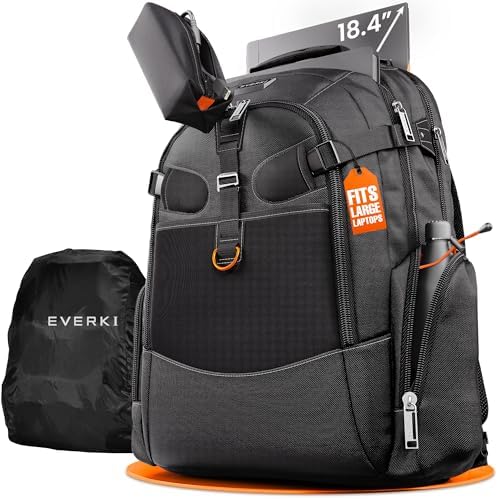
A 40L laptop backpack can sound like the safe answer for large laptops, heavy tech, and travel days. The Everki Business 120 comes closest when the load is structured around electronics, but the laptop chassis, zipper edge, divided space, and packed travel size still decide whether it fits your setup. This is a strong large-tech bag for the right setup, not a simple “everything fits” shortcut.
Scorecard
The Everki Business 120 lands in the Exceptional satisfaction tier, with low dissatisfaction signals for a large tech backpack. That score is useful for context, but it does not prove laptop fit, comfort, weather protection, or airline fit.
| Field | Value |
|---|---|
| DVSS Score | 92.92 |
| Satisfaction Tier | Exceptional |
| Dissatisfaction Score | 4.77% |
| Critical Dissatisfaction Rate | 4.33% |
Based on buyer feedback patterns, not hands-on testing. See how this scoring works.
At 4.33%, serious dissatisfaction stays low, but it is still enough reason to read the chassis, packing, and travel limits below. DVSS helps summarize satisfaction patterns, but the actual buying choice still depends on the fit, packing, carry, and travel limits below.
The strong score makes the Business 120 worth considering, especially for dense tech carry, but it should be read beside the chassis-fit, divided-storage, packed-airplane, and full-load carry checks.
Quick Take
- Best For: Large organized tech loads carried between home, office, car, airport, hotel, or short walking segments.
- Not For: Setups that need reliable fully packed under-seat fit, one open clothing cavity, or light long-distance carry.
- Top Strength: The 40L space works best when it holds laptops, tools, cables, tablets, and gaming electronics.
- Main Limitation: Screen size, pocket shape, zipper clearance, and full-load bulk still shape the choice.
Decision Matrix
| Your Business 120 setup | What to settle first |
|---|---|
| Large gaming or workstation laptop | Chassis shape and zipper-edge clearance |
| Dense tools, cables, tablets, or gaming electronics | Organized storage versus carry weight |
| Clothing-heavy travel packing | Divided 40L space versus open packing |
| Fully packed airplane use | Overhead planning versus under-seat expectation |
| Rain or fragile electronics concern | Extra protection versus built-in weather help |
The 40L label does not settle laptop fit
Large laptop carry starts with chassis shape.
Chassis shape decides the clean fit
Screen size is not enough for this laptop pocket.
The laptop pocket and zipper edge press against the real shape of the computer, not the screen label. A thick rear section, wide corner, or fan-heavy chassis can reach the closure area before the screen size tells the full story. That is where a laptop can sit inside the bag while still landing too close to the zipper edge.
The large-laptop appeal is real, but screen size alone does not settle the fit. In some setups, a large laptop can technically fit while the zipper edge or corner-padding area still changes confidence.
- Large-laptop confidence: The large-laptop promise still leaves the closure area to answer.
- Main-compartment fallback: Oversized flat tech may leave the laptop pocket and move into the larger storage area.
- Technical fit anxiety: A laptop can sit inside the bag while still riding too close to the edge.
The examples below show where the laptop pocket stays favorable, where the closure gets close, and where another compartment makes more sense.
| Your laptop or gear | How the Business 120 handles it |
|---|---|
| Asus G752-style tolerance case | Most favorable when the chassis stays within pocket tolerance |
| Dell Precision 7770-style edge case | May fit while sitting close to the closure |
| ASUS G752VT-style rear fan shape | Needs extra caution before assuming clean closure |
| Maschine Studio-style flat gear | Better treated as main-compartment cargo |
The safer read is not “large laptop fits,” but “large laptop fits when the chassis leaves room at the edge.”
Bottom corners are the protected claim limit
Laptop protection needs a corner caveat here.
A padded or suspended laptop area is not the same as confirmed full corner coverage. The bottom-corner area has a coverage limit, which matters most when the bag is set down with a valuable laptop inside.
A padded laptop area does not automatically prove full corner coverage.
- High-value laptop worry: The concern matters most when the device cost makes corner impact harder to dismiss.
- Fit versus protection: A laptop can fit the pocket while the protection question remains separate.
This table is for the protection question, not another fit test.
| Your protection concern | What needs extra help |
|---|---|
| Basic padded laptop carry | The corner caveat matters less here |
| Full bottom-corner confidence | A separate sleeve is the safer add-on |
| Expensive laptop in rough handling | The built-in padding claim should stay cautious |
The built-in laptop area can make sense for carry fit, while a sleeve is safer when corner confidence decides the purchase.
The space works like organized tech storage, not one open cavity
The 40L space favors sorted electronics.
The dividers change what 40L feels like
This is roomy, but it is not one open space.
The interior dividers split the 40L body into structured sections. That helps when the load is made of tech, tools, cables, tablets, and work items, but it changes how loose items sit inside the bag. Once the pocket layers fill up, upper pockets can block lower access.
The 40L label suggests room, but the divided interior makes this more of an organized tech bag than an open packing cavity. After only a few days of use, the complaint shifted from raw capacity to pocket shape and bulky daily carry.
- Clothes-plus-tech packing: The space can feel tighter once work items and clothing compete.
- Small-item searching: More pockets can make one small item harder to locate.
- Electronics-first use: Fixed sections favor sorted tech more than loose packing.
This table separates organized tech carry from open packing expectations.
| What you pack inside | Where the 40L space changes |
|---|---|
| Tools, tablet, cables, and work items | The divided layout is at its strongest |
| Clothes-heavy travel packing | The fixed sections become less forgiving |
| Mixed work gear and spare clothing | Separated spaces matter more than one cavity |
| Loose open-packing expectation | A different packing style may fit better |
Choose this bag for sorted electronics, not for one big clothing cavity.
The big compartments answer the first question. The smaller pockets answer a different one.
Small pockets do not fit every small item
More pockets do not always mean the right pocket.
The small organizer pockets accept or block accessories by shape. Pocket count helps with sorting, but pocket proportions decide whether a charger, mouse, card stack, pen item, or headphones actually have a clean place to go.
The pocket count is a strength, but a charger, mouse, cards, or headphones can still miss the right pocket shape.
- Charger storage: The bag may have pockets without giving that charger a clean home.
- Mouse and card items: Flat or square small items can still land awkwardly.
- Headphone protection: Bulky or delicate headphones may need a separate case.
The next table separates common accessories by the pocket problem they raise.
| Your small accessory | What to plan before buying |
|---|---|
| Laptop charger | Side or small pockets may not fit it |
| Wireless mouse or cards | Pocket shape matters more than pocket count |
| Pen items | Open-bottom storage may not suit everyone |
| Studio-quality headphones | Separate protection may be needed |
The organizer is strong, but exact accessory fit still needs caution.
Packed travel pushes this bag toward the overhead bin
Packed airplane use is the travel split.
Full loads change the airplane fit
A packed 40L bag is safer to plan around the overhead bin.
The bag’s airplane behavior changes as the load fills out the body. A lightly packed bag and a fully loaded 40L bag do not occupy cabin space the same way, especially when seat position and aircraft space are less forgiving. Once packed close to its limit, the safer assumption is overhead storage rather than reliable under-seat use.
The backpack shape can make it look personal-item friendly, but a packed 40L body points more safely toward overhead use. Across repeated flights, the packed body showed why under-seat use should not be treated as the safe assumption.
- Under-seat space: A packed load can consume the area the feet usually need.
- Aisle-seat pressure: Tighter seat positions make the same bag less forgiving.
- Personal-item doubt: The more the bag fills, the less reliable that assumption becomes.
Airplane fit changes most when the bag is packed close to its limit.
| Your travel setup | What the packed bag does |
|---|---|
| Light or not-stuffed carry | Under-seat use stays more plausible |
| Roomier seat situation | Fit may work, but it is not guaranteed |
| Fully packed 40L load | Overhead planning is the safer assumption |
| Tight or aisle-seat space | Treat under-seat use as unreliable |
If overhead space is acceptable, the travel case is much stronger.
Where the bag sits is one travel issue. What happens at screening is another.
Airport access is easier until the electronics get dense
Flat access helps, but it does not make a dense electronics load friction-free.
The laptop compartment opens flat for airport screening. That makes the laptop area easier to present, but a dense electronics stack can still trigger item removal when the packed load looks crowded to screeners.
Checkpoint-friendly access helps, but it does not guarantee a smooth screening experience when the electronics load is dense.
- TSA PreCheck case: Dense electronics can still lead to item removal.
- Screening speed: The packing density can matter more than the opening style.
This table keeps flat-opening access separate from dense-electronics screening.
| Your airport setup | What to expect |
|---|---|
| Laptop-focused carry | Flat access can make screening easier |
| Dense electronics stack | Item removal can still happen |
| No-delay expectation | Pack density becomes the risk |
The opening helps, but it does not make a dense electronics load invisible to screening.
The carry system works best before the load takes over
Weight is the second half of capacity.
Full loads change the carry decision
This bag is stronger for short heavy movement than long fully loaded walking.
The shoulder straps and back panel spread dense tech weight across the upper body. That helps a heavy work setup feel more manageable, but a fully packed 40L body still leaves the load on the shoulders and back. Without waist-belt-style load transfer, the Business 120 makes more sense between stops than across long walks with everything packed.
After a couple of years of heavy work travel, the shoulder-strap cushion became the wear point. After almost three years of full-day heavy carry, side fabric wear was described as superficial rather than a puncture. A separate four-year-plus use case keeps the durability picture from being only about wear.
- Work-tech loadout: A 16-inch laptop, iPad Pro, tools, and accessories fit the bag’s strongest use.
- Smaller-frame strain: The same body that helps capacity can feel oversized.
- Long-walk penalty: A fully packed load becomes a comfort problem over distance.
- Gaming weight: The electronics can fit before the carry comfort catches up.
This table separates dense tech carry from long fully loaded walking.
| Your loaded carry | When the weight catches up |
|---|---|
| Dense tech between office, car, hotel, or airport | This is the strongest carry case |
| Fully packed 40L walking day | The size becomes harder to ignore |
| Smaller-frame or low-bulk preference | Compare a lower-volume backpack |
| Heavy lift by the top handle | Use the shoulder carry as the main method |
The bag favors short movement with heavy tech more than long walking with everything packed.
The smaller carry details are useful, but they stay secondary to load weight.
Gaming electronics prove the capacity and the burden
The gaming gear can fit before the carry comfort catches up.
The main storage and organizer sections can take a dense electronics load. Once that load is inside, the same success shifts the choice from storage space to carry weight. This is where the Business 120 looks most impressive as a tech hauler and least convincing as a light walking bag.
The huge electronics capacity is impressive, but it should not be read as light carry.
- Acer Predator setup: The gaming load includes a second laptop, keyboard, controllers, and Switch dock.
- Accessory pile-on: Surge protection, battery backups, and cords raise the density further.
- Point-to-point travel: The load is more convincing between stops than on long walks.
The gaming case supports the bag’s capacity claim, not a light-carry claim.
Body size changes the comfort read
The same 40L body can feel different on different frames.
The large body and strap spread press differently on smaller and broader frames. Load size adds another layer, so comfort should stay conditional instead of universal.
A large backpack does not feel the same on every body.
- Smaller-frame reports: Two smaller-body cases described the bag as oversized or unwieldy.
- Broad-shoulder contrast: A broad-shouldered setup gave the large body a better fit read.
- Capacity tradeoff: The room that helps the load can also make the bag feel physically large.
Body-fit feedback works best as a frame-and-load split, not a universal comfort score.
| Your loaded carry | Comfort read before buying |
|---|---|
| Smaller frame or low-bulk preference | Compare a lower-volume backpack |
| Broad shoulders and large tech load | The body size is more likely to make sense |
| Heavy load on a smaller frame | Bulk becomes part of the choice |
The carry fit is conditional: load and body frame both matter.
The weather setup helps, but it is not full sealing
Rain help is not waterproof certainty.
The cover has edge and version limits
The cover helps with rain, but it does not close every weather gap.
The rain cover improves the weather story, but it does not establish fully sealed electronics protection. Edge coverage, back or corner exposure, faster-movement wind behavior, and version-sensitive cover inclusion all keep the protection claim limited.
The rain cover helps the story, but it does not turn this into a fully sealed electronics bag.
- Electronics confidence: Sensitive gear should not depend on the cover alone.
- Version check: Weather planning changes if the current bag differs from older versions.
- Bike or motorcycle use: Faster movement makes edge exposure more important.
Weather and protection claims need the tightest wording in this article.
| Your protection concern | Where the cover stops short |
|---|---|
| Normal rain help | The cover can be useful with caution |
| Full waterproof confidence | The cover does not prove full sealing |
| Current-version rain-cover reliance | Current-version details need confirmation before relying on it |
| Expensive electronics in wet conditions | Separate protection may be needed |
Treat the rain cover as help, not as proof of sealed electronics protection.
Who should skip it
| Skip if your setup needs | Why the Business 120 may not be enough |
|---|---|
| Universal large-laptop fit | Chassis shape can still change the fit |
| One open clothing cavity | The 40L space is divided for tech |
| Reliable packed under-seat use | Full loads point safer toward overhead |
| Light long-distance walking | Weight catches up when fully packed |
| Waterproof confidence | The rain setup does not prove full sealing |
| Exact pocket fit for every accessory | Some small items may need a separate pouch |
Buy or skip?
Buy the Everki Business 120 if you want one large backpack for dense, organized tech moved from stop to stop. The core trade-off is physical: the same 40L structure that helps it hold laptops, tools, cables, tablets, and gaming gear also divides the space, adds packed bulk, and puts full-load weight on your upper body.
Skip it if that trade-off does not match your setup. A setup that needs universal large-chassis fit, one open clothing cavity, reliable packed under-seat use, light long-distance walking, or waterproof confidence will run into the same limits that make this bag strong for heavy organized tech.
Check the Price: Everki Business 120 40L
See More Options: When the heavy-tech load is the appeal but the fit concern is the laptop pocket, compare large laptop backpacks built for heavy tech loads. When corner padding decides the purchase, add sleeve protection when corner padding is the concern. When the pockets miss your charger, mouse, cards, or headphones, add a separate pouch when the small pockets miss your accessories.
