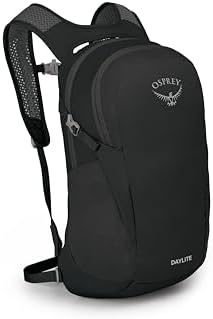
The Osprey Daylite 13L handles light loads well. Buyer feedback repeats the same pattern: this pack works best when you keep your carry genuinely small.
Light day-hike essentials, city carry, airline personal-item use, and compact 13–14-inch tech setups all fit this pattern. Add bulky clothing, a bigger laptop, extra tech, or a need for more secure internal organization, and buyer feedback gets more mixed.
The Daylite 13L is not built for cramming every possible item into a small pack. The real question is whether 13 liters actually covers your daily setup.

Product Snapshot
The evidence most consistently supports these decision-relevant characteristics:
- Compact 13L format. Buyers call the pack small and lightweight. It works for day use, not for heavy or high-volume carry.
- Ventilated back panel. Buyers notice better airflow and less back heat while walking or hiking. Still, the pack does not stop sweating entirely.
- Hydration-compatible internal sleeve. Buyers use this sleeve for a hydration bladder, laptop, or tablet. The evidence does not show full padding on every side when carrying a laptop.
- Side bottle pockets. Many buyers report secure bottle carry, including some 1L and 32 oz bottles. Wider bottles do not fit every time.
- Simple internal organization. Some buyers like the straightforward layout. Others want a secure zippered pocket for small valuables.
- Light-rain resistance, not full waterproofing. Some buyers report no leaks in light rain. Other feedback is clear: the bag is not waterproof. The evidence does not support reliable protection once rain gets heavy.
Buyer Evidence Metrics
| Buyer Question | Metric | Evidence |
| How consistently does the Daylite separate light day loads from bulkier or larger-device loads? | UBC 0.90 | Strong · n=20 |
| How consistent is the practical boundary between 13–14-inch-class laptops and larger laptop carry? | UBC 0.85 | Moderate · n=13 |
| Is capacity friction more concentrated in laptop/tech-heavy setups than in light day-load setups? | CFL 1.97× | Moderate · n=9 |
How to read these metrics: Use Boundary Consistency (UBC) reflects how consistently eligible buyer evidence separates a supported setup from the condition where that setup becomes more limited. Context Friction Lift (CFL) reflects whether a known friction is more concentrated in one eligible context than in the comparison baseline. These are buyer-feedback signals, not lab measurements, probabilities, or product-quality scores. See how these buyer-evidence metrics work.
The UBC 0.90 signal shows a clear pattern: light day-use loads usually fit, but bulkier setups or larger devices often hit capacity limits. This does not mean you have a 90% chance the bag will work for your setup.
The CFL 1.97× signal means buyers carrying laptops or tech gear report more capacity friction than those with light day loads. This does not mean tech carry fails twice as often. Based on the feedback we received, several laptop setups still work.
Fit–Friction Matrix
| Buyer Setup / Context | Fit Signal | Main Friction |
| Water, food, a light layer, and small essentials for a short-to-moderate day hike | Recurring Strong Fit | Capacity becomes less predictable once bulky layers or a broader multi-category load are added. |
| 13–14-inch-class laptop with a compact charger and limited accessories | Generally Works | Device dimensions vary, sleeve protection is limited in some reports, and added tech quickly consumes the remaining 13L space. |
| 15-inch-and-larger laptop or a laptop plus a bulkier accessory load | Conditional Fit | Larger devices may need to sit outside the sleeve, may not fit, or may leave too little useful room for the rest of the load. |
| Airline personal-item or under-seat use with a compact travel load | Generally Works | Positive airline-fit examples are specific observations, not universal guarantees; secure small-item organization can still be limiting. |
| Travel use that depends on secure storage for passport, cash, sunglasses, or similar small valuables | Limited Fit | Multiple buyers specifically wanted a zippered or hidden small-item pocket that this layout did not provide. |
| Large water bottle in a side pocket | Conditional Fit | Many bottles work, but wider bottle geometry produces conflicting fit reports. |
Where the Daylite 13L Fits Best
Buyer feedback is most consistent in four use cases:
- Light day hikes. Repeated examples include water, food, a light puffer or rain layer, sunscreen, phone, keys, and other small essentials. A two-hour Cadillac Mountain example worked with a sandwich, snack, rolled raincoat, and water bottle.
- City day use. Buyers report using the pack for urban sightseeing, including specific trips in Paris and Rome, where the load stayed limited to an emergency clothing layer, a book, water, and basics.
- Airline personal-item use. Specific buyers report under-seat or personal-item success, including one China Airlines trip and separate Flair and WestJet sizer examples. Those reports support observed compatibility in those situations, not a universal airline-size guarantee.
- Restrained daily tech carry. Multiple buyers report successful 13–14-inch-class laptop setups when the rest of the load remains compact.
What you carry matters more than the activity itself.
What Buyers Actually Carry
Buyer evidence gives a clearer picture than any generic feature list.
Typical successful loads include:
- water bottle or hydration bladder;
- lunch, snacks, or a sandwich;
- light jacket, rain layer, or puffer;
- phone, keys, sunscreen, small first-aid or personal items;
- one 13–14-inch-class laptop with a restrained charger/accessory load.
Several specific setups help define the practical range:
- A 13.6-inch MacBook Air plus Nalgene bottle was reported as workable for daily carry.
- A 13.3-inch e-ink device plus a 14-inch ThinkPad both fit in one buyer’s setup, although that buyer still wanted more impact padding.
- A 3L hydration bladder was reported as physically possible, but the same Q&A warned that it consumes much of the remaining 13L capacity.
Just because one item fits does not mean the rest of your load will still fit or carry well.
Where Capacity Starts to Break Down
The Daylite 13L can carry useful loads. The real limitation shows up when you try to fit too many bulky items at once.
The problem appears when several reasonable items compete for the same small space.
Capacity becomes more conditional when buyers add:
- a bulky jacket or several layers;
- a larger laptop;
- laptop plus multiple electronics and accessories;
- a wider lunch container;
- shoes or other awkwardly shaped items;
- hydration plus a broader day load.
Several buyers solved this by moving to the Daylite Plus. Others preferred the regular Daylite specifically because they valued the smaller footprint more than extra space.
This split matters. The Daylite 13L works best when you actually want a small pack, not when you hope it will carry like something bigger.
Laptop Carry: Usually Workable, Not Universal
The evidence supports a practical 13–14-inch laptop range more consistently than larger sizes, but screen size alone does not guarantee fit.
Positive examples include:
- a 13.6-inch MacBook Air;
- a 13.3-inch e-ink device;
- a 14-inch ThinkPad;
- multiple other 13–14-inch laptop reports.
The evidence also contains important contradictions:
- one older answer says a 13-inch notebook would not fit;
- one buyer reports a 15-inch MacBook fitting;
- another buyer reports a 15-inch laptop not fitting;
- one 17-inch laptop was forced into the main area rather than carried in the sleeve.
The evidence supports a conditional size boundary, not a universal cutoff. Check your laptop’s real dimensions, including any case, and decide if you are comfortable using a separate sleeve.
Organization: Simple Can Be a Strength or a Limitation
The Daylite’s simple layout splits buyers.
Some buyers like the reduced complexity. They use the main compartment for the bulk of the load and the front area for a few smaller items.
Other buyers specifically criticize the lack of secure internal storage. Repeated concerns include:
- no dedicated zippered internal pocket;
- no hidden back pocket;
- limited secure space for passport or cash;
- small items settling or moving around;
- sunglasses, lip balm, or similar items requiring more digging than desired.
This is not a universal defect. It becomes a bigger issue for travel buyers who want quick, secure access to small valuables.
Comfort and Body Fit
Light-load comfort is a recurring positive signal, especially when buyers value ventilation and a compact footprint.
Still, the evidence shows fit isn’t universal.
Positive examples include shorter users who report that the pack sits comfortably without overwhelming their frame. Other evidence shows the pack adjusting successfully across different family members.
More conditional reports come from:
- broader-shouldered users;
- very tall users;
- buyers carrying bulkier loads;
- buyers sensitive to thinner shoulder straps.
Several buyers mention long or dangling adjustment straps. Some remove or manage unused straps. Strap removability varies by version, so don’t assume every Daylite 13L has the same strap setup.
Bottle Carry: Strong Overall, With a Shape Caveat
The side pockets receive broadly positive buyer feedback.
Reported successes include:
- standard bottles;
- 20 oz bottles;
- 1L bottles;
- some 32 oz bottles.
But one wider 32 oz bottle did not fit securely.
The evidence supports using the side pockets to store bottles. Still, diameter and bottle shape matter more than listed fluid capacity.
Weather Protection: Do Not Read “Water Resistant” as “Waterproof”
The evidence is mixed but reasonably clear at the boundary.
Some buyers report:
- light rain without leakage;
- water-resistant behavior;
- DWR-type protection;
- successful use in wet conditions.
Other buyers explicitly say the bag is not waterproof and prefer a separate rain cover.
The strongest evidence-supported conclusion is narrow. The Daylite 13L may handle light rain or incidental moisture, but buyer feedback does not show reliable waterproofing once rain gets heavy.
Travel and Airline Use
The small footprint repeatedly helps in travel contexts.
Buyer examples include:
- personal-item or under-seat use;
- Paris and Rome city days;
- a month-long Philippines trip;
- a 15-day British Isles trip;
- packing the bag relatively flat inside larger luggage and using it after arrival.
These examples show the Daylite works as a compact secondary travel bag. They don’t guarantee it will fit every airline’s personal-item rules.
Travel buyers should weigh the organization limitation more heavily than day hikers. The same simplicity that keeps the bag light can become frustrating when passports, cash, charging gear, sunglasses, and other small items need secure separation.
What Buyers Compare It With
Osprey Daylite Plus
This is the most direct comparison in the feedback.
Buyers tend to split for a simple reason:
- Daylite 13L: the feedback favors it when compactness itself is the priority.
- Daylite Plus: several buyers move toward it when laptop carry, or general capacity, already feels close to the Daylite 13L’s limit.
Osprey Nebula 32L
One buyer used the larger Nebula as a work-pack reference and chose the Daylite for a much lighter, more streamlined travel/day role.
This comparison shows the Nebula 32L and Daylite 13L fill different roles. One does not replace the other.
Gregory Maya 20
One buyer preferred the Daylite’s simpler layout over the Gregory Maya 20, while still acknowledging that the Daylite’s 13L capacity can be small for some days.
What Buyers Should Check Before Buying
Before choosing the Daylite 13L, the evidence supports checking six things:
- Your real load. Gather the jacket, bottle, food, laptop, charger, and other items you actually carry. The evidence is strongest when your load stays compact.
- Your laptop’s actual dimensions. Buyer reports conflict once laptop size increases, and even some similar screen sizes produce different outcomes.
- Your protection expectations. The internal sleeve works for some laptop users, but the evidence doesn’t show full padding on every side.
- Your organization needs. If you need a hidden or zippered valuables pocket, recurring buyer feedback suggests this layout may feel too simple.
- Your body fit. Taller, broader-shouldered, or strap-sensitive buyers report more mixed feedback than smaller-framed users.
- Your weather expectations. Light-rain use is supported more clearly than sustained waterproof use.
Bottom Line
The buyer evidence most strongly supports the Osprey Daylite 13L as a compact, lightweight daypack for deliberately light loads.
It repeatedly works for day hikes, city use, personal-item travel, and restrained 13–14-inch-class tech carry. The evidence becomes more conditional when buyers add bulk, larger laptops, more electronics, stronger organization requirements, or expectations of heavy-rain protection.
The central trade-off is straightforward:
The same compactness that makes the Daylite 13L easy to carry also limits capacity, organization, padding, and structure.
If you want a small, lightweight pack and accept the trade-offs, the Daylite 13L matches the strongest buyer feedback. If you expect to push the 13L limit, treat that recurring capacity friction as part of the decision. Do not expect this pack to carry like a larger backpack.