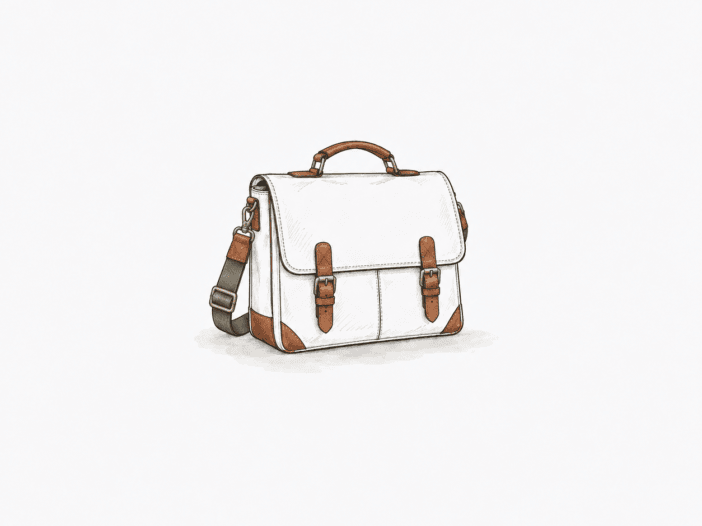
The Samsonite Colombian Leather Flap-Over works best if you carry one 15- or 15.6-inch laptop, plus work gear and documents, and want a professional leather bag. The flapover design keeps your setup organized and looks polished, but you trade away quick access, lighter weight, and the ability to stack easily on rolling luggage.
Fit becomes more conditional if you use a larger laptop, carry a second device, or want the bag to serve as a quick-access travel companion.

Product Snapshot
The main decision is whether the flapover style matches how often you need to reach for your gear and how much you plan to carry.
| Product detail | Decision relevance |
| Leather flapover briefcase/messenger format with top handle and adjustable shoulder strap | Suits professional work carry, but the flap and clasp arrangement adds an access step. |
| Padded laptop storage plus two main zippered areas, organizer pockets, and rear quick-access storage | Best aligned with a laptop, charger, documents, and normal work accessories rather than open-ended backpack-style loading. |
| 15–15.6-inch-class laptop fit is the most consistently supported zone | Larger devices require exact chassis-dimension checking because 16.5–17.3-inch reports conflict. |
| No dedicated trolley/pass-through sleeve is repeatedly reported | Business travel is workable, but buyers who depend on roller-luggage integration face a clear limitation. |
Buyer Evidence Metrics
Buyer evidence highlights two main boundaries: laptop and load size, and the trade-off between the flapover’s professional look and faster access.
| Buyer Question | Metric | Evidence |
| How clear is the laptop-size boundary? | UBC 0.86 | Moderate · n=14 |
| How consistently does one-laptop work carry outperform multi-device or overstuffed loads? | UBC 0.81 | Moderate · n=16 |
| How often does the flapover/closure appeal appear with slower-access friction? | TCR 0.67 | Moderate · n=9 |
| Does weight/bulk friction become more concentrated under heavy or full loads? | CFL 2.40× | Limited · n=4 |
How these metrics work:
- Use Boundary Consistency (UBC) measures how consistently eligible buyer evidence separates a supported use case from the condition where that use becomes more limited or conditional.
- Trade-Off Coupling Rate (TCR) measures how often an observed product strength appears together with a specific friction among eligible buyer evidence.
- Context Friction Lift (CFL) measures whether a known friction is more concentrated in a defined eligible context than in the eligible baseline. CFL is not severity or probability, and its public n reflects the smaller eligible comparison group.
- n is the number of relevant, eligible, deduplicated buyer observations used for that metric—not the product’s total review count.
These are buyer-evidence signals, not product-performance scores or probabilities. See how these buyer-evidence metrics work.
A UBC of 0.86 does not mean an 86% chance that a laptop will fit. It means the eligible evidence separates the commonly supported 15–15.6-inch zone from the more conditional larger-device zone with relatively high consistency.
Fit–Friction Matrix
A standard one-laptop work setup is the safest match. Each extra step—using a larger device, adding a second laptop, loading more weight, needing faster access, or depending on roller-luggage stacking—adds a new condition to check.
| Buyer Setup / Context | Fit Signal | Main Friction |
| 15–15.6-inch laptop + charger/mouse + folders or notebooks, sometimes a tablet | Recurring Strong Fit | Fit becomes less predictable once laptop chassis size or total load moves beyond this common work setup. |
| Two laptops or a primary laptop plus a second device needing dedicated protection | Conditional Fit | Several buyers make it work, but second-device padding, remaining space, and load weight become less consistent. |
| Office, client, campus, or meeting use where the bag is opened mostly while stationary | Generally Works | The flapover adds little penalty at a desk, but repeated access while standing or moving is slower. |
| Business trips using hand or shoulder carry | Generally Works | There is no dedicated trolley/pass-through sleeve for secure roller-luggage integration. |
| Heavy/full loads or longer shoulder-carry periods | Conditional Fit | Weight, bulk, shoulder-pad comfort, and hardware stress become more relevant as the load grows. |
| 16.5–17.3-inch-class laptop | Mixed / Variant-Dependent | Buyer reports conflict; exact chassis dimensions matter more than the screen-size label alone. |
The 15–15.6-Inch Zone Is the Safest Laptop Target
Buyers with 15- and 15.6-inch work laptops, including thicker business models, report the most reliable fit. Chargers, mice, folders, and other office gear fit alongside the laptop in these setups. This size range holds up across several real-world cases, not just a single example.
Laptops above 15.6 inches can be hit or miss. Some 16.5- and 17-inch models squeeze in, but others are too tight, or the flap won’t close. Check your laptop’s actual chassis measurements, not just the screen size, before deciding.
The Flapover Earns Its Professional Look by Giving Up Some Speed
Buyers point to the flapover design as a plus for professional looks and covered storage. That same design creates the clearest everyday trade-off.
TCR 0.67 shows that slower or fiddlier access often comes up in the same feedback that praises the flapover or closure style. This does not mean everyone struggles with the mechanism—some buyers find it easy—but the design works better for desk, meeting, or stationary access than for constant grab-and-go routines.
Capacity Works Best Until the Bag Becomes the Load
A laptop, charger, documents, books, and standard accessories make up a recurring, workable setup. Some buyers carry two laptops or unusually heavy loads. Those setups are less consistent and bring new problems: less spare room, uneven device protection, more shoulder weight, and greater hardware stress.
The load boundary shows up from both sides. UBC 0.81 supports the difference between a consistent one-laptop work setup and a more conditional multi-device or overstuffed carry. CFL 2.40× shows weight and bulk complaints piling up in heavy or full-load cases. The sample is limited, and some buyers still managed heavy loads.
Business Travel Works Better if You Do Not Depend on a Trolley Sleeve
Buyers use the bag for business trips and flights, including long travel stretches. The main travel limitation is not airport clearance. It is how the bag works with rolling luggage.
Repeated buyer reports confirm the bag lacks a dedicated trolley or pass-through sleeve. Some people wrap or shorten the shoulder strap around a suitcase handle. If you need a true luggage pass-through, this bag is a mismatch, not just a minor omission.
Long-Term Durability Can Be Strong, but the Hardware Record Is Mixed
Some buyers report serious long-term use: about three years and over 100 flights, four years of heavy carry before a shoulder strap failed under overload, and nine years of daily public-transit commutes before a corner seam started to separate. These examples show the bag can hold up under real use.
These stories do not guarantee consistent durability. Other buyers mention earlier issues with strap hardware, clasps, zippers, seams, fading, or dye transfer. One repeat buyer noticed small design changes between purchases, so older hardware experiences do not always match newer production runs.
What Buyers Should Check Before Buying
This bag makes the most sense if its work-focused strengths match your daily routine. Before you buy, check these five points:
- Measure your laptop’s chassis if you use anything bigger than a 15- or 15.6-inch. Reports on larger screens are mixed, so screen size alone isn’t enough.
- Think about how often you need to get into the bag while moving. The flapover is easier to live with if you mostly open and close it at a desk, meeting table, or other stationary spot.
- Plan for one main laptop plus your usual work gear as the safest bet. Two-device or overstuffed setups are possible, but they make space, padding, weight, and hardware stress more conditional.
- Do not count on roller-luggage integration. Buyers repeatedly report the bag lacks a dedicated trolley or pass-through sleeve.
- Expect some uncertainty in hardware and finish durability. Multi-year success stories are common, but so are scattered and recurring reports of strap, clasp, zipper, seam, fading, and dye-transfer issues.
Bottom Line
The Samsonite Colombian Leather Flap-Over lines up best if you want a professional leather work bag for a single 15- or 15.6-inch laptop, documents, and everyday accessories, and you mostly access it at a desk or meeting.
It becomes a less ideal choice if you use a larger laptop, carry multiple devices or heavy loads, need frequent access while moving, plan long shoulder-carry stretches, or rely on a built-in trolley sleeve for business travel.
Want to see how this structured leather option compares with lighter, more flexible alternatives? Explore our Best Laptop Messenger Bags roundup.
