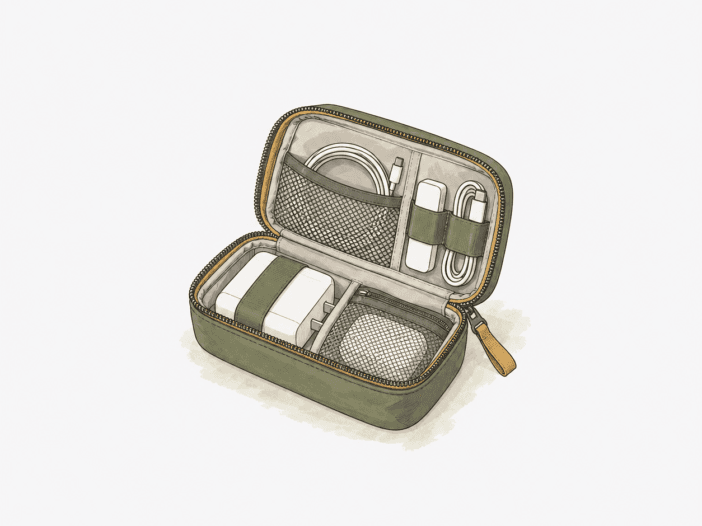
The Osprey Daylite Powerhouse works best for buyers who want to keep cables, compact chargers, charging blocks, a power bank, earbuds, or a small mouse organized inside a bigger bag. The pouch handles compact tech kits well. Space gets tight when you add a full laptop-accessory setup, bulky travel adapters, or several long cables.
Buyers use the Daylite Powerhouse for travel, everyday carry, work trips, and sometimes hiking or backpacking. Black and Tan Concrete both show up in buyer reports, but color does not change capacity, organization, access, or fit. There is no real variant decision here.

Product Snapshot
This pouch serves as a compact secondary organizer, not a catch-all for every tech item.
| Product detail | Decision relevance |
| Tech pouch / electronics organizer | Best suited to consolidating cables, chargers, power accessories, and other small electronics inside a larger bag. |
| Multiple compartments, pockets, elastic cable retention, and internal zippered storage | Supports separation and faster retrieval instead of loose, tangled accessories. |
| Repeated use inside backpacks | Buyer reports support a secondary-pouch role for travel, work, and everyday carry. |
| Black and Tan Concrete color options in buyer reports | Cosmetic only in the available evidence; no fit or capacity difference is established. |
| Exact external dimensions | Not reliably established. Buyer-reported measurements and listing expectations conflict, so dimension-sensitive buyers should verify the current product measurement before purchase. |
Buyer Evidence Metrics
The main takeaway from the metrics is simple: routine tech loads usually fit well. Once you add bulkier accessories or more cables, fit becomes less predictable.
| Buyer Question | Metric | Evidence |
| How consistently does fit change between compact/moderate loads and denser or bulkier loads? | UBC 0.89 | Moderate · n=18 |
| Are laptop or travel-power setups more likely to encounter accessory-space friction? | CFL 1.68× | Limited · n=5 |
| Does praised build quality usually come with a weight or bulk penalty? | TCR 0.25 | Moderate · n=8 |
How these metrics work:
- Use Boundary Consistency (UBC) measures how consistently eligible buyer evidence separates a supported use case from the condition where that use becomes more limited or conditional.
- Context Friction Lift (CFL) measures whether a known friction is more concentrated in a defined eligible context than in the eligible baseline. For CFL, public n reflects the smaller eligible comparison group.
- Trade-Off Coupling Rate (TCR) measures how often an observed product strength appears together with a specific friction among eligible buyer evidence.
- n is the number of relevant, eligible, deduplicated buyer observations used for that metric—not the product’s total review count.
- These are buyer-evidence signals, not product-performance scores, probabilities, rankings, or lab measurements. See how these buyer-evidence metrics work.
The numbers only matter if they help you decide what fits. UBC 0.89 does not mean you have an 89% chance your setup will fit. It means buyer evidence is pretty consistent about where capacity starts to get tight. Two buyers still managed to fit demanding loads: one packed two 20,000mAh power banks and four cords, another fit a 2019 87W MacBook charger. There is no hard universal cutoff.
CFL 1.68× means accessory-space friction shows up more often in laptop or travel-power setups, but that number comes from just five eligible reports. TCR 0.25 shows that sturdy construction does not always mean the pouch feels bulky. Most buyers who mentioned both build quality and portability called the pouch compact, light, or not bulky.
Fit–Friction Matrix
The Daylite Powerhouse works best for buyers who know their tech kit is compact and can lay it out before packing.
| Buyer Setup / Context | Fit Signal | Main Friction |
| Travel or everyday kit with cables, compact chargers or charging blocks, and small electronics inside a backpack | Recurring Strong Fit | No recurring friction is established at compact-to-moderate load levels; space becomes more conditional as the kit grows. |
| Charger or power bank plus cables, earbuds, a small mouse, dongles, or similar accessories | Generally Works | Item shape and bulk start to matter; some buyers report needing more room as the load expands. |
| Full laptop-accessory kit or a bulky travel-power setup | Conditional Fit | Charger and adapter volume can consume a large share of the available accessory space, although some larger power items have fit successfully. |
| Many cables or medium-to-long cords in one pouch | Limited Fit | Buyers report tighter rolling, reduced convenience, or needing another pouch when cable volume rises. |
| Buyers who need the pouch to fit a precise compartment or dimensional limit | Insufficient Evidence | Buyer-reported measurements conflict, and some buyers report listing-size mismatches. |
How Buyers Use It
Most buyers use this pouch as an organized tech kit inside a bigger bag, not as a standalone carry case.
- One buyer used it on an Alaska trip involving plane, train, and ship travel, keeping charging cables, power adapters, and earbuds organized inside a backpack.
- Another kept it in a laptop backpack during a conference trip specifically to consolidate cables.
- A Camino traveler carried charging cords, adapters, and power packs with the pouch stored inside a backpack from Portugal to Santiago, Spain.
- Other buyer reports extend the same basic role to everyday carry, daily use, work travel, hiking, and general trips.
The main pattern isn’t where you travel, but keeping loose tech accessories from piling up at the bottom of your main bag.
What Buyers Carry With It
Buyer loadouts show that the capacity boundary is conditional. What fits depends on your actual tech kit.
| Observed load | What it tells you |
| Small Bluetooth mouse + 65W GaN charger + cables/adapters | A mixed everyday-tech load can remain compact and organized without feeling unwieldy in at least one reported setup. |
| Two 20,000mAh power banks + four cords | Some comparatively bulky power loads can work, so capacity depends partly on item shape and arrangement rather than accessory count alone. |
| 2019 87W MacBook charger + charging-cable load | A full-size laptop charger can fit in a reported setup, but this does not establish compatibility with every charger or full laptop-accessory kit. |
Some buyers report that international adapters fit poorly, all laptop accessories get tight, and longer cords need to be rolled tighter. The safe move is not to assume large items never fit, but to check bulkier loads more carefully.
What Buyers Compare It With
One buyer specifically compared it with the Peak Design Tech Pouch after buying that pouch first. In that buyer’s experience, the Peak Design option felt too large for everyday use and more expensive, while the Osprey better matched the compact role they wanted.
That comparison comes from one buyer, not a general verdict on price or performance. If you want a smaller secondary tech pouch, the Daylite Powerhouse fits that role. If you need much more capacity, its compact size may feel limiting.
What Buyers Should Check Before Buying
Capacity is the main thing to check before buying. Construction quality rarely comes up as a problem in buyer reports.
- Lay out your actual tech kit before deciding. Compact cable-and-charger loads fit well in buyer reports. Full laptop-accessory setups or lots of cables are more likely to run into space friction.
- Check the shape of any bulky power items. International or travel adapters cause more problems than compact chargers, but some larger laptop chargers and power banks have fit.
- If you need an exact fit, verify the current external dimensions yourself. Buyer reports disagree on measurements and mention listing-size mismatches, so no single number is reliable.
- Decide if you need rigid protection or just organization. Buyer evidence supports good organization and a sturdy-feeling build, but does not show controlled crush protection. One buyer wanted more side structure to prevent squishing.

Looking for other ways to organize chargers, cables, and small electronics inside your main bag? Browse the shortlisted options in our Best Tech Pouches roundup.
