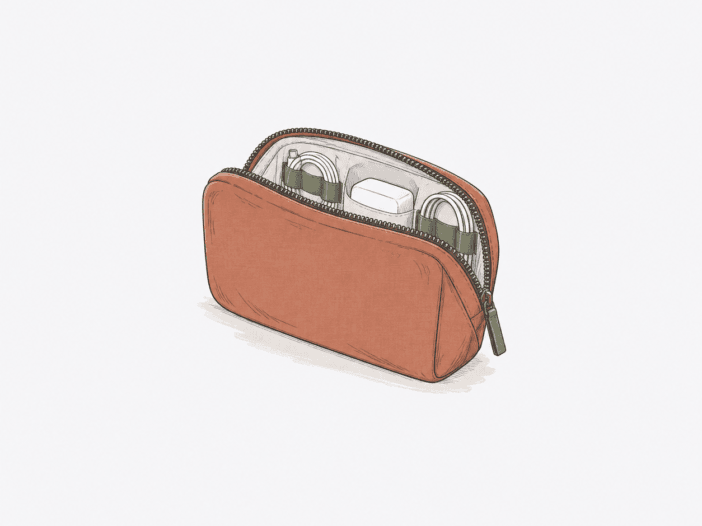
The Bellroy Tech Kit works best as a single, structured pouch for moving your everyday tech—chargers, cables, power bank, drives, mouse, earbuds, stylus—between bags. Buyer reports back up this use case, especially when seeing everything at once with the open-flat design matters.
The main trade-off shows up when your gear gets bulky, not just plentiful. Large charging bricks, hard items on opposite sides, loose tiny accessories, or a tight host bag can push the Tech Kit from a clean fit into a more conditional one.

Product Snapshot
The real question is whether your actual gear can share the Tech Kit’s structured depth without crowding or fighting for space—not just how much it holds on paper.
| Product detail | Decision relevance |
| Primary role | Structured tech organizer for mixed work, commute, and travel accessories. |
| Typical observed load | Chargers, USB-C/Lightning cables, power banks, SSD/HDD storage, mice, earbuds/headphones, adapters, styluses, and small removable media. |
| Access pattern | Book-style/clamshell opening is repeatedly linked to seeing and reaching multiple items at once. |
| Placement-specific fit | A Bellroy Q&A gives the magnetic slip pocket at about 11 × 21 cm; dedicated pockets and loops can have tighter limits than the main body. |
| Carry role | It is designed to ride inside another bag; Bellroy says there is no safe attachment point for cross-body straps. |
| Main trade-off | Structured organization improves visibility, but the fixed footprint can feel bulky in tight host bags and less forgiving when large items compete for depth. |
Buyer Evidence Metrics
The metrics point to one practical takeaway: normal mixed-tech loads rarely cause problems. Friction shows up more predictably when bulky items compete for space or when a specific pocket, not the whole pouch, becomes the limiting factor.
| Buyer Question | Metric | Evidence |
| Does a normal mixed-tech load stay workable until bulky items start competing for depth? | UBC 1.00 | Moderate · n=17 |
| How often does strong organization appear together with bulky-item interference? | TCR 0.23 | Strong · n=22 |
| Are dedicated pocket and loop boundaries consistent enough to guide placement? | UBC 1.00 | Moderate · n=13 |
| Is host-bag bulk clearly more concentrated in compact work-bag contexts? | CFL — | Very Limited · n=3 |
How these metrics work:
- Use Boundary Consistency (UBC) measures how consistently eligible buyer evidence separates a supported use case from the condition where that use becomes more limited or conditional.
- Trade-Off Coupling Rate (TCR) measures how often an observed product strength appears together with a specific friction among eligible buyer evidence.
- Context Friction Lift (CFL) measures whether a known friction is more concentrated in one defined context than in the eligible comparison baseline. For CFL, public n reflects the smaller eligible comparison group.
- n is the number of relevant, eligible, deduplicated buyer observations used for that metric—not the product’s total review count.
These are buyer-evidence signals, not product-performance scores, probabilities, rankings, or lab measurements. See how these buyer-evidence metrics work.
UBC 1.00 does not mean a 100% chance that your gear will fit. It means the eligible buyer evidence consistently separated the supported setup from the condition where friction began. Likewise, TCR 0.23 shows that bulky-item interference was a minority companion to otherwise organized loads, not a defect rate. The CFL value is intentionally not shown because only three eligible observations support the smaller comparison group.
Fit–Friction Matrix
A normal mix of accessories fits best. The decision shifts when you try to pack bulky hard items, lots of tiny loose gear, or squeeze the pouch into a tight host bag.
| Buyer Setup / Context | Fit Signal | Main Friction |
| Laptop/phone chargers + cables + power bank + drive + mouse or stylus in a backpack or briefcase | Recurring Strong Fit | Friction rises when bulky items are placed directly opposite each other or the pouch is packed to its limit. |
| Large charging brick or multiple bulky hard items added to an otherwise organized load | Conditional Fit | Items can compete for depth, creating squeeze, lumping, bulging, or harder closure. |
| USB sticks, microSD cards, short cables, and other tiny items that need secure separation | Conditional Fit | Some buyers report loose/open pockets, uneven elastic sizing, or the absence of an enclosed internal zip pocket. |
| Tech Kit placed inside a tight laptop bag, tote, computer-bag compartment, or constrained sleeve | Conditional Fit | The structured footprint can consume more host-bag space than expected; compartment geometry matters. |
| Very light day-trip setup where a power bank and a few essentials already fit in built-in bag pockets | Limited Fit | The regular Tech Kit can become more organizer than the load requires. |
How Buyers Use It: One Transferable Kit Works Best
The Tech Kit solves the hassle of rebuilding your accessory load every time you switch bags.
Buyer reports repeatedly describe carrying some combination of laptop and phone chargers, power banks, storage drives, mice, cables, AirPods or other headphones, adapters, and Apple Pencil or another stylus. The clamshell opening matters because the contents can be seen together rather than dug out one item at a time.
That role shows up in commuting, office work, mobile work, and travel. Specific examples include moving between office, school, cafés, and libraries; teaching at a conference with adapters and a hub; and opening the pouch book-style on an airplane lap.
Minimalist loads don’t get as much value from the Tech Kit. One buyer skipped it on day trips because a power bank and a few essentials fit in the bag’s own pockets. Several others found the regular size bigger than they needed.
The Main Boundary: Bulk Matters More Than Item Count
A dense load still works if your items spread out well. Problems start when hard, bulky pieces fight for the same internal depth.
Buyer examples show surprisingly full setups working: a 96W MacBook charger with a mouse and other charging gear; a 20,000mAh power bank with a small speaker, cables, an adapter, Apple Pencil, and AirPods; and a frequent-flyer setup with a 20k+ battery, two 125W USB-C plugs, AirPods, and multiple cables.
The friction isn’t just about large items not fitting. Buyers report trouble when a charger and drive sit on opposite sides, when the pouch is packed to the brim, or when a big charger eats up so much depth that the rest of the layout gets cramped.
That is why the load-boundary UBC is more useful than a simple capacity claim: the evidence consistently distinguishes ordinary mixed-tech packing from the point where arrangement and fullness start to matter.
Dedicated Pockets Have Stricter Limits Than the Pouch as a Whole
Don’t write off the Tech Kit just because one pocket looks too small. Separate pocket fit from whole-pouch fit—sometimes the main compartment still works even if a dedicated pocket doesn’t.
Bellroy’s Q&A repeatedly makes that distinction. A roughly 2.8 × 2 × 2-inch travel adapter is too large for the stretch-mesh pockets but fits comfortably in the main compartment. A travel router measuring 11.8 × 8.5 × 3 cm may be too tall for the stretch pocket, but the guide directs it to the magnetic slip pocket instead.
The same pattern appears with mice and charging bricks. MX Master-class mice can exceed the dedicated stretch or mouse pocket even when the main body remains an option, while a larger 140W MacBook Pro charger can fit but uses a meaningful share of the available space.
For small accessories, the picture reverses. Apple Pencil has explicit loop-fit support, and an Anker PowerCore+ 26800 is specifically discussed as fitting the magnetic slip area. Placement, not just total pouch capacity, is the more useful compatibility check.
Host-Bag Fit Is a Geometry Check, Not a Simple Size Rule
The Tech Kit fits in some compact bags, but buyer evidence is too mixed to assume every small work bag will carry it well.
There are successful examples: one buyer carried it inside a Peak Design Everyday Sling 6L alongside a Fujifilm X-Pro2 with a 23mm lens, and Bellroy says it fits the main compartment of the Classic Backpack Compact. Other buyers describe the regular Tech Kit as bulky in a laptop bag, too large for a Tokyo tote, or space-hungry in a computer bag.
That’s why the host-bulk CFL signal stays hidden. The relationship is worth checking, but the eligible comparison evidence is too limited for a broad rule. The practical move is to check your actual compartment shape and leftover depth after packing your other gear.
What Buyers Compare It With
Most buyer comparisons focus on capacity, everyday bulk, and whether Bellroy’s organization justifies the price premium. No single alternative is universally better.
| Compared option | Why it came up | Evidence limit |
| Peak Design Tech Pouch | One buyer switched to it for more capacity and longer trips; another described the Bellroy as smaller for travel. | Buyer comparison only; no controlled head-to-head test. |
| Aer Slim Pouch Xpac | One buyer chose it for everyday needs after returning the Tech Kit. | Specific example only. |
| Tomtoc tech pouches/kits | Multiple buyers used Tomtoc as a lower-price/value comparison and questioned Bellroy’s zipper/value proposition. | Exact Tomtoc models and equivalent loadouts are not consistently established. |
| Bellroy Tech Kit Compact | Appears as the smaller related option when the regular Tech Kit feels too large. | It is a comparison product here, not a decision-relevant variant of the focal Tech Kit. |
What Buyers Should Check Before Buying
The best pre-purchase check is to recreate your real load—not just count items and hope for the best.
- Start by mapping your bulkiest items. Mentally place your largest charger, power bank, drive, mouse, or adapter on opposite sides of the clamshell. If two hard items need the same depth, expect a more conditional fit.
- Decide how much security you need for tiny items. If loose USB sticks, microSD cards, or short adapters have to stay enclosed, buyer reports suggest checking the internal retention layout closely.
- Check your host-bag compartment, not just the bag’s headline size. The Tech Kit fits some compact bags but feels bulky in others because usable depth and compartment shape vary.
- Separate pocket fit from whole-pouch fit. Larger mice, travel adapters, routers, or charging bricks might not fit a dedicated pocket but can still work elsewhere in the pouch.
- Decide if the organization justifies the premium for your routine. Price and value criticism comes up often, especially from buyers who think a simpler or cheaper organizer would do the job.
- Inspect your unit and plan for spot cleaning. Buyer feedback covers both strong build quality and isolated zipper, stitching, bonding, or pocket defects. Bellroy’s Q&A recommends spot cleaning and advises against machine washing.

Open-flat access is only one way to organize your gear. See how the Bellroy approach stacks up against compact and higher-capacity choices in our Best Tech Pouches roundup.
