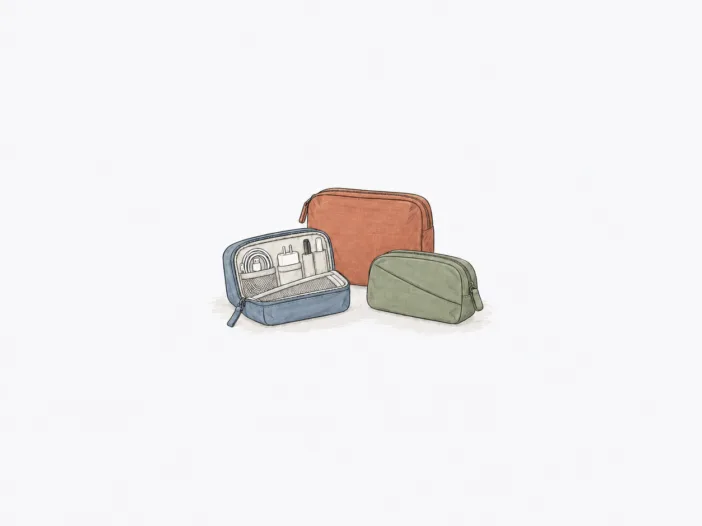
The real difference between tech pouches is not about picking a universal winner. What matters is whether the pouch fits the shape and volume of your actual charger, cables, power bank, adapters, and small electronics kit, and does not take over the bag you carry it in.
This roundup covers pouches used mainly as nested organizers inside a backpack, briefcase, tote, sling, or carry-on. The shortlist is organized by the load problem each pouch solves, not by a best-to-worst ranking.
Quick Comparison
| Product | Setup it matches | Main trade-off |
| Osprey Daylite Powerhouse | Light-to-moderate daily cable and charging kit inside a larger bag | Compact organization, but long cables, bulky adapters, and dense loads use up headroom quickly |
| tomtoc Light-T12 Pouch — Small | Slim charging kit where minimum footprint matters most | Thick power gear can exceed its usable depth and pocket width |
| Peak Design Tech Pouch — Small | Moderate kit that needs structured separation and upright desk access in a compact host bag | Smaller footprint, but bulky single items and loaded host-bag fit become the boundary |
| Bellroy Tech Kit | Moderate-to-dense work kit that benefits from visible book-style access | Strong organization, but opposing bulky items can pressure closure and slim host bags can feel crowded |
| Peak Design Tech Pouch — regular/full-size version | Larger consolidated accessory kit where keeping more gear together matters more than minimizing footprint | More load headroom, but a larger nested footprint and closure depends on item distribution |
| Thule Subterra Powershuttle Plus | Bulky chargers, larger power banks, headphones, or other block-shaped tech that benefits from removable dividers | More configuration headroom, but more host-bag footprint and exact Plus dimensions still need verification |
What Changes the Choice
- If your kit is mostly a few cables, a compact charger or power bank, and small accessories, the Osprey Daylite Powerhouse is the fit for the lightest everyday load in this shortlist.
- If you mostly carry slim accessories and compact chargers, tomtoc Small keeps the footprint down. If you need more divided organization or switch bags often, Peak Design Small can be more useful than trying to save every inch.
- If your work kit is moderate to dense and you want book-style visibility, the Bellroy Tech Kit becomes more relevant, as long as its closed 130 × 230 × 72 mm footprint fits inside your host bag.
- If you need to keep a larger mixed-tech kit together and have more host-bag room, look at the Peak Design Tech Pouch regular or full-size version.
- If your largest items are bulky blocks like large power banks, charging hardware, or headphones, and divider configuration matters more than minimizing footprint, the Thule Subterra Powershuttle Plus is the better fit.
Osprey Daylite Powerhouse keeps a light daily tech kit compact.
The Osprey Daylite Powerhouse fits a few to moderate cables plus a compact charger or power bank, small adapters, earbuds, and similar accessories. Its loops and internal storage zones make sense when the pouch acts as a compact module inside a backpack or laptop bag rather than a high-capacity organizer on its own.
The boundary arrives when the load becomes dense, cable coils get long, travel adapters become bulky, or rigid gear needs more structure. A representative loadout is a small Bluetooth mouse, 65W GaN charger, and cables or adapters. Near the capacity boundary, verify the current physical dimensions and dry-pack the actual kit before buying.
See the Osprey Daylite Powerhouse Product Insight for a closer look at where a compact daily charging kit starts to run out of room.

Peak Design Tech Pouch Small prioritizes upright organization in a smaller footprint
The Peak Design Tech Pouch Small fits a moderate electronics kit that benefits from divider-based separation and upright, open desk access, while keeping host-bag footprint controlled. It works well when the regular or full-size pouch would take up too much sling or backpack space.
The main limit is the largest single item, not just cable count. Large power banks, bulky camera items, or other thick pieces can remove the advantage of the smaller footprint. Check the biggest item and how it fits inside your intended host bag. If standalone carry matters, confirm the current strap or connector setup instead of assuming it is included.
Read the Peak Design Tech Pouch Small Product Insight if your decision comes down to compact host-bag fit versus bulky-item tolerance.

tomtoc Light-T12 Pouch Small keeps a compact charging kit from taking over the bag
Small-specific buyer feedback supports everyday and travel setups built around cables, chargers, adapters, and other relatively flat accessories. One reported load combined a phone, battery, watch, headphones, hearing aids, flashlight, and three chargers, showing that a small pouch does not necessarily mean a cable-only setup.
Shape is the real boundary here. Buyer reports flag usable depth and pocket width as the weak spots when thick power banks or oversized charging blocks go in. Since available evidence does not establish authoritative dimensions, if you carry unusually bulky hardware, check the fit yourself instead of relying on the size label.
Want to see where the compact format starts becoming restrictive? Explore the tomtoc Light-T12 Pouch Product Insight for the fuller fit and trade-off breakdown.

Bellroy Tech Kit suits dense work kits that benefit from book-style access.
The Bellroy Tech Kit is built around a different trade-off: visible organization for a moderate-to-dense work setup without going straight to the largest pouch. Its closed dimensions are 130 × 230 × 72 mm. It fits setups with laptop and phone chargers, cables, a power bank, mouse, portable drive, adapters, stylus, and earbuds spread across its organizer zones.
Geometry is the main constraint. Bulky bricks or drives placed opposite each other can bulge and put pressure on the bag when you close it. Very small loose items may need more secure enclosed retention. Measure the largest item, plan where it will sit, and check that the loaded pouch still has enough clearance inside your backpack, briefcase, or sling. Do not assume cross-body carry.
Explore the Bellroy Tech Kit Product Insight when your main question is whether a dense work kit will close cleanly and still fit your host bag.

Peak Design Tech Pouch regular/full-size version carries a larger consolidated kit.
The regular or full-size Peak Design Tech Pouch is more useful when you need to keep a larger set of chargers, cables, batteries, adapters, and small media together, and minimizing host-bag footprint matters less. Upright and open access is still part of the role. The extra capacity only works well when bulky items are spread out, not clustered into closure-sensitive zones.
At this point, the host bag becomes part of the buying decision. The regular version can take up substantial host-bag space, so check the loaded footprint in the bag you actually plan to use. If your kit is still moderate and host-bag space is tight, the Small version is the more space-efficient Peak Design option.
Go deeper with the Peak Design Tech Pouch Product Insight if you need to balance a larger consolidated load against host-bag footprint and closure.
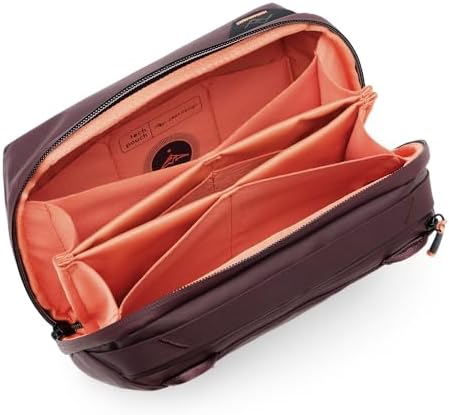
Thule Subterra Powershuttle Plus handles bulkier tech with configurable dividers.
The Thule Subterra Powershuttle Plus fits larger, block-shaped accessories with removable dividers. Example loadouts include an e-bike charger with cables and a MacBook Pro charging setup. An Anker 737 power bank and over-ear headphones are the larger items that most affect whether the Plus gives your setup enough usable headroom. The Plus can hold an iPad Mini.
The trade-off is footprint and verification. Exact Plus exterior and interior dimensions are still unresolved, so do not use the earlier Large dimensions for the Plus. Check the current Plus measurements against your host bag, and verify any strap or shoulder-carry interface if that matters to your setup.
Check the Thule Subterra Powershuttle Plus Product Insight if your setup depends on removable dividers, bulky blocks, or verified Plus dimensions.

