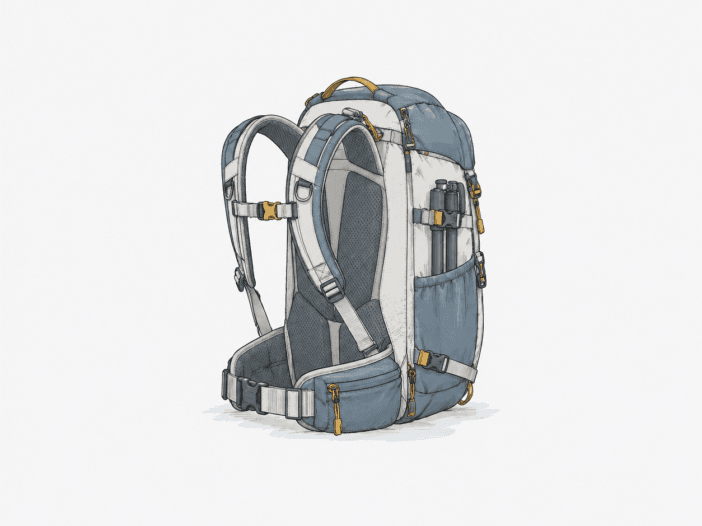
Photographers who want to carry a real camera kit on day hikes, long photo walks, or photo-focused travel will find the best match in the Flipside Trek BP 450 AW. The pack’s camera-first layout and rear access work well when personal gear stays limited to a jacket, food, water, and a few essentials. That same design sets the boundary: bulky clothing, larger laptops, very long mounted lenses, or a shorter torso can push the setup into more conditional territory.
This analysis covers the BP 450 AW specifically. Buyer evidence does not establish a separate decision-relevant variant inside this product scope.
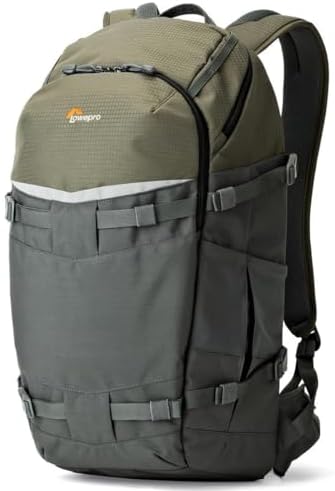
Product Snapshot
Treat this pack as a photo backpack that happens to work for day hikes, not as a hiking pack that carries a camera. That framing sets expectations for what fits and what doesn’t.
| Product detail | Decision relevance |
| Rear-opening camera compartment with adjustable dividers | Keeps camera access against the wearer’s back and supports configurable photo loads; many buyers use the waist belt to rotate the pack forward for access. |
| Upper personal-item compartment plus front storage | Works for ordinary day essentials, but becomes the main space constraint when camera gear, winter layers, or longer-duration supplies increase. |
| Tablet-oriented device area | Small tablets are the clearest fit; 13-inch laptops are often carried loose or in an alternate/front area, sometimes with less protection. |
| Side stretch pockets and external straps | Commonly used for water bottles, tripods, monopods, jackets, or other outdoor items. |
| Waist and sternum support | Often praised for load balance when properly adjusted, but fit is not universal across torso sizes. |
| Rain cover frequently reported as integrated/included | Several buyers report useful rain protection with the cover deployed, but fabric-only resistance is mixed and isolated buyer reports say their unit lacked the cover. |
Buyer Evidence Metrics
Buyer evidence draws the clearest lines at the boundaries, not in overall scores. Day-photo loads fit cleanly. Supertelephoto lenses, larger laptops, shorter torsos, and swing-around access with a full pack all need closer checking.
| Buyer Question | Metric | Evidence |
| When does non-camera space become the constraint? | UBC 0.85 | Strong · n=33 |
| When do long/supertelephoto setups change the layout? | UBC 0.89 | Moderate · n=18 |
| Is the small-device area a dependable 13–15-inch laptop solution? | UBC 0.86 | Moderate · n=14 |
| Does rear-access convenience sometimes come with swing-around friction? | TCR 0.22 | Moderate · n=9 |
| Is torso-fit friction more concentrated in short/petite body contexts? | CFL 2.29× | Limited · n=4 |
How these metrics work:
- Use Boundary Consistency (UBC) measures how consistently eligible buyer evidence separates a supported use case from the condition where that use becomes more limited or conditional. It is not a probability of fit.
- Trade-Off Coupling Rate (TCR) measures how often an observed strength appears together with a specific friction among eligible buyer evidence. It does not establish causation.
- Context Friction Lift (CFL) measures whether a known friction is more concentrated in a defined eligible context than in the eligible baseline. It is not a severity or probability measure; public n reflects the smaller eligible comparison group.
- n is the number of relevant, eligible, deduplicated buyer observations used for that metric—not the product’s total review count.
These are buyer-evidence signals, not product-performance scores. See how these buyer-evidence metrics work.
Fit–Friction Matrix
Check your real load against the closest matching row. Fit depends more on the shape of your gear and how much personal stuff you carry than on any ‘large camera bag’ label.
| Buyer Setup / Context | Fit Signal | Main Friction |
| Camera kit plus ordinary day-hike essentials | Recurring Strong Fit | Personal-item space tightens when the camera load becomes denser, winter layers increase, or the outing extends beyond day-use quantities. |
| DSLR/mirrorless body with roughly 70–200mm or 100–400mm-class attached lens plus additional lenses | Generally Works | Larger lens combinations consume more of the configurable camera compartment and reduce layout flexibility. |
| 150–600mm, 200–500mm, or 200–600mm-class setup, especially when kept mounted | Conditional Fit | Some setups work after reconfiguration, but others become tight, dominate one side of the compartment, or require separating body and lens. |
| 13-inch laptop carried with the camera kit | Conditional Fit | The dedicated small-device area is tablet-oriented; larger laptops often need loose/front/alternate placement with less consistent padding. |
| Rear camera access using the waist-belt swing workflow | Generally Works | A minority of buyers find rotating a loaded pack awkward or uncomfortable even though rear access itself is valued. |
| Short/petite torso or narrower frame | Mixed / Variant-Dependent | Buyer reports conflict: some shorter users adjust it successfully, while others report excessive back length or strap width. |
How Buyers Use It
Camera gear can dominate the pack without making day use impractical.
The pack works best for photography-first trips where camera gear comes first, and personal items stay minimal. Buyers report carrying one or two bodies, several lenses, batteries, filters, a light jacket, food, water, and a tripod strapped outside without trouble.
Capacity alone does not set the limit. What matters is how much space you have left for personal gear after loading your camera kit. UBC 0.85 with strong evidence (n=33) shows a clear pattern: ordinary day-hike loads usually fit, but camera-heavy, cold-weather, or longer trips often leave little room for clothing and other essentials. That metric tracks consistency in the evidence, not an 85% chance your load will fit.
Moderate telephotos are the easier case; supertelephotos are a geometry problem.
A camera body with a 70–200mm or 100–400mm-class lens attached fits in most reported setups. Once you move to a 150–600mm, 200–500mm, or 200–600mm-class lens, fitting the load gets more conditional.
Some buyers fit those larger lenses by giving up compartment space, removing the camera body, or reworking the internal dividers. Others report that access gets tricky or that a mounted combo just won’t fit. UBC 0.89 (n=18) marks that boundary in the evidence, while still capturing a few positive long-lens exceptions.
A small tablet fits easily. Carrying a laptop usually means finding an alternate spot.
Buyer reports make tablet carry straightforward. A 10-inch-class tablet fits as expected. A 13-inch laptop might ride loose in the front or another open area, not in a dedicated padded sleeve.
Laptop fit is conditional, not a simple yes or no. UBC 0.86 (n=14) shows the evidence consistently separates small-device slots from larger-device carry. That does not mean a 13-inch laptop has an 86% chance of fitting. The evidence does not establish exact 15-inch compatibility.
Rear access works well only if the harness and swing motion fit your body and workflow.
Buyers like having the camera opening against their back and being able to swing the pack forward without setting it on wet or dirty ground. That same move does not feel comfortable for everyone once the pack is loaded.
TCR 0.22 (n=9) shows swing-around friction comes up with rear-access strength in only a minority of eligible reports. CFL 2.29× (n=4) points to more torso-fit friction in short or petite users than in standard or tall ones, but the sample is small. Some shorter users still report a good fit, so treat this as a fit check, not a hard exclusion.
What Buyers Carry With It
Real-world loadouts show that lens shape and how much non-camera gear you carry matter more than the pack’s stated capacity.
| Observed loadout | Context | What it shows |
| Nikon D850 with 70–200mm f/2.8 attached, Sigma 60–600mm carried alongside | Long-term heavy photo use | A moderate telephoto can stay attached while a much larger lens is carried separately, but the camera section becomes strongly photo-focused. |
| Sony a6500, Sigma 16mm and 30mm lenses, Sony kit lens, GoPro kit, power bank, batteries and accessories | Three-week Australia road trip | A smaller mirrorless system leaves substantially more flexibility for accessories and travel items. |
| Panasonic G9 with 100–400 attached, 50–200 and 12–60 lenses, filters, batteries, tripod and water | Wildlife/photo outing | A camera-first day load can combine substantial photo gear with outdoor essentials when the external carry points are used. |
What Buyers Should Check Before Buying
Check your actual gear before buying. The 450 label does not guarantee every large-camera setup will fit.
- Lay out your camera and lens exactly as you want them ready to shoot. If you need to keep a 150–600mm, 200–500mm, or 200–600mm-class lens mounted, expect a more conditional fit than with a 70–200mm or 100–400mm-class setup.
- Plan your camera space and personal-item space separately. The pack works best when clothing, food, and other non-camera items stay within normal day-hike amounts. Winter or longer trips put more pressure on the upper and front storage.
- Treat laptop carry as a question of where you can fit it, not as a promise of a padded sleeve. A 13-inch laptop might fit in the front or another open area, but the evidence doesn’t show consistent padded carry for 13–15-inch laptops.
- Test torso fit with your actual load and try the rear-access swing. Shorter or petite users report both good and poor fits, and some buyers find the swing-around move awkward when the pack is full.
- Check for weather-protection pieces in the pack you receive. Many buyers get an integrated rain cover and find the cover useful, but a few report missing covers, and fabric-only water resistance is mixed.
- If you plan to fly with this pack, check your airline and aircraft directly instead of relying on buyer stories. Some buyers fit it under the seat; others can only fit it in the overhead. Universal airline fit is not established.
Outdoor carry is only one side of the decision. See the best camera backpacks across daily, field, and travel setups before choosing.
