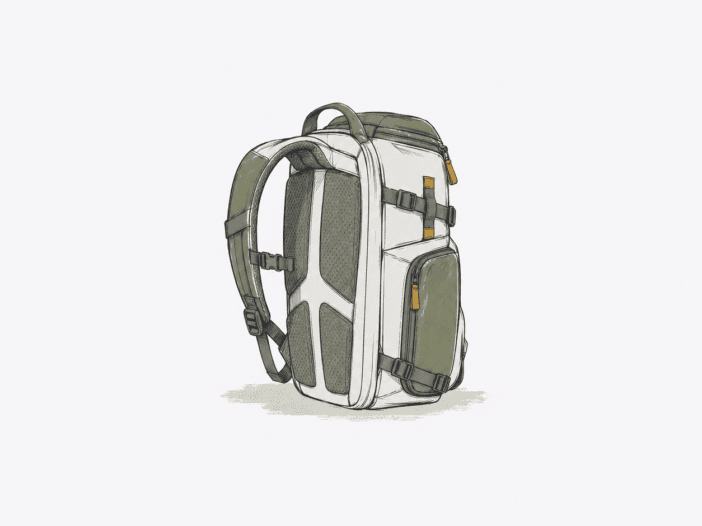
Photographers who carry a moderate DSLR or mirrorless kit, a laptop or tablet, and a limited set of personal gear get the most out of the Thule Aspect. The padded, structured layout consistently works as a hybrid camera-and-tech pack when protection and load support take priority over minimizing bulk.
Access is the main trade-off. The left-side camera opening works well when the lower pod has space, but buyers run into trouble as larger camera bodies, long attached lenses, battery grips, or extra gear fill that compartment. Air travel brings a second boundary: overhead and carry-on use are consistently workable, but under-seat fit is hit-or-miss.

Product Snapshot
| Product detail | Decision relevance |
| Camera storage | A separated padded camera pod keeps photo gear apart from the general compartment; Thule lists the pod at 10.2 × 5.9 × 11.4 inches. |
| Laptop and tablet carry | Buyer evidence supports 13–15.6-inch-class laptops; a fit answer says up to a 15.6-inch laptop plus an iPad can fit, while a 12.2-inch iPad Pro is described as very tight in the tablet section. |
| Empty weight | Thule states 3.2 lb and attributes the weight to the padding and structure used for fragile equipment. |
| Large-lens boundary | Thule says a Sigma 150–600-class telephoto is slightly too large. Buyer reports around 70–200-class lenses vary by camera body and packing arrangement. |
| Travel role | Overhead/carry-on use is more consistently supported than under-seat personal-item use. |
Capacity in liters and overall height numbers do not line up across buyer evidence, so treat those specs as unreliable for decision-making.
Buyer Evidence Metrics
Buyer evidence draws the sharpest boundaries around packed camera access, the side-access trade-off, protective bulk, and airline placement.
| Buyer Question | Metric | Evidence |
| Does camera retrieval get harder when the camera bay is packed tightly? | CFL 3.00× | Moderate · n=8 |
| Does side access remain a pure strength once real-world friction is considered? | TCR 0.50 | Moderate · n=12 |
| Does the protective structure often travel with bulk or weight friction? | TCR 0.60 | Moderate · n=10 |
| Is overhead/carry-on use a cleaner boundary than under-seat use? | UBC 0.80 | Moderate · n=10 |
How these metrics work:
- Context Friction Lift (CFL) measures whether a known friction is more concentrated in a defined eligible context than in the eligible baseline. It is not severity or probability. For CFL, public n reflects the smaller eligible comparison group.
- Trade-Off Coupling Rate (TCR) measures how often an evidence-supported strength appears together with a specific friction among eligible buyer evidence. It does not establish causality.
- Use Boundary Consistency (UBC) measures how consistently eligible buyer evidence separates a supported use case from the condition where that use becomes more limited or conditional. It is not a probability of success.
- n is the number of relevant, eligible, deduplicated buyer observations used for that metric—not the product’s total review count.
These are buyer-evidence signals, not product-performance scores. See how these buyer-evidence metrics work.
The main point for buyers: the Aspect is easier to use when you leave some space in the camera pod. CFL 3.00× does not mean you are three times more likely to have trouble. It means access friction showed up three times as often when the pod was packed tight compared to the baseline. UBC 0.80 does not mean an 80% chance of fitting under or over a seat. It shows how often the evidence separates overhead and carry-on use from the more conditional under-seat fit.
Fit–Friction Matrix
| Buyer Setup / Context | Fit Signal | Main Friction |
| Moderate DSLR or mirrorless kit + several lenses + laptop/tablet | Recurring Strong Fit | Larger attached lenses or extra camera gear reduce camera-pod margin and make access less forgiving. |
| Camera bay packed tightly, especially with a battery grip or long attached lens | Conditional Fit | The side opening becomes harder to load and unload; some buyers report catching, movement, or awkward retrieval. |
| Air travel when overhead-bin/carry-on use is acceptable | Generally Works | Under-seat personal-item fit is inconsistent across buyers and aircraft. |
| Day hikes or photo walks with waist/sternum support and a controlled load | Generally Works | The 3.2-lb empty structure and individual body fit can become tiring or create pressure as total load rises. |
| Very large telephoto or 150–600-class lens requirement | Limited Fit | Thule says a Sigma 150–600-class lens is slightly too large, and other long-lens examples remain body-and-lens dependent. |
Side access works best when the camera pod has room to breathe.
The side camera opening gives some buyers a real advantage, not just a marketing feature. Several users describe slinging the pack onto one shoulder and pulling out the camera without setting the bag down.
Still, the access system has clear limits. Half of the eligible buyers who liked side access also reported friction: left-side orientation, a narrow opening, the camera catching on the edges, or slower retrieval with bigger gear.
One buyer made a Canon 5D Mark IV with an attached 70–200mm f/2.8 work after adjusting the dividers. Buyers using a Canon 6D with a battery grip or tightly packed multi-lens setups found the rounded side opening harder to use.
For buyers, that means:
- Test the exact camera body and attached-lens combination you intend to carry.
- Leave working space around the primary camera rather than treating every divider slot as capacity to fill.
- If you regularly place the bag on the ground and want every lens visible at once, the side-only opening is a meaningful limitation.
- The camera zipper is on the left side of the pack, and some buyers found that orientation less natural than others.
The protection is useful, but you carry its structure all day.
Rigid padding is the main reason buyers call the Aspect protective and stable for camera gear. That same structure keeps the pack from behaving like a soft daypack when lightly loaded.
Thule lists the empty weight at 3.2 lb and links that weight to the padding and structure. Among buyers who praised the protective build, bulk or weight friction came up often enough to count as a recurring trade-off, not just a one-off complaint.
The carry system helps many buyers manage that trade-off. Padded shoulder straps, sternum support, and a removable waist belt all help with heavier camera-and-tech loads. Still, body fit changes the outcome. One 6’2″ user reported lower-back pressure with a 17-lb load, and smaller users also called the pack physically imposing.
This pack suits buyers who want structure around expensive gear, not those trying to cut empty-pack weight or keep the profile slim.
For air travel, overhead use is the safer assumption.
Buyer evidence backs the Aspect as a travel camera pack, but not as a sure bet for under-seat personal item use.
Overhead-bin and general carry-on use appear repeatedly without the same level of friction. One buyer traveling through Iceland and Scotland reported an easy overhead-bin fit with a DSLR kit, jackets, a laptop, and a tripod, while describing under-seat use as more challenging because of the pack’s rigidity.
Some buyers do make it work. One buyer fit the bag under the seat on American Airlines A321 and 737 planes. Others said it did not fit under the seat or was too risky to count on as a personal item.
The answer isn’t a simple yes or no. Under-seat fit depends on the airline, the aircraft, and how you pack. If your trip depends on using the bag as a personal item, check the airline and aircraft details before you count on it.
Also note that recurring buyer evidence says the bag lacks a luggage-handle pass-through, which matters more in airports once the camera load becomes heavy.
Long lenses are the clearest equipment-fit boundary.
The Aspect handles substantial photo kits, but fitting one long lens does not guarantee another body-and-lens combo will work.
Thule says a Sigma 150–600 telephoto is a bit too big. Their fit guide for a Nikon D800 only supports attached lenses up to 150mm. Buyer evidence on 70–200-class lenses is mixed. Some setups worked, while others were tight enough to stretch the opening or make retrieval harder.
The camera-plus-attached-lens combo matters more than any generic ‘how many lenses fit’ number. Wildlife shooters and buyers with large bodies, battery grips, or long attached zooms have less margin than those carrying smaller primes or detached lenses.
What Buyers Carry With It
These are specific buyer examples, not guaranteed fit templates.
| Observed setup | Context | What it shows |
| Canon 5D Mark IV + attached 70–200mm f/2.8 + several smaller lenses + Canon 80D + 15-inch MacBook Pro + Wacom tablet | High-capacity camera/tech load | The pack can absorb a substantial mixed kit, but divider setup and side access become increasingly important. |
| Nikon Z6 + 70–200mm f/2.8 + short zoom + Mavic Mini 2 + iPad Air + 13-inch laptop + travel clothing | Travel companion | Camera, drone, devices, and personal items can coexist when the load is organized rather than simply packed to the limit. |
| Nikon D5500 + multiple lenses + rain jackets + gloves + laptop + tripod | Iceland and Scotland trip | The hybrid camera/travel role worked well for overhead carry, while under-seat use remained the weaker travel case. |
What Buyers Should Check Before Buying
You get the most predictable results from the Aspect when you check the few variables that keep changing buyer outcomes.
- Your exact camera-plus-lens combination: Do not assume one successful 70–200mm example guarantees another. Large bodies, battery grips, and long attached lenses change both fit and retrieval.
- Your preferred access motion: The camera pod opens from the left side. Buyers who naturally sling the pack that way often like it; others find the orientation awkward.
- Your realistic loaded weight: The pack starts at 3.2 lb before you add camera gear, laptop, drone gear, water, or tripod. Comfort is often good, but not universal across body types and loads.
- Your airline use case: Overhead carry is more reliable than under-seat fit. Do not count on the Aspect as a personal item unless you check the airline and aircraft details first.
- Your external-carry priorities: The side area usually holds either a tripod or a water bottle, and buyers report those uses compete for space. Evidence does not support a built-in luggage-handle pass-through.
- Current construction details and weather plan: Buyer reports on divider hold, blue zipper-pull durability, and hip-belt pocket build are mixed year to year. No included rain cover is a recurring theme, and buyer rain or snow experiences do not add up to a controlled waterproof rating.
If you are still weighing separated storage against faster access or more capacity, explore our best camera backpack roundup to compare the trade-offs.
