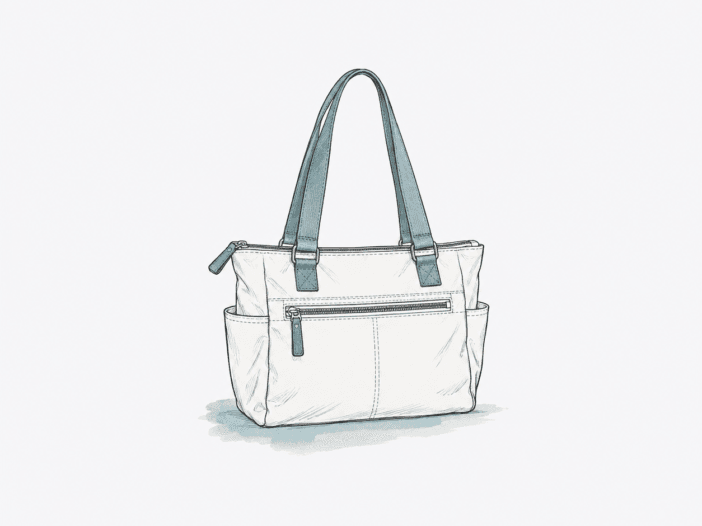
The Baggallini Any Day Tote fits best if you want a soft, pocket-rich tote for work and air travel. It handles a tablet or Kindle, chargers, documents, daily essentials, one bottle, and—when the size works—a laptop. Buyer reports keep coming back to the quick-access pockets, zip-top main opening, crossbody carry, and luggage-handle pass-through as the features that make it practical.
The trade-off shows up when you expect it to work like a dedicated laptop tote. Carrying a laptop works for many buyers, but evidence is mixed on padded structure, and larger 15–16-inch work laptops can cause bottom-seating or coverage issues. The soft body also means you do not get a rigid, self-standing work bag.
Available evidence does not support a clear variant split. Conflicting descriptions of the laptop pocket and padding stay as a family-level buying uncertainty. Instead of assuming every unit matches one description, check the current configuration before you buy.

Decision Snapshot
| Decision Area | What the Buyer Evidence Suggests | Main Boundary |
| Cleanest fit | Mixed work or air-travel load with electronics, documents, small essentials, and moderate bottle use | Dedicated laptop protection is not consistently established |
| Organization | Strong quick-access pattern for phones, keys, travel documents, chargers, and small work items | Heavily loaded exterior pockets can take space from the interior |
| Carry | Shoulder handles, crossbody option, and luggage-handle pass-through support flexible travel handling | Shoulder retention is mixed, especially with bulky outerwear |
| Structure | Soft-sided construction supports flexible packing and a lighter carry feel in several reports | Rigid, consistently self-standing behavior is not established |
| Air travel | Rolling-luggage use is repeatedly positive | Under-seat fit depends on airline limits and packed shape |
| Configuration | No decision-relevant family variant is supported | Laptop-pocket and padding descriptions conflict across the family evidence |
Does It Match Your Setup?
| Buyer Setup / Context | Fit Signal | Main Friction |
| Tablet or Kindle + charger/cables + travel essentials + one bottle | Recurring Strong Fit | Heavier exterior-pocket loading begins to reduce interior space |
| Moderate laptop + documents/notebooks + compact accessories | Generally Works | Dedicated padding and laptop-specific structure are not consistently established |
| 15–16-inch work laptop where full bottom seating, coverage, or built-in protection matters | Conditional Fit | Larger-device seating and coverage become uncertain |
| Air travel + rolling suitcase | Generally Works | Under-seat fit remains load- and airline-dependent, and luggage-handle compatibility should be checked |
| Shoulder carry over bulky winter outerwear | Conditional Fit | Strap retention is mixed; slippage appears in some reports |
| Work tote that must remain rigid and self-standing | Limited Fit | Soft structure and conflicting stand-up reports work against that role |
The clearest pattern is moderate, compartmentalized carry—not maximum packing. The flexible pocket system makes the tote easy to organize, but it gets less forgiving when rigid bottles or a larger laptop start competing for the same space.
Pocket-first organization is the core strength—and the first capacity trade-off.
Buyers report using the front and interior pockets for phones, keys, travel documents, earbuds, chargers, tablets, books, and small work items. That is where the Any Day Tote stands out: you do not have to dig through one big compartment or add extra organizer pouches.
A single large bottle usually works in an exterior pocket. The boundary shows up when you load those pockets heavily. One detailed loadout with two rigid bottles still fit, but the bottles cut into interior width and distorted the front-pocket area. Q&A also notes that filling the exterior pockets can take space from the main compartment.
Think of the exterior pockets as shared volume, not free extra space. They help you organize, but they do not keep the full interior footprint when you pack them hard.
Laptop carry works until dedicated protection becomes the requirement.
Several buyers report carrying a laptop or computer with regular work essentials. That includes an average-size laptop in a separate sleeve, or a computer with several notebooks and a thin lunch tote. This supports occasional or moderate laptop use as part of a mixed load.
The evidence is less reassuring when the laptop is the main load. One 15-inch work laptop did not fully seat at the bottom, and one 16-inch laptop was not fully covered. Several Q&A responses mention no dedicated laptop pocket or no extra padding, while one detailed review describes a padded zippered pouch that fit a Chromebook.
The evidence does not show a reliable production revision or configuration split, so you cannot safely assume one version has padding and another does not. If you need the tote itself to provide verified laptop protection, check the exact current compartment before you buy.
Rolling-luggage travel is a cleaner fit than guaranteed under-seat travel.
The luggage-handle pass-through keeps showing up as useful for airport travel, and the crossbody option gives you another way to keep your hands free. One travel load with a Kindle, mini iPad, charger and cables, small bottle, medication, snacks, and paperwork was reported workable. The light interior and luggage sleeve helped with access and handling.
Under-seat fit is not universal. Some buyers report success, but one Lufthansa-focused Q&A compared the tote with the airline’s quoted dimensions and found the tote larger. That setup relied on the soft sides to compress when lightly packed. This supports checking both airline and load, not assuming it always counts as a personal item.
Evidence Signals
| Buyer Question | Practical Reading | Evidence Signal |
| Does laptop carry stay clean as protection and larger-device fit become more important? | Basic laptop carry is repeatedly workable, but full seating, coverage, and dedicated padding become more conditional | UBC 0.92 · Moderate · n=12 |
| What changes when the exterior pockets carry more rigid bottle volume? | A large single bottle is workable in several reports; fuller or multiple rigid bottle loading is where interior-space and pocket-shape friction appears | UBC 1.00 · Limited · n=5 |
| Does bulky winter outerwear make shoulder carry less reliable? | The signal is worth checking, but the evidence is sparse and mixed, so no numeric rate is shown | CFL — · Very Limited · n=2 |
UBC is not a probability of success. Here it describes how consistently eligible buyer evidence separates the cleaner use from the boundary where friction begins.
- UBC: how consistently eligible buyer evidence separates a supported use from the condition where it becomes more limited or conditional.
- CFL: whether a known friction is more concentrated in a defined context than in the eligible baseline; it is not a severity score.
- n: relevant, eligible, deduplicated buyer observations used for the metric—not the product’s total review count. For CFL, public n is the smaller eligible comparison group.
These are buyer-evidence signals, not product-performance scores or probabilities. See how these buyer-evidence metrics work.
Real buyer loadouts show where the boundary appears
These are observed examples, not guaranteed capacity templates.
Travel electronics load
Kindle · mini iPad · charger/cables · small water bottle · medication · snacks · paperwork
→ Reported workable for air travel, with the luggage sleeve and light interior helping airport handling and item visibility.
Work setup
Computer · several 1-inch notebooks · thin lunch tote
→ Reported to fit while leaving the exterior pockets useful, which supports the tote’s mixed work-load role without requiring maximum packing.
Dense mixed load
Bullet journal · hardcover book · Kindle · Chromebook · letter-size binder · 20 oz Contigo bottle · 12 oz Klean Kanteen
→ Everything fit in one detailed example, but the two bottles reduced interior room and distorted the front-pocket area. That makes it a useful boundary example rather than a capacity promise.
Why buyers compare it with more laptop-specific alternatives
| Compared Product | What Mattered | What Shifted the Choice |
| Baggallini Avenue Tote | Dedicated laptop structure versus broader pocket organization | Q&A describes the Avenue as the more laptop-specific option, while other buyers preferred the Any Day Tote’s pocket layout or did not need the extra laptop padding |
| Baggallini Women’s 3-in-1 Convertible Backpack | Handling a dense mixed load with rigid bottles | In one detailed comparison, the Any Day Tote fit the load, but bottle-related space and pocket distortion helped push the buyer toward the convertible backpack |
The comparison evidence points to a role difference rather than a universal winner: the Any Day Tote is strongest when pocket access and flexible mixed carry matter more than a dedicated laptop-first layout.
Durability reports deserve an early inspection, not a failure-rate assumption.
Buyer reports keep mentioning zipper failure, loose or incomplete stitching, strap fraying, and tears or rips. That is enough to make durability something you should check, but the available evidence does not show how often these issues happen.
Reports of missing wristlet and missing crossbody or shoulder strap also come up. These are better treated as delivery or configuration uncertainty, not as a separate product variant.
What Buyers Should Check Before Buying
- Measure the actual laptop chassis, not just the screen-size label. If full bottom seating or full coverage matters, the 15–16-inch evidence is conditional.
- Verify the current laptop compartment and padding. Buyer reports and Q&A conflict on whether the interior zippered section functions as a padded laptop pocket.
- Pack the exterior pockets with your real bottle load. A single large bottle can work, but multiple rigid bottles or heavily filled front pockets can reduce interior room.
- Test shoulder carry with the clothing you actually wear. Strap retention is mixed, and bulky outerwear is a specific friction point in the evidence.
- Check both the airline limit and your rolling-luggage handle. Under-seat fit depends on packed shape, and luggage-handle compatibility should not be assumed from the pass-through alone.
- Inspect the delivered tote early. Check zippers, stitching, handle/strap attachment, and whether the expected wristlet and crossbody strap are present.
Baggallini Any Day Tote on Amazon
See how this tote complements the rest of Baggallini’s Tech Carry lineup.
