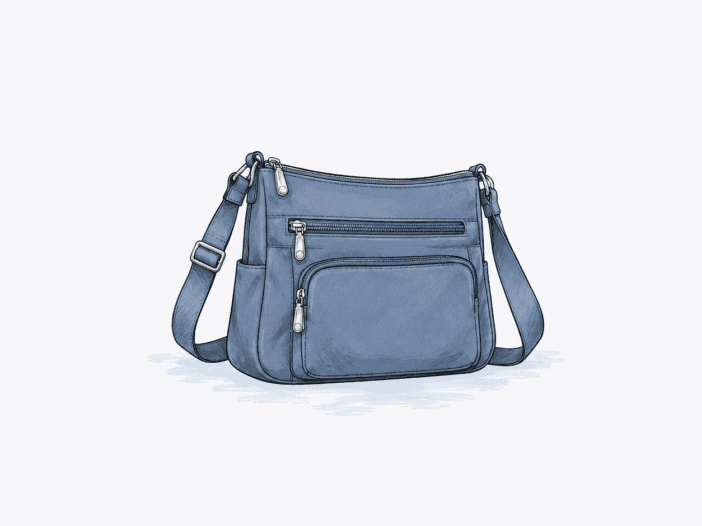
The Baggallini Modern Pocket Crossbody works best for buyers who carry slim essentials or small tech: a phone, wallet or cards, glasses, keys, passport, a compact charger or battery pack, and a few personal items. Buyer feedback repeatedly supports the compact, pocket-heavy layout when you want to avoid a bigger or heavier bag.
The trade-off shows up when your load gets bulkier, not just when you add more items. Larger wallet-and-cosmetic combos, a full-size bottle, or other high-volume pieces can push against the available space. As the load gets heavier, the narrow strap becomes a bigger comfort factor.
Check the configuration boundary before you buy. The quick-access phone pocket comes up often in Q&A and is tied to the Modern version, but a few buyers report receiving units missing expected pockets or details.

Decision Snapshot
| Decision Area | What the Buyer Evidence Suggests | Main Boundary |
| Cleanest fit | Compact everyday essentials and slim small-tech loads are the most consistently supported use | Larger or higher-volume combinations reduce flexibility |
| Organization | Multiple pockets, card storage, key attachment and quick phone access often reduce rummaging | A minority of buyers find the compartment layout fragments usable space |
| Carry comfort | The compact bag can remain easy to carry for many users | Narrow-strap pressure recurs in loaded carry, although it is not universal |
| Configuration | The quick-access phone pocket is a meaningful part of the common Modern setup | Some purchased units are reported without expected pockets or accessories |
| Travel security | RFID card-area storage is repeatedly described | Locking zippers and a slash-resistant strap are not established family-wide |
Does It Match Your Setup?
| Buyer Setup / Context | Fit Signal | Main Friction |
| Phone, wallet/cards, glasses, keys, small charger and light personal items | Recurring Strong Fit | Bulky additions begin to consume the limited open volume |
| iPad mini 7 in a case, two phones, wallet, keys and a small charger for mobile work | Specific Example Only | One detailed example supports this load; larger tablets and laptops are not established |
| Phone, compact digital camera, sunglasses/readers and small travel essentials | Specific Example Only | A full-size bottle did not fit in the observed travel setup, and the wearer disliked the narrow strap |
| Larger wallet/cosmetic combinations or full-size bottle expectations | Limited Fit | Load shape and volume can make the interior feel restrictive even when several pockets remain available |
| Heavier multi-item crossbody carry | Conditional Fit | Narrow-strap pressure becomes more relevant for some buyers, but a substantial comfortable counterexample exists |
The main boundary is load shape and volume, not just how many items you carry. A dense but slim tech load can fit, while even a few bulky items can be harder to place.
Slim, Shape-Efficient Loads Make the Small Footprint Work
Buyer reports often describe successful loads built around a phone, small wallet or card holder, glasses, keys, passport, compact cosmetics, and a charger or battery pack. This pattern explains why buyers call the bag small but not impractical.
The fit gets tighter when your items need more three-dimensional space. Buyers report trouble fitting a wallet plus a zippered cosmetic bag, or arranging a wallet, sunglasses, keys, and makeup together. Water bottles get mixed results. There is also a Q&A example where a thick wallet still fit, so the evidence does not support a strict ‘large wallet never fits’ rule.
So, whether the bag works comes down to the shapes of your actual items, not just how many you carry.
The Pocket System Usually Helps Access More Than It Hurts Capacity
Organization comes up as a recurring strength. Buyers mention separate pockets, RFID card slots, a key tether or clip, pen storage, back zip storage, and quick phone access as reasons the bag is easier to use without digging around.
But more pockets do not work for everyone. Some buyers say the pockets feel too small, excessive, or less space-efficient than a simpler compartment. One buyer compared it to an older Baggallini crossover and said the older three-compartment design held more, even though the Modern Pocket Crossbody has more organizational features.
The split is clear: if you want designated spots for small items, this layout fits better. If you prefer one open space for bulkier gear, it may not.
The Narrow Removable Strap Becomes the Carry Variable as Load Rises
The included strap is about 3/4 inch wide, according to Q&A. Buyer reports mention complaints about the narrow strap. Some users describe pressure or digging after adding phones, glasses, wallets, or other loaded items. Others say they swapped the detachable strap for a wider one.
That friction is not universal. One buyer carried an iPad mini 7 in a case, two phones, a wallet, keys, a small charger, and personal items through an 11-hour work shift and still found the carry comfortable. Another buyer said the light strap did not dig in.
So, comfort depends on both the load and the wearer. The removable strap gives at least one buyer a practical workaround: swap in a wider strap.
The Quick Phone Pocket Is Useful—but Configuration Consistency Needs Verification
Q&A distinguishes the Modern Pocket Crossbody from the Baggallini Pocket Crossbody by describing more pockets and a dedicated or hidden quick-access phone pocket. Buyers who received that configuration frequently call the phone access practical.
But the evidence does not support treating every unit as identical. One buyer got a bag without the quick phone pocket and an expected interior pocket. Another described a previous same-style bag with a removable interior money pouch that was missing from the newer purchase. A separate buyer said an expected zipper-lock detail was absent.
These reports do not map out formal variants. They do set one buying rule: if a specific pocket, pouch, or security detail matters to you, check the current configuration instead of assuming every color or listing is the same.
Evidence Signals
| Buyer Question | Practical Reading | Evidence Signal |
| Is there a clear boundary between compact loads and bulkier carry? | The eligible evidence consistently separates slim essentials/small-tech setups from higher-volume loads, although item shape still matters | UBC 1.00 · Strong · n=29 |
| Does the compact footprint often create a capacity complaint? | Capacity friction is a minority pattern within compactness-positive evidence and concentrates around bulky shapes, bottles and broader loads | TCR 0.32 · Strong · n=22 |
| Do the many pockets usually reduce usable space? | Most organization-positive evidence does not report fragmentation; the problem appears in a smaller subset of buyers | TCR 0.13 · Strong · n=30 |
| Does heavier loaded carry make strap friction more relevant? | Narrow-strap complaints are more concentrated in explicitly loaded multi-item carry, but the evidence is limited and includes a strong comfortable counterexample | CFL 1.60× · Limited · n=5 |
- UBC: how consistently eligible buyer evidence separates a supported use from the condition where it becomes more limited or conditional.
- TCR: how often an observed strength appears together with a specific friction among eligible buyer evidence; it does not establish causality.
- CFL: whether a known friction is more concentrated in a defined context than in the eligible baseline; it is not a severity score.
- n: relevant, eligible, deduplicated buyer observations used for the metric—not the product’s total review count. For CFL, public n is the smaller eligible comparison group.
These are buyer-evidence signals, not product-performance scores or probabilities. See how these buyer-evidence metrics work.
Real Buyer Loadouts Show Why Volume and Shape Matter
These are observed buyer examples, not guaranteed capacity templates.
Mobile-work example
iPad mini 7 in a case · two phones · wallet · keys · small charger · lipstick · spare contacts · portable toothbrush and toothpaste
→ One buyer said this load fit without making the bag look overstuffed and stayed comfortable through an 11-hour shift. This is useful evidence for slim small-tech carry, but it does not show compatibility with larger tablets or any laptop.
Travel-tech example
iPhone 11 Pro · digital camera · curved sunglasses · mini readers · other small essentials
→ One buyer said this load fit in the small, lightweight bag and planned to put it inside carry-on luggage. In the same setup, a full-size water bottle did not fit, and the narrow strap was a clear point of dissatisfaction.
What Shifted Buyers Toward—or Away From—This Layout
| Compared Product | What Mattered | What Shifted the Choice |
| Baggallini Pocket Crossbody | Pocket count and quick phone access | Q&A describes the Modern version as adding more pockets and a dedicated or hidden phone pocket; current configuration still needs verification |
| eBags small crossbody, model not supplied | Extra space and phone access versus stronger travel-security features | One buyer moved toward the Baggallini for more room and organization but kept the eBags bag for travel because locking zippers and a slash-resistant strap mattered more there |
| Older Baggallini crossover, model not supplied | Designated pockets versus open usable volume | One buyer preferred the older three-compartment layout because it held more, reinforcing that organization style can matter as much as nominal bag size |
What Buyers Should Check Before Buying
- Verify the current pocket configuration. If the quick phone pocket, interior pouch, or a specific locking detail is essential, confirm it on the exact listing or unit, since buyer reports aren’t fully consistent.
- Pack your real load by shape, not just by item count. A slim mix of phone, cards, glasses, and compact tech can work well, but a full-size bottle, large wallet, or bulky cosmetic pouch can quickly change the fit.
- Think about strap pressure at your actual loaded weight. Narrow-strap friction comes up, especially with heavier loads, but it is not universal. One buyer swapped in a wider removable strap with success.
- Treat the reported RFID card-area feature separately from anti-theft hardware. Buyer evidence does not establish locking zippers or a slash-resistant strap across the family.
- Do not extrapolate the iPad mini example to larger devices. The evidence supports one iPad mini 7 workload but does not establish fit for larger tablets or laptops.
Baggallini Modern Pocket Crossbody on Amazon
Explore where this compact crossbody fits among the brand’s backpacks, totes, and tech slings.
