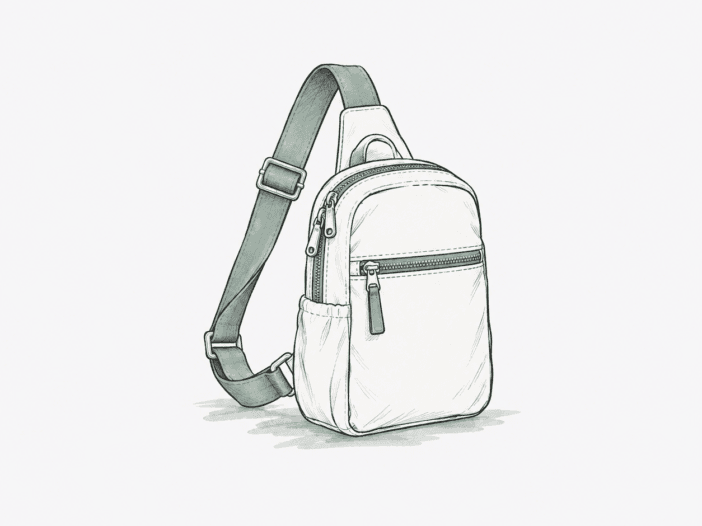
The Baggallini Mini Sling works best when you keep your load intentionally small: phone, wallet or cards, keys, glasses, passport, and a few other compact essentials. Buyer reports repeatedly support this setup for errands, walking around town, and light travel. Some examples also include airport, street-fair, cruise, and international travel use.
The trade-off shows up when you add a larger rigid item. Compact essentials can fit together, but a tablet or normal water bottle quickly competes for the same space.
No evidence-backed size or model split exists. Color differences are cosmetic in the available evidence. Older Q&A conflicts on RFID protection, slash resistance, and the attached-pouch configuration, so you should check those details on the current product instead of relying on past answers.

Decision Snapshot
| Decision Area | What the Buyer Evidence Suggests | Main Boundary |
| Cleanest fit | Phone, wallet/cards, keys, glasses, passport, and small personal items form the most consistently supported load. | The fit becomes less forgiving when one larger rigid item starts taking over the compact interior. |
| Main trade-off | Close-body, low-bulk carry works well for buyers who deliberately limit what they bring. | The same compactness gives up the open capacity of a larger sling or small day bag. |
| Larger-item fit | Some compact e-reader carry is possible in specific evidence. | iPad mini/tablet-class items, larger paper items, and normal bottles make remaining space or closure more conditional. |
| Organization | Multiple compartments often help buyers give small items fixed locations. | A smaller group reports slower retrieval, awkward reach, or too many places to search once pockets are fuller. |
| Carry orientation | Front and crossbody wear are repeatedly workable. | Preferred shoulder side and dominant-hand access matter for some buyers, while others report successful use from either side. |
| Configuration | No functional product variant is established. | Historical Q&A does not establish one stable RFID, slash-resistance, or attached-pouch configuration. |
Does It Match Your Setup?
| Buyer Setup / Context | Fit Signal | Main Friction |
| Phone + wallet/cards + keys + glasses + small personal items | Recurring Strong Fit | Adding bulky extras quickly reduces the spare capacity that makes the compact setup work. |
| Passport + phone + wallet + small travel extras | Recurring Strong Fit | A thicker wallet or broader toiletries load can make the same setup noticeably tighter. |
| Compact e-reader + everyday essentials | Specific Example Only | A Kindle Paperwhite worked in one clearly documented setup, but it occupied much of the largest usable section. |
| iPad mini/tablet-class item or normal bottle + usual essentials | Conditional Fit | The larger rigid item can consume most usable space, crowd other essentials, or interfere with clean closure. |
| Many small items assigned to separate compartments | Generally Works | Some buyers find retrieval slower or pocket access more awkward after the compartments are filled. |
| Carry where left-hand access or shoulder-side alternation is important | Mixed | Reports conflict: some buyers manage either shoulder, while others find one orientation materially easier to access. |
The strongest pattern is not just about carrying a few items versus many. The shape and size of what you pack matters more. Several small essentials can still work, but adding a tablet or bottle changes the whole packing equation.
Larger Rigid Items Change the Bag Faster Than Small Essentials Do
The Mini Sling can handle a surprisingly varied set of small items when you spread them across its compartments. Phones, wallets, passports, glasses, medication, toiletries, notebooks, earbuds, and similar essentials show up in successful everyday and travel setups.
The boundary gets clearer when a larger rigid object takes over most of a section. Tablet-class devices and water bottles are where usable flexibility drops off in buyer reports.
Water-bottle evidence is especially useful because it shows up in more than one buyer report. Very small bottles may fit, but carrying a normal bottle can take up space you might need for a phone, wallet, or other essentials.
That makes the Mini Sling a more predictable organizer for essentials with limited room for larger items, rather than a tablet- or bottle-centered sling.
Pocket Density Rewards Deliberate Organization More Than Fast Rummaging
Many buyers use the compartments as fixed homes for small items. They usually separate phones, wallets, cards, cosmetics, keys, earbuds, tissues, and travel items instead of stacking them in one open space.
That setup works less well for buyers who want fast, flexible access. A smaller but recurring set of comments points to pockets that are hard to reach when full, too many spots to remember, or a shape that makes it harder to grab what you need.
The distinction is practical: the layout works best if you want a fixed spot for each small item. It is less predictable if you prefer one open space and minimal pocket management.
Strap Adjustability Does Not Make Access Equally Ambidextrous
The strap is adjustable, but pocket orientation still changes how you use the bag. Several buyers report successful crossbody use from either shoulder. In contrast, others say one side is easier for reaching certain zippers or that their preferred hand-and-shoulder combination makes access awkward.
This conflict matters because no single “correct” way to wear the sling exists. If you switch shoulders, rely on left-hand access, or need a specific crossbody orientation, you should test that exact motion instead of assuming strap adjustment makes every access angle work.
Evidence about left-hand or side-alternating use is sparse, so it supports a verification point, not a claim that the bag is or is not ambidextrous for everyone.
Historical Q&A Does Not Establish One Security Configuration
Security details are the main configuration uncertainty in the evidence.
Q&A responses conflict on RFID protection. Separate Q&A is negative or uncertain about slash resistance, and other Q&A indicates that an attached pouch shown in some imagery was not included with certain purchases. The available evidence does not establish whether those differences reflect revisions, listing changes, or another configuration split.
For that reason, do not treat RFID protection, slash resistance, and the attached pouch as standard features without checking the current item. Buyer requests for locking or clip-secured zipper pulls also do not mean that locking hardware is included by default.
Buyer Evidence Signals
The metrics reinforce the same practical reading. The large-item boundary is unusually clear, while compactness and compartment organization only create friction for part of the otherwise positive evidence.
| Buyer Question | Practical Reading | Evidence Signal |
| Does the load change meaningfully once a larger rigid item becomes part of the setup? | Yes. Compact personal essentials separate cleanly from iPad mini, bottle, tablet, or larger-paper loads in the eligible evidence, but this is not a formal device-fit guarantee. | UBC 1.00 · Moderate · n=19 |
| Does the low-bulk advantage usually come with a capacity problem? | Not usually. Capacity friction appears in part of the compactness-positive evidence, but it is not the dominant outcome. | TCR 0.40 · Strong · n=20 |
| Does useful compartment organization usually create retrieval friction? | No. Pocket-navigation friction appears in a minority of otherwise organization-positive eligible evidence. | TCR 0.25 · Moderate · n=16 |
| Should buyers with a strong left-hand or shoulder-alternation need pay extra attention to orientation? | Yes, but the context evidence is too sparse for a publishable numeric lift and several other buyers report workable both-shoulder access. | CFL — · Very Limited · n=3 |
- UBC: how consistently eligible buyer evidence separates a supported use from the condition where it becomes more limited or conditional.
- TCR: how often an observed strength appears together with a specific friction among eligible buyer evidence; it does not establish causality.
- CFL: whether a known friction is more concentrated in a defined context than in the eligible baseline; it is not a severity score.
- n: relevant, eligible, deduplicated buyer observations used for the metric—not the product’s total review count. For CFL, public n is the smaller eligible comparison group.
These are buyer-evidence signals, not product-performance scores or probabilities. UBC 1.00 does not mean you have a 100% chance that your device or bottle will fit. The directional-access CFL value is intentionally hidden because only three eligible observations support that specific context. See how these buyer-evidence metrics work.
Real Buyer Loadouts Show Where the Boundary Appears
These are observed examples, not guaranteed capacity templates.
Passport travel load
iPhone 6 Plus · small thick wallet · passport · travel-size hand cream · lip balm
→ The compact travel load fit with a little room left, but the same evidence described the bag as tight for someone used to carrying more.
Portugal and Spain travel load
Phone · small wallet · notebook · small pouch · tissues · room keys
→ The buyer used separate compartments to keep things organized and found the arrangement useful during travel.
Kindle Paperwhite edge
Kindle Paperwhite without a case · everyday necessities
→ The e-reader fit the largest section, but it was close to the practical upper edge of that space. This is a specific observed example, not evidence of broad e-reader compatibility.
iPad mini boundary
iPad mini + normal personal items
→ Separate evidence describes the tablet as tight, leaving little room for other items or making it hard to close the bag cleanly. This example shows why physical fit alone is not the same as a useful multi-item setup.
Buyers Switch When “Mini” Stops Matching the Job
The comparison evidence is anecdotal and buyer-specific, but it clarifies what pushes someone toward or away from this size.
| Compared Product / Format | What Mattered | What Shifted the Choice |
| Lululemon 2L | Expected step up in usable space | One buyer wanted something larger than a Lululemon 2L and reported that the Mini Sling did not provide the expected increase. |
| Larger Baggallini size | More room versus keeping the bag compact | Another buyer tried the next size up and found it too large, making the Mini Sling the better match for an intentionally smaller load. |
| Day Tripper | Need for more usable capacity | One buyer ordered a Day Tripper after deciding the Mini Sling was too small. The evidence does not support a broader model-to-model verdict. |
| Waist/fanny-pack format | Faster access without repositioning | One buyer tried the Mini Sling as a replacement but found the compartment structure and handling less convenient for that specific access pattern. |
These examples do not establish a universal alternative. They show the key switching question: do you want to keep your load deliberately small, or expect a compact sling to handle a broader day-bag role?
What Buyers Should Check Before Buying
- Lay out the actual essentials you plan to carry. Phone, wallet or cards, keys, glasses, passport, and small personal items form the cleanest pattern. Larger rigid items change the fit much faster than adding more small objects.
- Measure any tablet, e-reader, or bottle that matters to your setup. A Kindle Paperwhite worked in one specific documented load, while iPad mini and normal-bottle evidence is more conditional. These examples do not establish universal compatibility.
- Mentally pack the small compartments before buying. If you like fixed homes for each item, the layout is often a strength. If you want one open space and fast rummaging, the same pocket density can become friction.
- Check your preferred shoulder and dominant-hand access. The evidence is mixed enough that if you rely on one orientation, you should verify how the zippers face in that exact carry position.
- Verify the current security and configuration details that matter to you. Historical Q&A does not reliably establish RFID protection, slash resistance, an attached pouch, or locking zipper hardware across the family.
Baggallini Mini Sling on Amazon
For the bigger picture—from compact slings to laptop carry—see our Baggallini Tech Carry guide.
