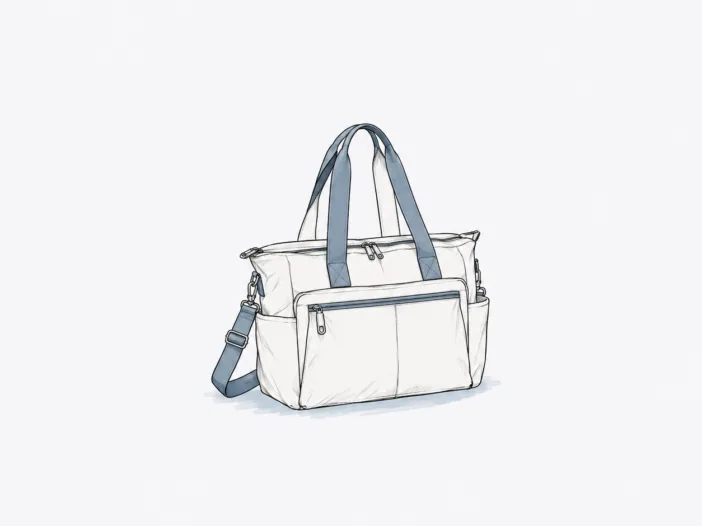
The Baggallini Overnight Laptop Tote fits best when you need one bag for a laptop or tablet, chargers, documents, personal items, and sometimes a small clothing load. This setup works especially well if your rolling luggage handles most of the weight.
The main trade-off shows up when you really use that flexible capacity. Buyer evidence repeatedly shifts from useful storage and organization to heavier, bulkier, or less stable carry as the tote fills up.
Available evidence does not show a meaningful size variant to choose from. Instead, the real boundaries are whether you use the tote expanded or unexpanded, your laptop’s actual dimensions, and how much of your trip you’ll need to carry the tote instead of stacking it on rolling luggage.

Decision Snapshot
| Decision Area | What the Buyer Evidence Suggests | Main Boundary |
| Cleanest fit | Mixed work-and-travel carry with tech, documents, personal items, and rolling luggage | Dense loads make shoulder or crossbody carry more demanding |
| Laptop fit | 13–14-inch-class laptops have the clearest sleeve-fit pattern | 15-inch and larger devices become inconsistent; exact chassis size matters |
| Configuration | Expansion adds useful room for clothing, purchases, or a larger mixed load | Expanded or fully packed carry can become bulky and awkward |
| Organization | Extensive pockets usually help separate tech and travel items | A minority find the pocket count slows retrieval; there is no dedicated bottle pocket |
| Travel use | Under-seat placement and trolley-sleeve use recur across buyer reports | Packed-state airline fit is not guaranteed, and some small/two-wheel host bags become unstable |
| Carry style | Shoulder handles work well in some setups, with crossbody carry adding flexibility | Loaded crossbody/long-distance carry exposes strap and weight friction more clearly |
Does It Match Your Setup?
| Buyer Setup / Context | Fit Signal | Main Friction |
| Air travel + rolling luggage + moderate mixed tech/personal load | Recurring Strong Fit | Packing it densely shifts more weight and stability demand onto the tote and host luggage |
| 13–14-inch-class laptop + chargers/documents | Generally Works | A covered 14-inch laptop already used most of the sleeve width in one direct example |
| 15–17-inch-class laptop that must use the padded sleeve | Mixed / Variant-Dependent | Sleeve fit varies materially across reported devices; exact chassis dimensions and any protective case need verification |
| Expanded weekend load with clothing or purchases | Conditional Fit | Extra space can translate into more bulk and a less comfortable carry |
| Heavy work load or long airport carry without relying on rolling luggage | Limited Fit | Loaded weight, strap support, balance, and carrying distance become the constraint |
The pattern is less about how much the tote can hold and more about what happens once you fill it. Buyer evidence supports its storage role more consistently than comfortable long-distance carry with a heavy load.
Expansion Solves Space; Rolling Luggage Matters Once the Tote Gets Heavy
Expansion is one of the main reasons buyers pick this tote. Reports describe it handling purchases on international trips, a change of clothes, work gear, and mixed tech or travel loads that go beyond a standard laptop tote.
But that same strength creates the main trade-off. Heavier packing is repeatedly linked to more awkward carry, greater shoulder or crossbody strain, and occasional balance issues when the tote sits on smaller rolling bags.
This makes the trolley sleeve more than just a convenience. If you can keep the tote stacked on rolling luggage through airports or stations, the larger capacity stays easier to use. When you have to carry the tote for longer distances, the load itself becomes the decision boundary.
One buyer replaced a Baggallini Carryall because they wanted a larger main compartment, expansion, and a laptop compartment. That switching example helps define the product’s role: it favors more flexible mixed-load capacity, not minimalist daily carry.
Laptop Fit Gets Uncertain Beyond the Clearest 13–14-Inch Cases
The strongest laptop-fit pattern is around 13–14-inch-class devices. One report described a 13-inch laptop with substantial room, while a 14-inch Asus Zenbook in a close-fitting cover fit but used most of the sleeve width.
Beyond that, screen-size labels alone do not predict sleeve fit. One 15-inch Dell fit with some room, but another 15-inch laptop did not fit. A 15.6-inch laptop was too tight, and a tested 16-inch Lenovo did not fit the sleeve. A 17-inch Dell could ride in the main compartment without a case, but not in the dedicated sleeve.
So the practical question is not just, “Is my laptop 15 inches?” It is whether your laptop’s actual chassis dimensions, plus any protective case you leave on, fit the padded compartment.
The Pocket Layout Is Usually a Strength, With Two Specific Limits
Organization is one of the most consistent positives. Buyers describe using the tote for laptops or tablets alongside chargers, passports, medication, notebooks, headphones, clothing, and other travel essentials, without relying on one undivided cavity.
The first limit is retrieval style. A small minority found the number of pockets excessive or spent more time remembering where they put an item. This matters for buyers who prefer one large open compartment.
The second limit is bottle access. Recurring Q&A and buyer comments indicate there is no dedicated water-bottle pocket. You can still carry a bottle inside the tote or in an improvised pocket, but that differs from purpose-built external bottle access.
Evidence Signals
| Buyer Question | Practical Reading | Evidence Signal |
| Does the tote’s capacity regularly come with carry burden? | A meaningful share of capacity-positive observations also report loaded-weight, bulk, strap, or long-distance carry friction, although some buyers still describe the tote as light in their setups | TCR 0.42 · Strong · n=24 |
| Do all those pockets usually make organization harder? | No. Search complexity appears as a minority friction within otherwise organization-positive evidence | TCR 0.08 · Strong · n=25 |
| Is there a useful laptop-size boundary? | Yes, but it is not absolute: the evidence mostly separates cleaner 13–14-inch fit from more conditional 15–17-inch sleeve fit, with one 15-inch success as an exception | UBC 0.88 · Moderate · n=8 |
- TCR (Trade-Off Coupling Rate): how often an observed strength appears together with a specific friction among eligible buyer evidence. It does not establish causality.
- UBC (Use Boundary Consistency): how consistently eligible buyer evidence separates a supported use from the condition where it becomes more limited or conditional.
- n: relevant, eligible, deduplicated buyer observations used for the metric—not the product’s total review count.
These are buyer-evidence signals, not product-performance scores or probabilities. See how these buyer-evidence metrics work.
Real Buyer Loadouts Show Where the Boundaries Appear
These are observed examples, not guaranteed capacity templates.
Airport and subway mixed load
15-inch Dell · 10-inch tablet · charging cables · plug converters · change of clothes · medication
→ The buyer reported useful organization and trolley-sleeve use on a 22-inch checked bag, while also flagging an unpadded crossbody strap and an overly long laptop-retention strap.
Long-flight essentials without expansion
Laptop · Kindle · over-ear headphones · water bottle · snacks · notepads · small blanket · socks
→ One buyer reported fitting this mixed flight load without expanding the tote, showing that the unexpanded state can still support substantial travel carry.
Two-laptop work travel
Two laptops · headphones · glasses · work notebooks
→ The load was carried successfully, but the buyer specifically wished for wheels because airport walking made carry comfort the limiting factor before storage space ran out.
What Buyers Should Check Before Buying
- Measure your laptop, not just its screen-size label. Sleeve fit evidence becomes inconsistent around 15 inches and above, and a protective cover can take up extra space.
- Estimate the packed weight you will actually carry. The tote’s capacity may not last when you carry that load on your shoulder or crossbody for long distances.
- Check how the tote will sit on your rolling luggage. Most trolley-sleeve reports are positive, but a full tote can twist or tip some smaller or two-wheel luggage setups.
- Verify airline limits against your packed state. Buyers repeatedly report under-seat use, including unexpanded setups, but those observations do not establish universal personal-item compliance once the tote is fully packed or expanded.
- Decide whether a dedicated bottle pocket matters to you. The available Q&A and buyer evidence do not establish one.
Baggallini Overnight Expandable Laptop Tote on Amazon
To see how this larger tote compares by role with Baggallini’s other formats, visit our Baggallini Tech Carry overview.
