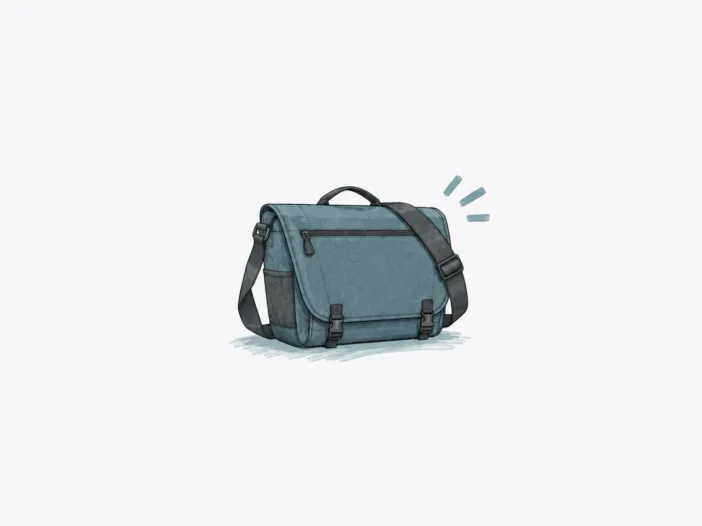
The Osprey Daylite Messenger works best for buyers who want to ditch backpack bulk but still carry a laptop or tablet and daily gear. Most buyer reports come from work, campus, and around-town use. The same compact, tapered shape that keeps the bag easy to handle also sets its main limits: 16-inch-class laptops fit inconsistently, and wide or bulky loads can hit the space ceiling faster than you might expect.
No decision-relevant variants show up in buyer evidence. The real choice is whether your laptop size, bottle, organization style, and daily load fit inside the bag’s proven comfort zone.

Product Snapshot
The Daylite Messenger fits best when you want compact carry, not when you need to max out expansion.
| Product detail | Decision relevance |
| Family scope | One decision-relevant bag configuration is supported; color differences do not change fit. |
| Carry layout | Shoulder/crossbody carry plus a top handle gives multiple carry modes; shoulder-only stability is mixed in a small subset of reports. |
| Storage layout | An open main compartment, padded laptop sleeve, front organizer/zip pocket, bottle pocket, and opposite side zip pocket provide flexible storage without heavy internal subdivision. |
| Laptop-fit pattern | Most 14–15.6-inch-class examples are workable, but exact device geometry matters; 16-inch-class reports are clearly mixed. |
| Bottle-fit pattern | Smaller or standard bottles are more consistently secure; larger or taller bottles show more retention and handling friction. |
Buyer Evidence Metrics
Buyer evidence draws three clear lines: laptop size, bottle size, and how much capacity you trade for compactness. Shoulder-only slippage comes up too, but the sample is too small for a public number—treat it as a check, not a dealbreaker.
| Buyer Question | Metric | Evidence |
| How clearly does laptop fit change as devices move toward the 16-inch class? | UBC 0.82 | Moderate · n=17 |
| Does bottle size change how consistently the exterior pocket works? | UBC 0.86 | Limited · n=7 |
| How often is the compact profile paired with an explicit capacity or expansion limit? | TCR 0.25 | Moderate · n=16 |
| Is shoulder-only strap slippage a recurring context-specific signal? | CFL — | Very Limited · n=2 |
How these metrics work:
- Use Boundary Consistency (UBC) measures how consistently eligible buyer evidence separates a supported use case from the condition where that use becomes more limited or conditional.
- Trade-Off Coupling Rate (TCR) measures how often an observed product strength appears together with a specific friction among eligible buyer evidence.
- Context Friction Lift (CFL) measures whether a known friction is more concentrated in a defined eligible context than in the eligible baseline. CFL is not severity or probability, and its public n reflects the smaller eligible comparison group.
- n is the number of relevant, eligible, deduplicated buyer observations used for that metric—not the product’s total review count.
- These are buyer-evidence signals, not product-performance scores.
See how these buyer-evidence metrics work.
A laptop UBC of 0.82 does not mean you have an 82% chance your laptop will fit. It means buyer evidence holds steady at a boundary: most 14–15.6-inch-class laptops work, but 16-inch-class fit gets much more conditional.
Bottle UBC follows a similar pattern, but the sample is smaller and includes at least one clear 32 oz bottle that fits. A TCR of 0.25 is not a penalty—it just shows that compactness and capacity friction sometimes show up together, but plenty of buyers who like the compact size do not report a real capacity problem.
Shoulder-only slippage comes from just two eligible reports, so there is no public CFL number. Treat this as something to check for yourself, not a broad comfort verdict.
Fit–Friction Matrix
The bag fits best with a compact daily load. Friction goes up as you move toward bigger laptops, bigger bottles, more dividers, or more expansion.
| Buyer Setup / Context | Fit Signal | Main Friction |
| Laptop or tablet + charger + documents/lunch + small daily essentials | Recurring Strong Fit | Tapered or narrower usable space becomes more noticeable as the load grows beyond daily essentials. |
| 14–15.6-inch-class laptop + normal work accessories | Generally Works | Exact laptop dimensions and shape still matter; one 14-inch sleeve-fit failure and tighter 15–15.6-inch examples prevent a universal size guarantee. |
| 16-inch-class laptop + daily accessories | Conditional Fit | Some 16-inch MacBooks fit, while others protrude or do not sit correctly in the laptop sleeve. |
| Large/tall bottle around 32–40 oz or 750 mL in the exterior pocket | Conditional Fit | Retention, pocket depth, or pocket angle becomes inconsistent; one 32 oz example works cleanly. |
| Laptop plus loose cables and small accessories without a separate organizer | Mixed / Variant-Dependent | Some buyers find the front and side organization sufficient, while others describe the open main compartment as too sparse or shapeless. |
How Buyers Use It
Most buyers use this bag for daily work or campus carry. Travel comes up too, but those reports are more case-by-case.
- Work and campus loads usually mean a laptop or tablet, chargers, folders, lunch, water, and small accessories—without the bulk of a full backpack.
- For around-town carry, buyers like the lighter profile for walking, commuting, errands, and short trips where overpacking gets in the way.
- Travel use shows up in personal-item, long-haul, and rail reports. One buyer fit the bag in Porter, Flair, and WestJet sizers, and another used it for a 35-day European rail trip. Still, these are specific cases, not proof it fits every airline rule.
What Buyers Carry With It
Buyer loadouts show the bag holds more than just a laptop, but they also make it clear that exact item shape matters more than just screen size.
| Specific buyer load | Observed result | Decision meaning |
| 14-inch Dell work tablet + iPad Pro 13 + work folders + Apple chargers + 20 oz Stanley thermos | Reported as a comfortable work/personal-item setup | A compact dual-device work load sits well inside the bag’s observed role. |
| MacBook Pro 14 + cased Steam Deck + over-ear headphones + accessories | Reported to fit together | The open main compartment can accommodate mixed tech gear when the overall load remains compact. |
| 16-inch MacBook Pro + 32 oz water bottle | Reported as a clean fit in one example | Useful as proof that the combination can work, but other 16-inch laptop and 32 oz bottle reports conflict, so it should not be generalized. |
What Buyers Should Check Before Buying
The quickest way to decide is to check the spots where buyer reports start to break pattern.
- Measure your laptop’s actual dimensions, not just the screen size. Most 14–15.6-inch-class laptops fit, but not all. 16-inch-class fit is clearly conditional.
- Decide if you want open space or lots of built-in dividers. The main compartment gives you flexible packing, but buyers who want heavy organization may find it too bare.
- Check your bottle against the pocket. Smaller or standard bottles fit best. Larger or taller bottles show mixed results for retention, depth, and handling.
- Pick your carry mode before you load up. Many buyers find it comfortable, but some mention neck pressure, back or shoulder discomfort, or the strap slipping off one shoulder. Crossbody carry may work better if you notice strap movement.
- Pick compactness only if you are okay with a hard limit on expansion. The bag gets praise for staying light and close to the body, but the tapered shape is less forgiving with wide, boxy, or carry-all loads.
- Check for any features you consider must-haves. Some buyers miss a rear quick-access pocket, luggage pass-through, or a fully zippered main opening. Buyer evidence does not show these as available in this bag family.
The Daylite Messenger fits buyers who want to carry less but still keep the essentials. If your setup pushes the 16-inch laptop, large-bottle, or high-expansion limits, check those points before buying. That is where positive buyer patterns start to break down.
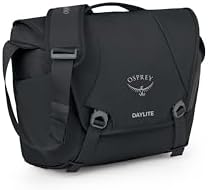
Before settling on a compact messenger, compare it with larger and more structured options in our Best Laptop Messenger Bags for Work and Daily Carry guide.
