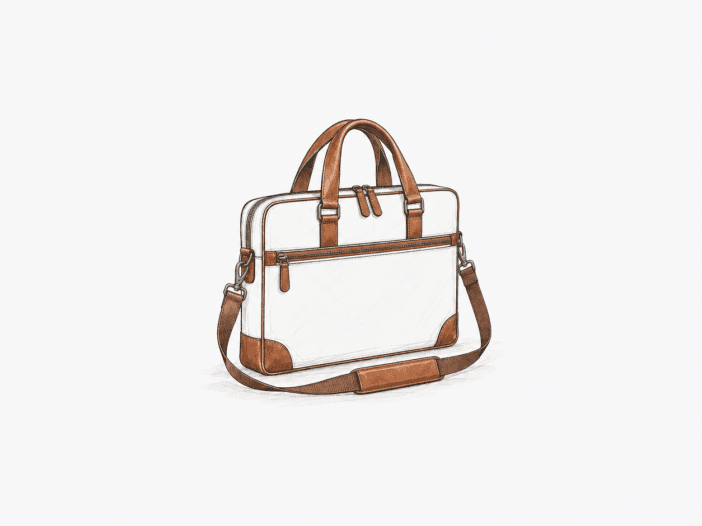
People who pack a laptop, charger, notebook, and a handful of small accessories report this brief handles daily work and commuting without fuss. The slim profile draws the most praise from buyers who want a bag that stays close to the body and slides easily over a trolley handle for airport runs or light travel.
That slim shape keeps the bag compact but limits space for bulky extras. Carrying a 16-inch laptop usually means shifting it to a different compartment or reworking your packing order. Buyer evidence shows no decision-relevant difference between product variants, so these findings apply to the entire Classic Leather Slim Brief family.

Product Snapshot
The main question is whether your daily work setup stays slim enough for this bag’s design. Fitting a laptop is only part of the story.
| Product detail | Decision relevance |
| Slim briefcase role | Best supported for laptop-centered work, commuting, and light travel rather than high-volume carry. |
| Observed laptop boundary | Two 14-inch laptop examples fit without a stated workaround; one 16-inch MacBook Pro report required the main compartment rather than the dedicated laptop section. |
| Trolley integration | Multiple buyers describe using the rear pass-through/strap over an extended luggage handle for airport or light-travel convenience. |
| Protection evidence | One detailed daily-use report describes laptop padding as slight; stronger protective performance is not established. |
| Material and finish confidence | Buyer reports conflict on leather authenticity, while finish and early-wear reports range from very positive to scratches, edge wear, stitching issues, and arrival damage. |
Buyer Evidence Metrics
Buyer evidence shows two patterns. A compact bag does not always run out of space, but you lose room for extras. Carrying a larger device gets trickier if you need to use the dedicated laptop section.
| Buyer Question | Metric | Evidence |
| How often does compact carry appear together with limited extra-item room? | TCR 0.38 | Moderate · n=8 |
| Does laptop use become more conditional when moving from 14-inch examples to 16-inch examples? | UBC 0.75 | Limited · n=4 |
How these metrics work:
- Trade-Off Coupling Rate (TCR) measures how often an observed product strength appears together with a specific friction among eligible buyer evidence.
- Use Boundary Consistency (UBC) measures how consistently eligible buyer evidence separates a supported use case from the condition where that use becomes more limited or conditional.
- n is the number of relevant, eligible, deduplicated buyer observations used for that metric—not the product’s total review count.
These are buyer-evidence signals, not product-performance scores. See how these buyer-evidence metrics work.
Fit–Friction Matrix
This bag works best when your workload stays slim. Packing bulkier gear or a larger laptop creates more friction and often forces you to change how you use the compartments.
| Buyer Setup / Context | Fit Signal | Main Friction |
| Laptop + charger/cables + notebook or documents for daily work | Recurring Strong Fit | Bulky additions reduce the spare capacity that makes the slim profile practical. |
| 14-inch laptop + small electronics or work accessories | Generally Works | No recurring friction established in the available evidence. |
| 16-inch MacBook Pro + tablet or paperwork | Conditional Fit | One buyer reports the 16-inch MacBook Pro fits only in the main compartment, not the dedicated laptop section. |
| Slim work load attached to a trolley for airport or light travel | Recurring Strong Fit | No recurring trolley-interface friction is established; the bag still favors a relatively slim load. |
| Laptop + bulky accessories or substantial extra gear | Limited Fit | Multiple buyers describe minimal storage, little room for extras, or a not-roomy interior. |
The Slim Profile Works Best When the Load Stays Flat
Staying compact is this brief’s main strength, but it does not handle every load efficiently. Buyers who pack laptops, chargers, cables, notebooks, and other flat work items report the best results.
TCR 0.38 sets the boundary here. Three out of eight buyers who liked the compact size and commented on capacity also mentioned running low on space for extra items. Five did not report that problem at their stated loads. This does not mean you have a 38% chance of running out of space. It means limited headroom and the slim profile sometimes show up together, especially when you pack bulkier gear.
The evidence points to a slim brief that works best when you treat it as such. It is not built to swallow a backpack’s worth of accessories.
14-Inch Carry Looks Straightforward; 16-Inch Carry Depends on the Compartment
Two specific 14-inch examples describe successful carry without a workaround: one with a 14-inch MacBook Pro plus headphones and gadgets, and another with a 14-inch laptop plus a business-card holder and additional small items.
The 16-inch evidence is more conditional. One MacBook Pro 16-inch owner reports that the laptop fits the bag but not the dedicated laptop compartment, so it rides in the main compartment while paperwork uses the laptop section. Another buyer describes the brief as useful for documents and a 16-inch laptop or tablets but does not say which compartment is used.
UBC 0.75 with n=4 shows a fairly consistent pattern in this small sample. This does not mean you have a 75% chance of fitting a 16-inch laptop. If you need a 16-inch device to fit inside the dedicated laptop section, check that compartment’s size before you buy.
Trolley-Linked Travel Is a Real Use Case, Not Extra Capacity
Several buyers describe the rear pass-through or strap as useful over an extended luggage handle, including airport and light-travel situations. That makes the brief easier to pair with rolling luggage without changing what the brief itself carries well.
The travel benefit is mobility, not extra storage. Buyer evidence still points to slim workloads. It does not establish durability under heavy baggage handling or demanding travel conditions.
What Buyers Carry With It
The clearest loadouts stick to everyday digital work, not bulky travel gear.
- Laptop, charger, charging and extension cords, several pads, and a notebook for daily use. The buyer found the handles comfortable and the shoulder strap reliable, but described the loaded bag as heavy and the laptop padding as slight.
- Laptop, mouse, charger, notebook, thin screen stand, and headphones for light travel. The buyer found the handles comfortable on a longer walk but described storage as minimal and less suitable for bulky items.
- A 14-inch MacBook Pro, headphones, and other work gadgets. The buyer reported room for the setup but didn’t describe a workaround for fit.
- A 16-inch MacBook Pro, iPad Air in its case, and paperwork. The setup fit, but the MacBook Pro used the main compartment rather than the dedicated laptop section.
What Buyers Should Check Before Buying
The bag’s fit is easiest to judge by checking the load conditions that repeatedly changed buyer outcomes.
- Check the dedicated laptop section if you carry a 16-inch device. A 16-inch MacBook Pro is reported as fitting the bag but not that dedicated compartment.
- Count bulky accessories, not just devices. Several buyers are satisfied with laptop-plus-essentials carry, while others describe minimal storage, only two pockets, or little room for extra items.
- Do not assume thick laptop protection. One detailed daily-use report specifically calls the padding slight and adds extra soft material at the bottom of the laptop section.
- Inspect finish quality if cosmetic condition matters. Buyer reports include first-use or first-week scratching, edge deterioration after a few uses, stitching/finishing issues, arrival damage, and one handle-crack report alongside many positive build-quality comments.
- Verify material composition if genuine leather is a deciding requirement. Some buyer reports, and a reported Samsonite hang tag, describe genuine leather, while other buyers say the material does not look or feel genuine. The buyer evidence does not resolve that conflict independently.
Buyer evidence is most consistent for people who keep their work routine slim and laptop-centered. Adding bulky accessories, extra storage needs, or a 16-inch laptop that must use the dedicated section makes it more likely you’ll hit fit limits.
The Samsonite makes more sense for some office loads than others. See how its slim format compares with more structured and higher-capacity alternatives in our Best Laptop Briefcases roundup.
