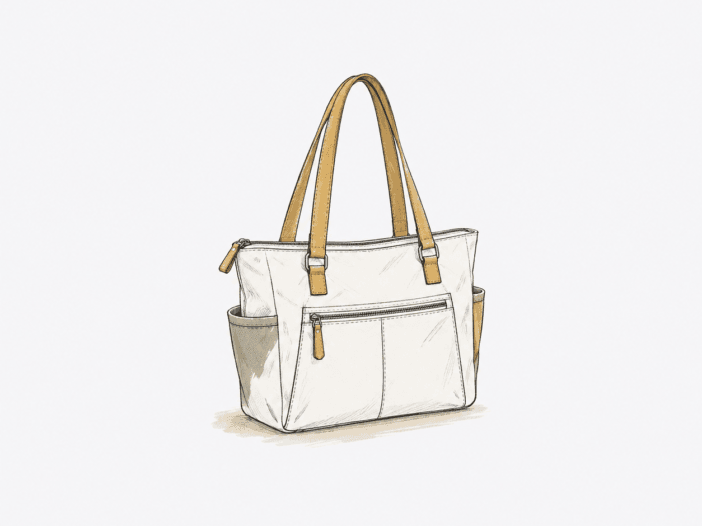
The Baggallini Avenue Tote works best for buyers carrying a compact laptop or tablet alongside everyday work or in-flight essentials. It does not suit buyers looking for a high-capacity laptop hauler or a mini overnight bag. The strongest pattern is organized, flexible carry for devices in the 13–14-inch physical envelope range, with shoulder, crossbody, and rolling-luggage options that people actually use.
The main trade-off shows up just as often. The tapered shape and multi-use pocket layout set tighter boundaries for larger laptops, wide bottles, and any setup where you want both the rear storage pocket and the luggage pass-through at once.
Product Snapshot
The Avenue Tote only works well when its travel and organization features match your real load. Listed dimensions that sound big do not guarantee a good fit.
| Product detail | Decision relevance |
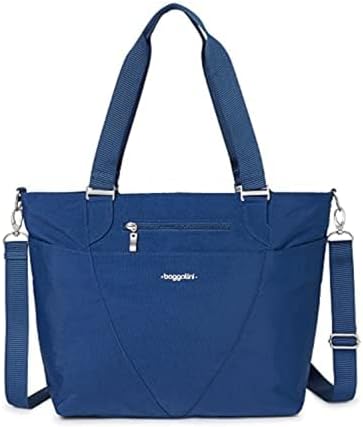
| Zip-top tote with attached shoulder handles and removable crossbody strap | Gives buyers several carry modes for commuting, airport movement, and daily use. |
| Padded internal device area with Velcro retention | Repeatedly works with compact laptop/tablet setups, but larger laptop fit depends on the device’s physical dimensions. |
| Rear zippered pocket converts to a luggage-handle pass-through | Useful on rolling luggage, but that rear storage area can become unavailable while attached. |
| Tapered body with a narrower base than top | Helps explain why nominal width does not translate into equal usable space at every level of the bag. |
| Buyer-reported size around 12 in high, 17–18 in wide at the top, and about 5.5 in deep | Useful as an approximate reference only; reported measurements are not perfectly consistent, and airline-fit decisions still require current carrier limits. |
Buyer Evidence Metrics
Laptop-sleeve fit is the clearest boundary. Compact devices fit much more consistently than larger 15–17-inch-class laptops.
| Buyer Question | Metric | Evidence |
| How consistent is the padded-device fit boundary? | UBC 0.93 | Moderate · n=14 |
| How often does luggage attachment coincide with rear-pocket storage loss? | TCR 0.20 | Moderate · n=15 |
| Is exterior bottle-pocket friction more concentrated with regular or wide bottles? | CFL 1.20× | Moderate · n=8 |
A UBC signal does not mean a 93% chance your laptop will fit. It means buyer evidence consistently separates smaller, roughly 13–14-inch physical-device envelopes from the more conditional 15–17-inch-class range. One reported 15-inch sleeve success keeps the boundary from being a hard cutoff.
TCR shows rear-pocket storage loss only sometimes appears with luggage-pass-through use, not every time. CFL shows a modest increase in bottle-pocket friction for regular or wide drinkware, but some bottles still fit.
How these metrics work:
- Use Boundary Consistency (UBC) measures how consistently eligible buyer evidence separates a supported use case from the condition where that use becomes more limited or conditional.
- Trade-Off Coupling Rate (TCR) measures how often an observed product strength appears together with a specific friction among eligible buyer evidence.
- Context Friction Lift (CFL) measures whether a known friction is more concentrated in a defined eligible context than in the eligible baseline. For CFL, public n reflects the smaller eligible comparison group.
- n is the number of relevant, eligible, deduplicated buyer observations used for that metric—not the product’s total review count.
- These are buyer-evidence signals, not product-performance scores, probabilities, rankings, or lab measurements.
See how these buyer-evidence metrics work.
Fit–Friction Matrix
The Avenue Tote works best for workday or flight-access loads. Fit gets more conditional as your device, drinkware, or travel load gets bulkier.
| Buyer Setup / Context | Fit Signal | Main Friction |
| Roughly 13–14-inch physical-envelope laptop + charger, planner, phone, and daily essentials | Generally Works | Exact device dimensions still matter; screen-size labels alone do not guarantee padded-sleeve fit. |
| 15–17-inch-class laptop when the padded sleeve is required | Conditional Fit | Larger devices often move to the main compartment or fail to seat fully in the padded area; one 15-inch success prevents a hard cutoff. |
| Tablet or compact laptop + in-flight essentials + rolling luggage | Recurring Strong Fit | Rear-pocket storage can be sacrificed while the luggage pass-through is active, and airline personal-item limits vary. |
| Regular or wide bottle/travel mug needing easy exterior-pocket access | Limited Fit | Narrow exterior openings repeatedly create bottle-fit and retrieval friction. |
| Laptop + fuller daily load carried for long periods | Conditional Fit | Comfort varies with load and strap choice; a minority report heaviness or a narrow/sliding crossbody strap. |
| Bulky travel load or spare-clothing packing | Limited Fit | Buyer evidence is stronger for work and in-flight essentials than for clothing-heavy packing. |
Laptop Fit Is About the Device Envelope, Not the Screen Label
Buyers with compact laptops see the most consistent fit. A Lenovo ThinkPad T480 at about 13 by 9 inches fits the padded area, along with other laptops in the 13–14-inch physical envelope range.
Fit gets less predictable with 15–17-inch-class devices.
- Several larger laptops were carried successfully only in the main compartment.
- A 15.5-inch ThinkPad was reported too wide for the padded section.
- A 17-inch device was reported as not fitting the padded area.
- One buyer did report a 15-inch laptop fitting the device section, so a universal 15-inch cutoff is not supported.
Check your laptop’s actual width and height against the device area. Do not rely on diagonal screen size alone.
The Luggage Pass-Through Is Useful, but It Shares Its Job With a Pocket
The rear double-zip area is one of the Avenue Tote’s most consistently useful travel features. Buyers repeatedly describe sliding the tote over a rolling-luggage handle as convenient, secure, and easier than balancing a shoulder bag on top of a suitcase.
The design builds in a compromise. The rear section doubles as storage. When the pass-through is open, buyers who use the rear pocket may need to empty it or give up that storage for a while.
Check this trade-off if you plan to keep documents, wipes, or other frequently used items in the rear pocket while moving through an airport.
Exterior Bottle Storage Is the Clearest Everyday Fit Limitation
The front and side pocket layout looks flexible at first. Regular bottles and travel mugs are where buyer reports get less consistent.
Buyers repeatedly mention openings that are narrow at the top or awkwardly shaped. Some fit small bottles, an 8- to 10-ounce bottle, or specific reusable bottles without trouble. Others move their drinkware into the main compartment because the exterior pockets are too tight.
The Avenue Tote suits buyers who use slim drinkware or don’t mind carrying a bottle inside. Buyers who need dependable exterior access to a wide bottle or travel mug will find it less reliable.
Capacity Works Better for Flight Access and Work Gear Than for Bulky Packing
The tote handles realistic work and in-flight loads: a laptop or tablet, papers, a wallet, a phone, chargers, headphones, snacks, glasses, a light layer, and sometimes a small purse.
That does not make it an overnight bag. Buyer reports get more mixed when the load includes bulky clothing, a full spare outfit, multiple large bottles, or several dense work items at once.
For travel, the strongest evidence supports using the tote to keep important items organized and reachable under the seat or on top of a roller. It does not replace a larger carry-on.
What Buyers Compare It With
The most useful comparisons focus on load shape and access, not brand prestige.
| Compared product | Why it entered the comparison | What changed the decision |
| Baggallini 3-in-1 Convertible Backpack | Buyer wanted a more briefcase-like setup carrying a Chromebook, binder, books, and two bottles. | The Convertible Backpack handled the full test load and bottle storage more cleanly; the Avenue Tote did not. |
| Baggallini Any Day Tote | Compared for laptop, binder, and bottle-heavy everyday carry. | It fit the tested load, though bottles reduced interior space and distorted the front-pocket area. |
| Baggallini Anywhere Large Hobo / Hobo | Considered as a smaller or more casual alternative. | Avenue Tote evidence favors it when buyers need more laptop, paper, or work-item capacity; Hobo examples were smaller or more access-constrained. |
What Buyers Should Check Before Buying
The Avenue Tote is easiest to self-select when you check the few boundaries listed that size doesn’t answer.
- Measure your laptop, not just the screen size. The padded-device fit is strongest for compact 13–14-inch physical envelopes. Larger laptops often need the main compartment.
- Check your bottle diameter and how you want to access it. Regular or wide bottles and travel mugs are the most common source of friction in exterior pockets.
- Decide if you need rear-pocket storage while using a suitcase handle. The luggage pass-through and rear storage use the same area.
- Check your airline’s current personal-item limits. Multiple buyers report successful under-seat use. One detailed airline comparison found the tote outside several carrier dimension limits.
- Match the carry mode to your typical load. Many buyers use the tote handles or crossbody option. Heavier loads can expose strap and shoulder comfort limits.
- Keep the role realistic. The strongest evidence supports work gear and in-flight essentials, not spare clothing or bulky overnight packing.
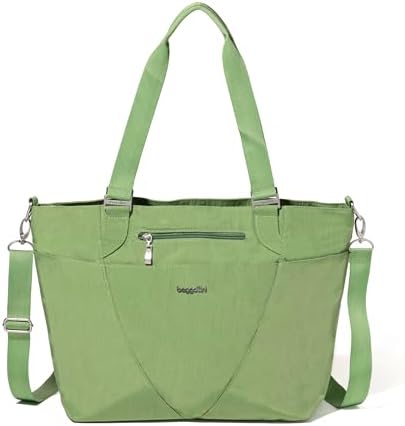
Need more than crossbody versatility? Browse the best laptop tote bags for work, commuting, and travel → to see how other carry styles change the trade-offs.
