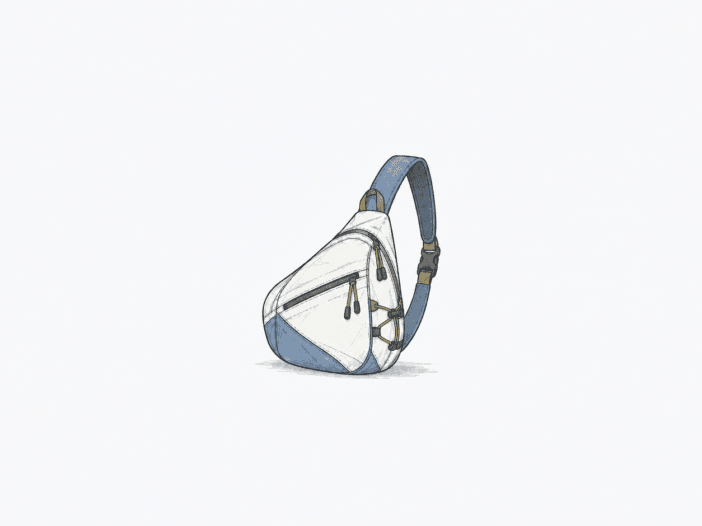
The Borealis Sling Bag works best for buyers who want a deliberately small, hands-free bag for errands, sightseeing, short hikes, theme parks, or as a travel add-on. The most common successful load stays compact: phone, wallet, keys, sunglasses, snacks, medications, small tech, a light layer, and sometimes a small tablet.
The main trade-off shows up fast. The low-bulk shape and wide-opening access leave little extra room if you want to carry a large reusable bottle, a big phone in the strap pocket, a bigger tablet, a bulky case, or need extra crossbody strap length. No carry-relevant variant split shows up in buyer evidence; NPF labeling does not link to changes in fit, capacity, access, or carry behavior.
Product Snapshot
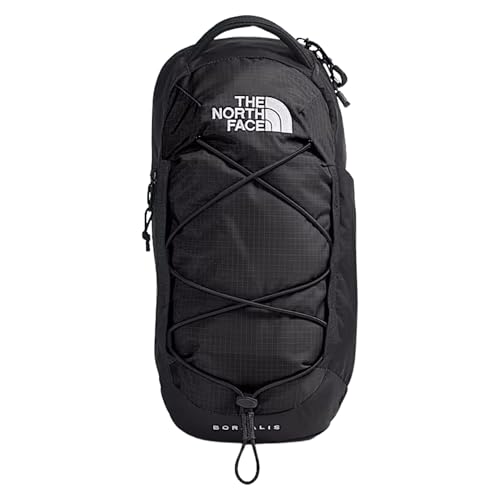
This 6-liter bag makes the most sense when you treat it as a compact sling, not as a shrunken backpack.
| Product detail | Decision relevance |
| Reported 6 L volume | Best matched to essentials and small tech; buyers expecting backpack-like space are more likely to feel constrained. |
| Small-tablet-oriented device fit | iPad mini/8-inch-class devices are the clearest fit; 11-inch devices become case-dependent, while 12.9/13-inch devices and laptops fall outside the supported pattern. |
| Fixed strap attachment | The bag can be worn in different positions by some users, but the strap attachment itself is not reconfigurable; body fit should be checked rather than assumed. |
| Wide-opening main compartment, soft-lined storage, and front bungee | These features repeatedly make a small load easier to access and extend carry for a light layer or similar soft item. |
| Narrow external bottle and strap pockets | Both pockets work inside tighter size limits than some buyers expect, making actual bottle and phone dimensions important before purchase. |
Buyer Evidence Metrics
The strongest numbers point to practical boundaries you can check before buying, not a single overall score.
| Buyer Question | Metric | Evidence |
| Does the compact footprint usually come with main-load capacity friction? | TCR 0.29 | Moderate · n=14 |
| How consistent is the small/slim-bottle versus wider-bottle boundary? | UBC 0.93 | Moderate · n=15 |
| How consistent is the standard-phone versus Ultra/Pro Max strap-pocket boundary? | UBC 0.88 | Moderate · n=17 |
| How consistent is the small-tablet versus larger-tablet boundary? | UBC 1.00 | Moderate · n=10 |
| Is strap/body-fit friction more concentrated among explicit taller/larger-frame reports? | CFL 1.43× | Limited · n=4 |
How these metrics work:
- Trade-Off Coupling Rate (TCR) measures how often an observed product strength appears together with a specific friction among eligible buyer evidence. TCR 0.29 does not mean 29% of all owners have a capacity problem; it only describes the eligible compactness-positive evidence used for this relationship.
- Use Boundary Consistency (UBC) measures how consistently eligible buyer evidence separates a supported use case from the condition where that use becomes more limited or conditional. UBC values are not probabilities of fit.
- Context Friction Lift (CFL) measures whether a known friction is more concentrated in a defined eligible context than in the eligible baseline. CFL is not friction severity or probability. For CFL, public n reflects the smaller eligible comparison group.
- n is the number of relevant, eligible, deduplicated buyer observations used for that metric—not the product’s total review count. These metrics are buyer-evidence signals, not product-performance scores.
See how these buyer-evidence metrics work.
Fit–Friction Matrix
The real fit question is not small bag versus big bag. It is whether your actual load fits inside the Borealis Sling Bag’s narrow but useful compact-carry range.
| Buyer Setup / Context | Fit Signal | Main Friction |
| Everyday or travel essentials: phone, wallet, keys, small tech, snacks, and a light layer | Recurring Strong Fit | Main space becomes less forgiving when the buyer expects larger-daypack capacity or adds bulkier items. |
| Essentials plus a small/slim bottle in the external pocket | Generally Works | Wider reusable bottles, including several YETI/Nalgene-class examples, are frequently difficult or unable to fit. |
| iPad mini/8-inch-class device plus compact accessories | Generally Works | 11-inch fit depends on exact geometry and case thickness; 12.9/13-inch devices are generally outside the supported boundary. |
| Standard or Pro-size phone intended for quick access from the strap pocket | Conditional Fit | Some standard phones are still snug, while Ultra/Pro Max-class phones are usually tight or unusable. |
| Crossbody carry across different body sizes or over layers | Mixed / Variant-Dependent | Several taller/larger users report the strap too short or high, but other tall users report workable fit; smaller-frame pressure or sliding also appears. |
| Walking, sightseeing, or short hiking after confirming body fit | Generally Works | Scrambling, repeated bending, or snowboard-like movement can make the sling shift without a stabilizing secondary strap. |
Compact Carry Is the Strength—If You Pack Like It Is a Sling
Buyers who intentionally keep the load small repeatedly describe the Borealis as useful precisely because it avoids backpack bulk. Successful examples include everyday essentials, compact camera gear, chargers and power banks, snacks, medications, a Kindle or small tablet, and a light layer under the front bungee.
This trade-off shows up in the TCR signal. Some buyers who praise the compact size also mention running into main-load capacity friction, but most do not. The practical takeaway: treat the compact footprint as the design goal. Do not expect extra space just because the label says 6 liters.
Buyer examples back this up. One setup carried a 16-ounce bottle, GoPro, wallet, and sunglasses through Italy and Universal Studios. Another used the bag for a two-month Asia trip with a phone, wallet, medications, action camera, Kindle, and a light textile on the bungee. These show efficient small-load packing, but don’t guarantee every similar load will fit the same way.
Bottle, Phone, and Tablet Size Are the Three Fastest Pre-Purchase Checks
The most reliable fit boundaries come from the items buyers expect to use with the bag’s dedicated pockets or sleeve.
- Bottle pocket: Small/slim bottles repeatedly work, while wider reusable bottles are much less reliable. UBC 0.93 reflects a highly consistent boundary within the eligible buyer evidence, not a 93% fit probability.
- Strap phone pocket: Standard and Pro-size phones have several successful examples, but fit is still case- and model-sensitive. Ultra/Pro Max-class phones are usually reported as tight or unusable, producing UBC 0.88.
- Tablet carry: iPad mini and 8-inch-class devices form the clearest supported range. Eleven-inch devices depend on exact dimensions and case thickness, while 12.9/13-inch tablets generally fall outside the fit pattern. The UBC 1.00 signal describes consistency within the eligible observations, not guaranteed compatibility.
If you do not need the side pocket for a bottle, several buyers found it more useful for a compact umbrella, small handle, GPS, or another narrow item. This workaround adds storage, but it does not change the bottle-size limit.
Body Fit and Movement Matter More Than Height Alone
The strap is the least predictable part of fit. Some users around 6 feet and above report the bag rides too high, or the strap runs out of length. Others at similar heights report a comfortable fit with slack to spare. Smaller-frame users sometimes report sliding or collarbone pressure under certain loads.
CFL 1.43× means strap and body-fit friction shows up more often in the taller or larger-frame group than in the smaller comparison group. The evidence is limited at n=4 for this comparison, so height alone is not a reliable yes/no rule. The safer check is your full setup: torso and chest build, preferred bag position, clothing layers, and how much weight you plan to carry.
Movement changes fit, too. Walking, sightseeing, and short hikes show repeated positive reports. Scrambling, frequent bending, and snowboard-style motion bring up complaints about the bag shifting. If you need high-motion stability, don’t assume walking comfort will carry over to more dynamic movement.
What Buyers Should Check Before Buying
The fastest way to decide is to test your largest or least-flexible item first, not your smallest essentials.
- Map your real load. If you need to carry a laptop, a 12.9- or 13-inch tablet, or a thick 11-inch tablet setup with a bulky case, buyer evidence does not support this bag for that role.
- Check your actual bottle. The external pocket fits small or slim bottles. Wider reusable bottles are a common deal breaker.
- Check your phone with its normal case. If you care about strap-pocket access, do not assume a large phone will fit comfortably just because the main compartment can hold it.
- Check crossbody fit over the clothes you actually wear. Fixed attachments and mixed strap-length reports make body fit matter more than height alone.
- Match your activity to sling stability. Routine walking and short hikes are well supported. Scrambling and other dynamic movement are more conditional.
- Decide if compact open storage is enough for you. If you want lots of internal dividers, easier inner-pocket access, or less fleece-lined maintenance friction, the organization may not be as useful as the pocket count suggests.
Want to see where this compact utility sling fits against device-, camera-, and travel-focused alternatives? Browse our best tech sling bags roundup.
