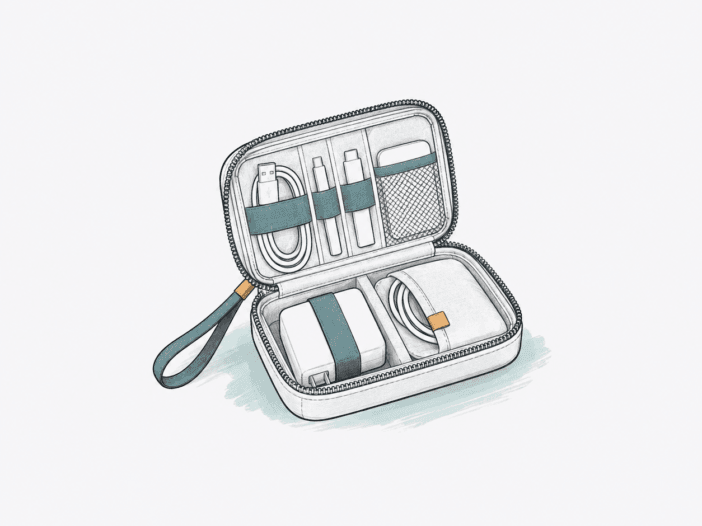
The Powershuttle works best for buyers who want to keep chargers, cables, power banks, drives, and other small tech sorted inside a backpack or carry-on. The real decision point is not just item count. What matters is how thick, rigid, or awkward your accessories are. That is where the compact footprint starts to limit how much you can actually fit.
Medium shows the clearest boundary in real use. Moderate, spread-out cable and charger loads usually fit without trouble. Routers, thick charging blocks, long or stiff cords, and extra adapters start to push against the zipper and make it harder to close. Plus handles bigger loads in the buyer evidence, but there is not enough data to say where Plus finally runs out of space.

Product Snapshot
Think of this as a structured tech organizer meant to ride inside another bag. It is not built for standalone shoulder carry.
| Product detail | Decision relevance |
| Product type | Tech pouch for chargers, cables, power banks, drives, small devices, and related accessories. |
| Observed size labels | Mini, Small, Medium, Plus, and Large. Buyer evidence does not establish that Mini = Small or Plus = Large. |
| Manufacturer dimensions | Small: 4.5 × 1.8 × 8.5 in; Medium: 8.7 × 2.0 × 5.7 in; Large: 7.1 × 3.5 × 9.4 in. |
| Current-generation access | A rear cable passthrough is identified; the exterior slip pocket belonged to an older generation and is no longer a current feature. |
| Strongest supported role | Keeping compact tech loads visible and separated inside backpacks and carry-ons. |
| Main trade-off | Compact, compartmentalized organization versus reserve space for thick, rigid, or bulky accessories. |
Buyer Evidence Metrics
Medium stands out in the metrics. Moderate accessory loads tend to fit, but once you add more rigid or bulky gear, fit becomes much less predictable.
| Buyer Question | Metric | Evidence |
| How consistently does Medium separate moderate loads from rigid or bulky loads? | UBC 0.88 | Moderate · n=8 |
| How often is compactness paired with reduced reserve capacity? | TCR 0.60 | Moderate · n=10 |
| Is load/closure friction more concentrated in Medium than in the eligible non-Medium baseline? | CFL 1.88× | Moderate · n=8 |
How these metrics work:
- Use Boundary Consistency (UBC) measures how consistently eligible buyer evidence separates a supported use case from the condition where that use becomes more limited or conditional.
- Trade-Off Coupling Rate (TCR) measures how often an observed product strength appears together with a specific friction among eligible buyer evidence.
- Context Friction Lift (CFL) measures whether a known friction is more concentrated in a defined eligible context than in the eligible baseline. CFL is not severity or probability; its public n reflects the smaller eligible comparison group.
- n is the number of relevant, eligible, deduplicated buyer observations used for that metric—not the product’s total review count.
These are buyer-evidence signals, not product-performance scores. See how these buyer-evidence metrics work.
UBC 0.88 does not mean Medium will fit your setup 88% of the time. In the eligible evidence, this score means moderate, shape-friendly loads usually fit, while rigid or bulky combinations start to cause problems. One dense Medium load still worked, so this is not a strict cutoff. TCR 0.60 shows a trade-off appears in the evidence, not that one factor causes the other. Some buyers with compact loads report no real capacity friction. CFL 1.88× points to a pattern in the data, not a size ranking, since the non-Medium group mixes several different variants.
Fit–Friction Matrix
Match your actual load shape to the observed setup, not just the nominal size label.
| Buyer Setup / Context | Fit Signal | Main Friction |
| Mini for minimal daily gadgets or phone accessories | Conditional Fit | The compact footprint works for intentionally small kits, but one buyer wanted more reserve room for trips. |
| Small with a compact power brick, two cables, and spare earphones | Specific Example Only | A thicker 3–4 port 60–100W travel charger can exceed the usable internal thickness. |
| Medium with cables, compact chargers, a power bank, laptop adapter, or drive distributed across the interior | Generally Works | Rigid, tall, or bulky additions consume closure space faster than item count alone suggests. |
| Medium with a router, charging brick, 20,000mAh power bank and cables—or a fuller load of longer/rigid cords | Limited Fit | Buyer reports show complete closure failure with these denser geometries. |
| Medium with an iPad mini | Mixed / Variant-Dependent | Manufacturer guidance says it should fit, while one buyer reports a new Medium would not accept the device fully. |
| Plus with larger charger/cable sets, including an e-bike charger or large power-bank setup | Recurring Strong Fit | The pouch is larger, and one buyer wanted a shoulder-strap attachment; no recurring Plus capacity ceiling is established. |
Variant Fit Patterns
Treat each size label as a separate variant. Pick your size based on the thickest or least flexible item you need to pack.
- Mini works best for buyers who carry only the bare minimum each day. The footprint stays small, but even a short trip load can push you to size up.
- Small has limited buyer evidence. One buyer fit a compact power brick, two cables, and earphones. A thicker multi-port travel charger hit the depth limit and did not fit.
- Medium is the best-documented size for real-world fit boundaries. It handles several dense loads, but shape matters. Rigid blocks, tall items, long cords, and extra adapters are the usual trouble spots. Buyer evidence directly disputes iPad mini compatibility.
- Plus gets positive capacity feedback for the loads buyers have tried, including larger chargers and an Anker 737 power bank. The evidence does not show where Plus finally runs out of space.
- Large comes with manufacturer dimensions, but there is not enough clearly labeled buyer evidence to define fit or capacity patterns. Do not assume Plus and Large are the same size.
What Buyers Carry With It
Exact loadouts show why component shape matters more than a simple accessory count.
| Scope | Observed loadout | What it shows |
| Medium | Small power bank + MacBook Pro adapter + external drive + six cables | It fit, but closure was already tight enough that additional power adapters would have reduced flexibility. |
| Medium | GL.iNet travel router + compact charging brick + INIU 20,000mAh mini + cables | The case would not close, showing how several rigid blocks can overwhelm the same nominal size. |
| Plus | E-bike battery charger + cables | Plus fit this setup where Medium did not, giving a clear size-switching example. |
| Plus | Anker 737 power bank | One buyer reports it fitting vertically; this is a specific compatibility example, not a guarantee for all large power banks. |
| Unknown variant | Sony a6000 + extra lens + cables | The setup fit, and the same pouch was later reconfigured for Sony XM3 headphones, showing divider flexibility without establishing a size-specific boundary. |
What Buyers Should Check Before Buying
The main mistake to avoid is picking by pouch name or item count alone. Always check the exact variant and measure the largest, least flexible accessory you plan to carry.
- Check the exact size label and generation. Buyer evidence covers Mini, Small, Medium, Plus, and Large, but does not show Mini equals Small or Plus equals Large.
- Start by measuring the thickest rigid item you plan to pack. Multi-port chargers, routers, power banks, long or stiff cords, and tall components are more likely to cause closure problems than just counting cables would suggest.
- If you want to fit an iPad mini in Medium, check your exact device. Manufacturer guidance and one buyer report conflict, so the evidence does not support a clear yes or no.
- Do not expect the old exterior slip pocket. The current version has a rear cable passthrough instead. The exterior slip pocket is gone.
- Use this pouch mainly as an organizer inside another bag. Buyer evidence backs up backpack and carry-on use. One Plus buyer wanted a shoulder-strap attachment, but it isn’t available for standalone carry.
- Do not put too much weight on construction or protection claims. Buyer feedback ranges from strong praise to complaints about zipper feel, interior materials, and padding. The evidence does not consistently establish long-term durability, weather resistance, or real drop protection.
Need to compare the Powershuttle with pouches built for smaller kits or different organization styles? See the alternatives in our Best Tech Pouches roundup.
